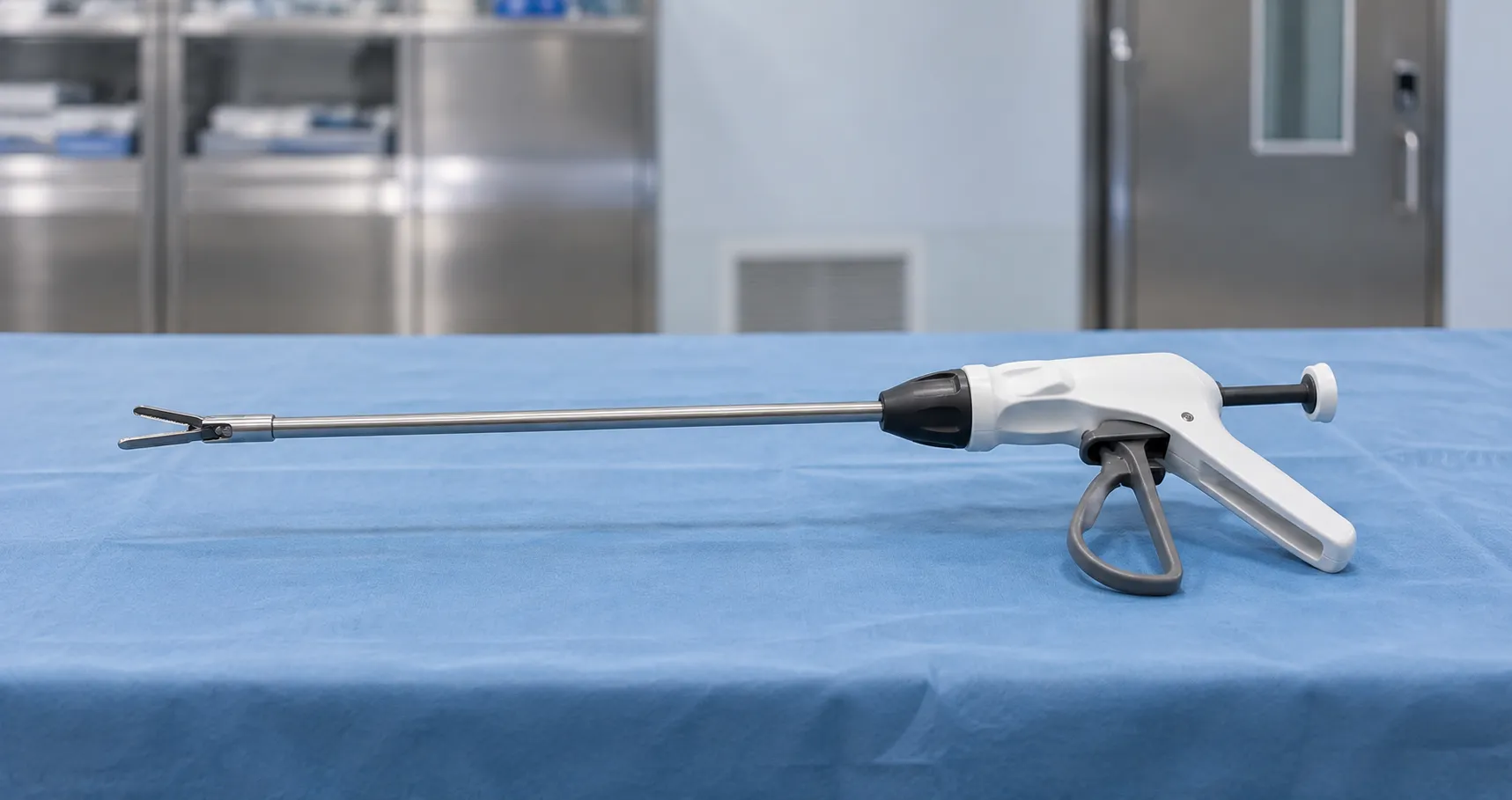

An orthopaedic power drill is a surgical hand tool that drives drill bits, reamers, saws, wires and screws through bone using electrical, battery or pneumatic power. It replaces the effort and imprecision of hand tools, giving controlled speed and torque to prepare bone for implants, fixation and osteotomy. For a theatre or biomedical procurement lead, the decision turns on the power source, the range of attachments, sterilisation method, weight and balance in the hand, and the lifetime cost of batteries, chucks and servicing.
The drive system is the heart of the choice. Battery, mains-electric and pneumatic platforms each trade autonomy, power delivery and reprocessing differently, and the right one depends on your case mix, from fine hand surgery to heavy arthroplasty and trauma.
How a surgical power drill works
A motor drives a chuck or coupling that holds the working tip, and a trigger or lever regulates speed. The surgeon selects forward, reverse, and oscillate modes and, on many systems, a torque limit so a screw seats without stripping the thread. Cannulated attachments let a drill or reamer pass over a guide wire, which is essential for accurate placement in trauma and joint work. Because the tool cuts bone, heat is a genuine concern: excessive speed or a blunt bit raises the temperature at the cutting edge and can cause thermal necrosis, so sharp bits, sensible speed,d and irrigation matter. Modern systems balance high torque at low speed for reaming with high speed for fine drilling, and give tactile and audible feedback so the surgeon senses when the bit breaks through the far cortex.
Two figures describe the output: speed, in revolutions per minute, and torque, the rotational force the motor can sustain. Drilling a pilot hole or wiring a small fragment needs high speed and modest torque, whereas reaming a femoral canal or driving a large cortical screw needs high torque at low speed. A capable platform delivers both across its attachment range, and electronic control keeps torque steady as the bit loads rather than stalling. The oscillate mode reverses direction rapidly through a small arc so a drill can advance near a nerve or vessel with less risk of the soft tissue winding onto the bit.
Power sources compared
Battery systems dominate modern trauma and arthroplasty because they are cordless, powerful, and free of air lines. The trade-off is battery management: cells must be charged, tracked and replaced as capacity fades, and sterile transfer of the battery into an autoclaved handpiece needs a defined technique. Pneumatic drills run on medical compressed air or nitrogen and deliver smooth, high power with a light handpiece, but they need a gas supply and hose and are noisier. Mains-electric systems with a sterilisable motor and console suit some settings but tether the tool to a cable. Battery platforms have become the default for most orthopaedic lists, yet pneumatic tools retain a following for their power-to-weight in high-volume arthroplasty.
Attachments and modularity
The handpiece is a platform; its value comes from the couplings it accepts. Common attachments include Jacobs and keyless drill chucks, quick-connect couplings for AO and other wire and pin drivers, sagittal and reciprocating saw heads, acetabular and intramedullary reamers, and sternal saw attachments for cardiac access. A modular quick-change coupling lets the scrub team swap a drill for a saw in seconds without extra tools. When comparing systems, list the attachments each speciality needs and confirm they share one handpiece family, because a single platform spanning trauma, arthroplasty and hand surgery cuts inventory, training and reprocessing load.
Key specifications a buyer must check
Assess maximum torque and speed for the heaviest task the tool will do, and the fine control needed for delicate work. Weigh the handpiece with a battery fitted, because balance affects surgeon fatigue over a long list. Check the chuck and coupling standards, cannulation diameter, oscillation and torque-limiting modes, and the noise level. For battery systems, review cell chemistry, charge time, cycle life, how many batteries are needed to cover a full list, and how the sterile battery is transferred. Confirm ingress protection and that the handpiece withstands repeated steam sterilisation without seal degradation. Consider ergonomics in detail: trigger travel, grip diameter,ter and whether the tool can be operated comfortably by surgeons with different hand sizes, since a poorly balanced handpiece tires the operator and can reduce control on precise work.
Sterilisation and reprocessing
Surgical drills are reused, so reprocessing shapes the total workload. Most handpieces and attachments are steam-sterilisable in a validated autoclave cycle, but batteries and some electronics may need a sterile-transfer housing rather than direct autoclaving, so the exact method varies by design. Lubrication of moving parts to the manufacturer's schedule keeps torque up and prevents seizure. Trays must be configured so sterile services can clean, inspect, lubricate, and pack the set reliably between cases. Ask for the validated reprocessing instructions and confirm your decontamination unit can meet them, since a tool that cannot be turned around quickly becomes a bottleneck on a busy list. Fluid ingress is a common failure mode, so cannulations and couplings must be cleaned and dried to the stated method, and any sealed motor should be checked against the service interval where the manufacturer specifies one by cycle count.
Standards and regulation
A surgical power tool is a medical device requiring UKCA or CE marking and a declaration of conformity. Electrically powered consoles meet the IEC 60601 family for safety and electromagnetic compatibility, and reprocessing is validated to the relevant sterilisation standards. Great Britain registration and device vigilance sit with the MHRA, with wider guidance on GOV.UK. Ask suppliers for the declaration of conformity, the validated sterilisation parameters and any restrictions on battery reprocessing before the tool is accepted into service.
Consumables, servicing and total cost of ownership
The handpiece is durable, but the running costs add up: rechargeable batteries have a finite cycle life and are a scheduled replacement, drill bits, saw blades, wires and reamers are consumed per case, and the whole system needs periodic service and lubrication. Model the lifetime cost across battery replacement intervals, blade and bit usage at your case volume, and the service contract, not just the purchase price. Ask about warranty length, loan-handpiece cover during repair, and lead times on couplings and batteries. Standardising on one platform reduces spare-part variety. The MediGear buyers team can compare drill platforms and attachment sets, or contact us for availability.
Procurement checklist
-
Match the power source (battery, pneumatic, electric) to your case mix and infrastructure.
-
List the attachments each speciality needs and confirm one handpiece family covers them.
-
Check torque, speed, cannulation, oscillation, and torque-limiting modes.
-
Weigh the handpiece with battery fitted and assess balance and noise.
-
Confirm validated steam sterilisation and any sterile battery-transfer method.
-
Verify UKCA or CE marking, IEC 60601 compliance and MHRA registration.
-
Model lifetime cost across batteries, blades, bits and servicing.
-
Check warranty, loan cover and lead times on batteries and couplings.
Conclusion
An orthopaedic power drill is a long-lived platform whose value depends on the attachments it drives, how it reprocesses and what its batteries and blades cost over years of use. Choose the power source that fits your needs, standardise on one handpiece family across specialities, and budget for the consumables and servicing that dominate the lifetime cost. Comparing verified platforms through MediGear helps your theatre invest in a drill system that stays reliable across trauma, arthroplasty and fine bone work.
Disclaimer
This article is for informational purposes only. It is published by MediGear (medigear.uk) for general information and procurement guidance, and is not clinical, diagnostic, treatment, technical, engineering, legal or regulatory advice, nor a product endorsement, guarantee or substitute for professional assessment. MediGear does not provide medical consultations. Buyers should consult their clinical, biomedical, estates and regulatory contacts, and the manufacturer's documentation, and independently verify all specifications, certifications, compatibility and suitability before purchase. Specifications, certifications and availability are correct at the time of publication and may change without notice. MediGear is a medical-equipment distributor and does not sell medicines or pharmaceutical products.