A nitrous oxide pipeline delivers N2O from a central cylinder store to anaesthetic machines in operating theatres, where it forms part of a controlled anaesthetic gas mixture. Nitrous oxide is a piped medical gas on the hospital's medical gas pipeline system, distributed at a nominal 400 kPa (4 bar) like oxygen. Still, it is in far fewer locations — principally theatres, and sometimes maternity and dental suites. This guide focuses on the nitrous oxide source, its delivery to theatre and the occupational exposure controls that go with it.
Two things define a nitrous oxide installation: a reliable cylinder-manifold source, and the scavenging and ventilation that protect staff from breathing waste gas.
The exposure figure and controls described here are drawn from HSE workplace exposure guidance and the HTM 02-01 and ISO 7396-1 requirements for nitrous oxide and scavenging pipelines, summarised for theatre managers and procurement teams rather than as clinical anaesthesia guidance.
The nitrous oxide source: an automatic manifold
Nitrous oxide is not manufactured on site. It is supplied in cylinders and stored as a liquefied gas that gives off vapour as it is drawn down. The source is an automatic manifold — two banks of cylinders, duty and standby, with automatic changeover so an empty bank switches to a full one without interrupting supply. A pressure-regulating manifold reduces cylinder pressure to pipeline pressure, and low-content and changeover alarms warn estates staff to reorder. Larger consumers may use a bulk arrangement, but the cylinder manifold is the common configuration because theatre N2O demand is comparatively modest.
Because N2O is stored as a liquid under pressure, the vapour draw-off rate is limited by how fast the liquid can evaporate, which is one reason cylinders are grouped into banks rather than used singly.
Delivery to the theatre
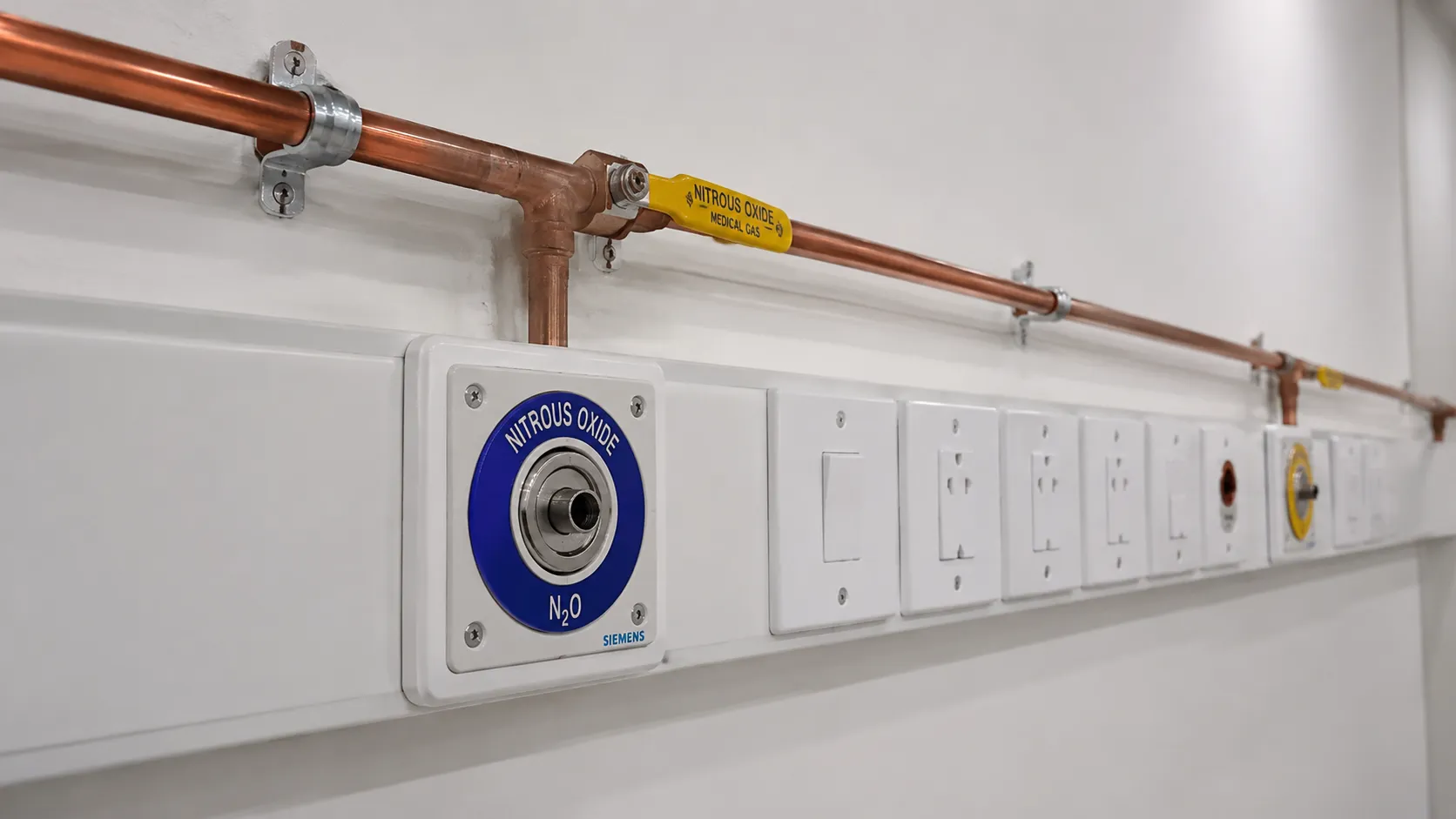
From the manifold, nitrous oxide is distributed through the pipeline, with area valve service units and alarms, to the theatre, where it terminates at a gas-specific terminal unit identified in French blue. An anaesthetic machine connects there via a non-interchangeable probe. It blends nitrous oxide with oxygen under the anaesthetist's control, with oxygen-failure safeguards that cut nitrous oxide if oxygen pressure is lost. The pipeline's job ends at the terminal unit; the gas-mix anaesthetic machine sets the gas mixture at the line.
The nitrous oxide manifold room
The cylinder manifold lives in a dedicated, ventilated store sized for the duty and standby banks plus reserve cylinders. Ventilation matters because a nitrous oxide leak in an enclosed space can raise concentrations and, at high levels, displace oxygen. Cylinders are secured against falling, full and empty stock is segregated, and content alarms prompt changeover so a bank is swapped before it empties. Access for safe cylinder handling with proper trolleys is part of the design. For procurement, confirming the store's ventilation, capacity and the cylinder supply contract is as much a part of the specification as the pipeline itself.
Occupational exposure and scavenging
The defining safety issue with piped nitrous oxide is not the patient but the theatre staff, who can be exposed to waste gas over long lists. The Health and Safety Executive sets a workplace exposure limit for nitrous oxide of 100 parts per million as an 8-hour time-weighted average, and hospitals control exposure to stay within it. Control relies on an anaesthetic gas scavenging system (AGSS) that captures waste gas at the anaesthetic machine and discharges it safely, backed by theatre ventilation with a high air-change rate and by well-maintained, leak-free connections. AGSS is itself part of the medical gas pipeline system and is designed, tested and maintained under the same framework.
The anaesthetic gas scavenging arrangement
AGSS is worth understanding as its own service, because it is what makes piped nitrous oxide acceptable in a modern theatre. An active system uses a pump or venturi to draw waste gas from the anaesthetic machine's exhaust through a receiver and out of the building, at a flow the system is designed to handle. It has its own terminal units, pipework and disposal plant, validated and maintained under the same standards as the gas pipelines. When specifying a theatre, the AGSS terminal at each anaesthetic position, the capacity of the disposal plant, and its integration with the theatre ventilation must all be confirmed, because a nitrous oxide supply without effective scavenging is not a safe installation.
Piped supply versus portable cylinders
Not every location that uses nitrous oxide is piped. A theatre suite with steady demand justifies a fixed pipeline and manifold, while an occasional-use area may rely on cylinders mounted directly on the anaesthetic machine. Piped supply removes cylinder handling at the point of care and provides a continuous source, but it adds the manifold, pipeline, and scavenging infrastructure, along with maintenance. Where Entonox — a ready-mixed 50/50 nitrous oxide and oxygen blend used for analgesia — is needed, it is treated as a separate piped service or supplied from its own cylinders, not drawn from the nitrous oxide pipeline. Deciding which locations to pipe is part of scoping the installation.
Monitoring occupational exposure
Meeting the exposure limit is not a one-off design task; it is verified in use. Hospitals monitor theatre nitrous oxide concentrations— through passive dosimetry, personal sampling, or fixed monitors—to confirm that scavenging and ventilation keep exposure within the limit, and they investigate rising readings. A poorly maintained AGSS, a leaking connection or inadequate ventilation will show up as raised exposure readings. For a theatre manager, agreeing how exposure will be monitored, and building AGSS servicing and leak testing into the maintenance contract, is what turns a compliant design into a compliant working theatre.
Standards and regulation
Nitrous oxide pipelines and AGSS are designed, installed and validated under HTM 02-01 and ISO 7396-1, managed through Authorised and Competent Persons and a permit-to-work system. As part of a medical device installation, the pipeline is regulated by the MHRA with UKCA or CE conformity. At the same time, occupational-exposure duties sit with the employer under health-and-safety law enforced by the Health and Safety Executive. There is also growing attention to nitrous oxide as a potent greenhouse gas, and many trusts are reviewing N2O use and manifold losses on environmental grounds — a factor worth raising in any new specification.
Why leak-tightness matters
Nitrous oxide installations lose gas in two costly ways: through manifold and pipeline leakage, and through waste at the anaesthetic machine. Both raise running costs, and both add to occupational exposure and environmental impact. Leak testing at validation and periodically in service, tight terminal-unit connections and a well-functioning AGSS therefore serve clinical safety, staff protection and budget at the same time — an unusual alignment that makes leak-tightness a genuine procurement priority rather than a compliance afterthought.
Specifying a nitrous oxide pipeline: points to confirm
-
Automatic duty/standby cylinder manifold with changeover and low-content alarms, sized to theatre demand.
-
Gas-specific, French-blue N2O terminal units with non-interchangeable probes at each theatre position.
-
AGSS scavenging provided at every anaesthetic position and validated with the pipeline.
-
Theatre ventilation air-change rate adequate to control waste-gas exposure to the HSE limit.
-
Oxygen-failure safeguard interaction confirmed on the connected anaesthetic machines.
-
Compliance with HTM 02-01 and ISO 7396-1, with UKCA/CE conformity evidenced.
-
Leak testing and periodic exposure monitoring built into the maintenance regime.
-
Cylinder handling, storage and reorder logistics agreed with the gas supplier.
Running costs and stewardship
Nitrous oxide costs are driven by cylinder supply, manifold maintenance, AGSS servicing and exposure monitoring rather than by any on-site generation. Manifold and pipeline leakage can waste a surprising share of purchased gas, so leak-tightness matters for both cost and environmental impact. Comparing suppliers on gas supply terms, manifold reliability and maintenance certification — and factoring in an environmental review of N2O use — gives procurement a fuller basis for a decision than price alone.
Getting theatre gas delivery right
A nitrous oxide pipeline succeeds when the source is reliable, and staff exposure is properly controlled. MediGear is a UK medical-equipment distributor that helps facilities compare verified suppliers of manifolds, terminal units and scavenging components against the standards a theatre project must meet. Theatre and estates teams can start with our buyer resources, or contact the team to discuss a specification.
Disclaimer
This article is for informational purposes only. It is published by MediGear (medigear.uk) for general procurement guidance and advice; it is not clinical, treatment, technical, regulatory advice, a guarantee, or a substitute for professional assessment. MediGear does not provide medical consultations. Buyers should consult their clinical, biomedical, estates and regulatory contacts, and the manufacturer's documentation, and independently verify all specifications, certifications, compatibility and suitability before purchase. Specifications, certifications and availability are correct at the time of publication and may change without notice. MediGear is a medical-equipment distributor and does not sell medicines or pharmaceutical products.