
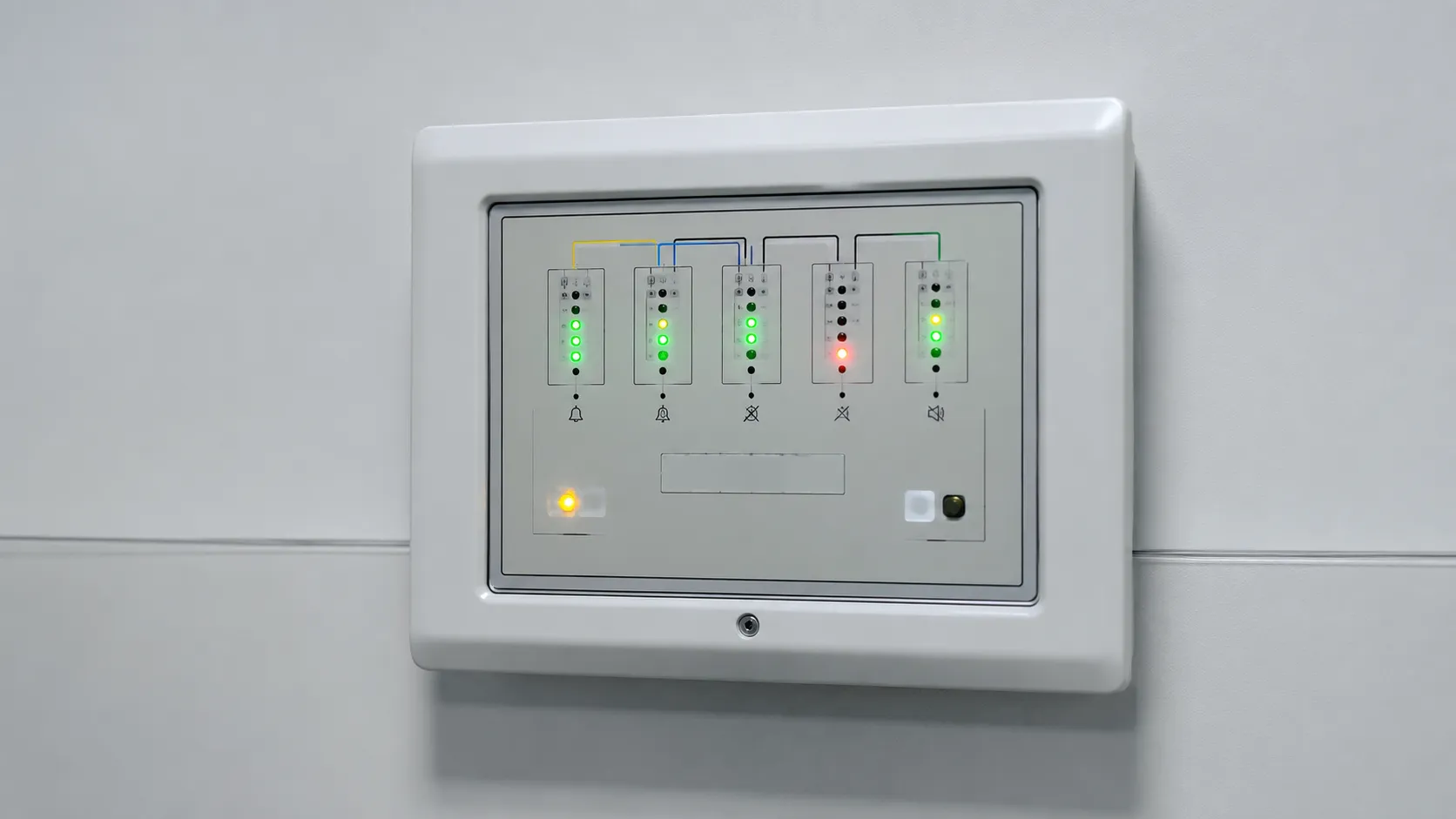
A medical gas alarm panel is a wall-mounted monitoring unit that continuously monitors the pressure and status of a hospital's piped medical gases and vacuum, and raises a visual and audible warning the instant a reading drifts outside its safe band. When a fault develops — oxygen pipeline pressure falling, a manifold running low, a compressor tripping — the panel flags it with a gas-labelled indicator, a fault message and a sounder, so staff can respond before the supply to patients is put at risk.
For estates and clinical-engineering buyers, the alarm panel is the visible layer of a much larger pipeline safety system. This guide sets out the alarm categories, the sensors that feed them, the standards that govern them and the points to settle before you specify a unit.
The three alarm categories you are actually buying
UK medical gas alarms divide into three functional roles, and a panel is chosen for the job it does rather than being a single generic product.
Plant and source alarms
These sit in or near the plant room and are watched by estates and technical staff. They report the health of the supply sources: a manifold changing over or reaching its reserve, a compressor or vacuum pump fault, a dew-point or pressure deviation on medical air. They typically show operating, warning and emergency states so a technician knows whether a source is simply switching duty or has genuinely failed.
Area alarms
Area alarms are the clinical-facing panels. Fitted where nursing staff will see them — a ward corridor, a theatre lobby, an ICU base — they monitor the pressure downstream of the area valve serving that department and warn if it strays high or low. Their job is to tell clinical staff that the gas at the bedspaces they manage may be compromised.
Combined and emergency signalling
Larger installations bring both together, with emergency conditions escalated to a permanently staffed location such as a switchboard or estates control so that a serious fault is never left unseen out of hours.
How a reading becomes a flagged fault
Each monitored service feeds the panel from a sensor. Pressure transducers on the pipeline convert line pressure to an electrical signal; volt-free contacts from plant equipment report running or fault states; level or pressure switches on a manifold signal when a cylinder bank is emptying. The panel compares every input against its configured thresholds, and when a value crosses a limit, it drives the matching indicator and the sounder. A mute or accept button silences the audible alarm so staff can work, while the visual indicator stays lit until the underlying condition clears — and a well-designed panel re-sounds if a new, separate fault appears while an earlier one is muted.
Which gases and services a panel monitors
A single panel is built with an independent channel per service, each labelled and colour-identified for the gas it watches. In a UK hospital that commonly means oxygen, nitrous oxide, medical air at 4 bar, surgical air at 7 bar, carbon dioxide, oxygen/nitrous oxide mixture and medical vacuum. Confirm the exact service list for the location, because a theatre panel and a general ward panel rarely carry the same channels. Correct gas labelling and colour coding on the fascia matters: staff read the panel under pressure, and an ambiguous label costs time.
Medical gas alarm standards and compliance
Alarm behaviour is not left to the manufacturer's discretion. The design, warning states and testing of medical gas alarms sit within Health Technical Memorandum HTM 02-01 and the pipeline standard BS EN ISO 7396-1, which set out operating, warning and emergency alarm functions and how they are commissioned. As electrical monitoring equipment placed on the UK market, a panel must carry UKCA or CE marking under the UK Medical Devices Regulations, with the manufacturer's declaration of conformity available. Because this article draws on those published standards together with pipeline manufacturer commissioning data, buyers should still confirm current requirements with the MHRA and their authorised person for medical gases rather than relying on a summary.
Visual and audible signalling that staff can trust
An alarm is only useful if it is noticed and understood. Look at indicator brightness and viewing angle for the mounting position, the audible level and tone against the background noise of the area, and whether normal, warning and emergency states are visually distinct at a glance. A test button that verifies lamps and sounder without a live fault is essential for routine checks, and clear on-panel text describing the fault removes guesswork for staff who are not gas specialists.
Networked, addressable and logging panels
Modern panels move beyond a standalone box. Addressable systems can link repeat panels so the same status shows in several locations, feed a building management system, and log events with a time stamp for later review. Data logging supports maintenance planning and incident investigation, while networked repeats mean a plant fault can be surfaced at both the plant room and a staffed control point. If integration matters to your estate, confirm the communication protocol and whether it fits your existing monitoring before you commit.
Installation, testing and ongoing maintenance
A panel is commissioned as part of the pipeline system, with each channel proven against a known pressure condition beforehand. Over the operational side of HTM 02-01, alarms fall within a planned maintenance regime overseen by an authorised person and carried out by competent staff, with periodic functional testing. Check for battery or standby power so the alarm survives a mains interruption, and confirm how sensors are recalibrated or replaced over the unit's life. Serviceability — accessible sensors, supported spares, clear documentation — shapes the running cost as much as the purchase price.
Warning states versus emergency states
Not every alarm carries the same urgency, and a good panel makes the difference obvious. A warning condition tells staff a source needs attention soon — a manifold down to its last full bank, or a compressor running without its usual redundancy — and is normally handled by estates within a planned window. An emergency condition signals that pressure at the point of use is already outside safe limits and demands an immediate technical and clinical response. Blurring the two is dangerous in both directions: a routine warning treated as a crisis wastes effort, while a genuine emergency mistaken for a minor warning costs time that patients do not have. The panel's job is to make each state unambiguous through distinct indication and, for emergencies, escalation to a staffed location.
Getting the siting right
A panel that no one sees is worthless, so where it goes is part of the specification. Area panels belong where the staff responsible for those patients work and pass frequently — a nurse base, a ward corridor, a theatre lobby — not tucked into a store or office. Plant panels sit at the source for technical staff, and the most serious conditions are repeated to a permanently attended point such as switchboard or estates control so nothing is missed overnight. Repeat panels that mirror the same status in several places reduce the chance of an out-of-hours fault going unnoticed, and they should be planned alongside the pipeline zoning so the monitoring matches the areas it protects.
Before you specify a medical gas alarm panel
-
List every gas and vacuum service the panel must monitor at that location, with the correct operating pressures.
-
Confirm the panel type — plant/source, area or combined — suits who will watch it and where.
-
Check it meets HTM 02-01 and BS EN ISO 7396-1 alarm functions and carries UKCA or CE marking.
-
Verify visual clarity and audible level for the mounting environment, with a lamp and sounder test.
-
Ask whether the mute re-alerts on a new, separate fault while an earlier one is muted.
-
Confirm standby power so the alarm works through a mains failure.
-
Decide if you need networking, repeat panels or BMS integration, and confirm the protocol.
-
Review sensor calibration intervals, spare-part support and the maintenance contract.
Getting the alarm layer right
A medical gas alarm panel earns its place by turning an invisible pipeline fault into a warning someone can act on. Match the panel type to its audience and location, insist on the correct standards and clear signalling, and plan the calibration and maintenance from the outset. Buyers comparing panels across manufacturers can use Medigear.uk to review specifications and reach verified suppliers, or contact the team through the contact page for sourcing support.
Disclaimer
This article is for informational purposes only. It is published by MediGear (medigear.uk) for general information and procurement guidance, and is not clinical, diagnostic, treatment, technical, engineering, legal or regulatory advice, nor a product endorsement, guarantee or substitute for professional assessment. MediGear does not provide medical consultations. Buyers should consult their clinical, biomedical, estates and regulatory contacts, and the manufacturer's documentation, and independently verify all specifications, certifications, compatibility and suitability before purchase. Specifications, certifications and availability are correct at the time of publication and may change without notice. MediGear is a medical-equipment distributor and does not sell medicines or pharmaceutical products.