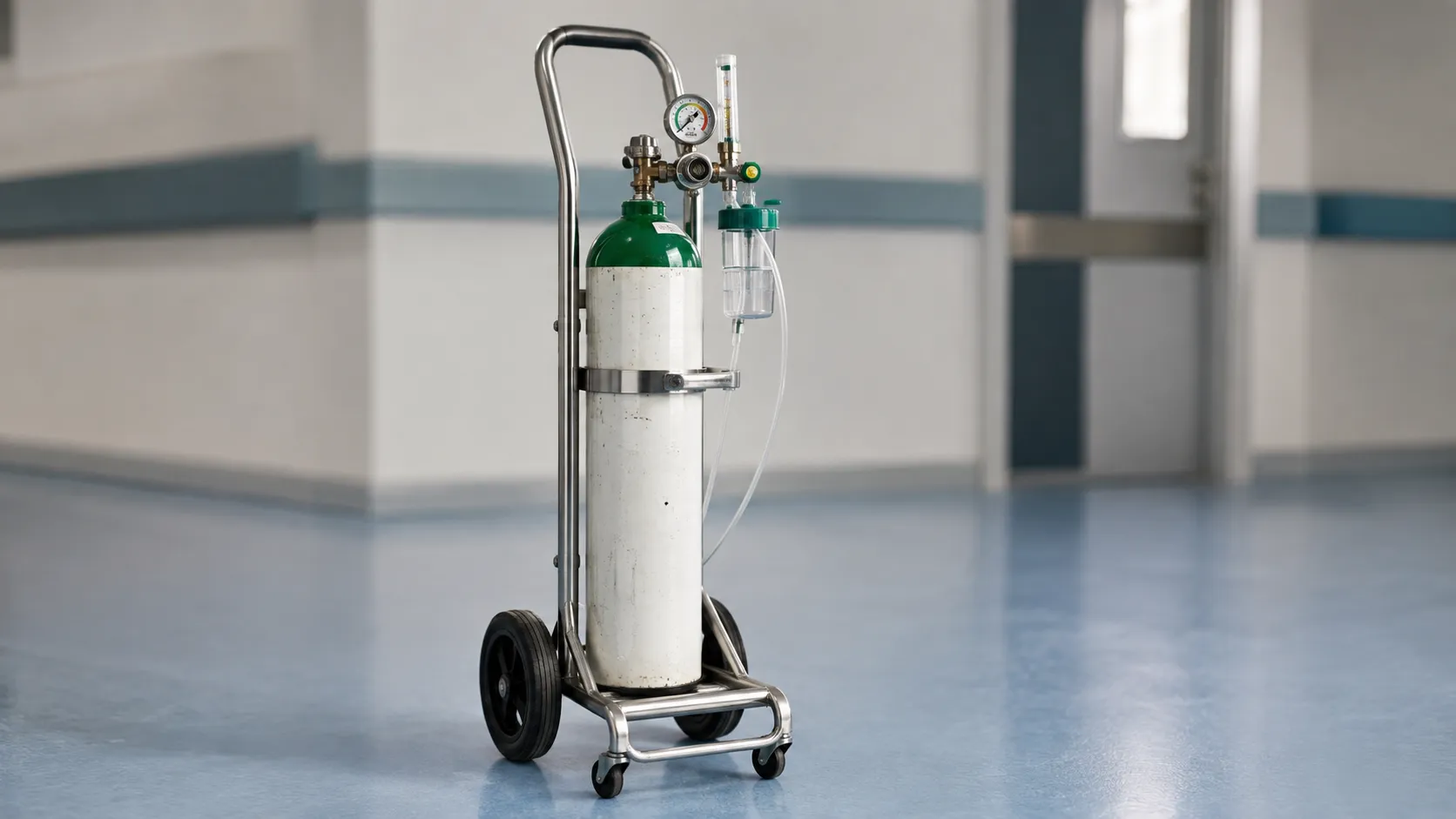
Medical gas cylinders are portable, high-pressure containers that store a therapeutic or clinical gas – most often oxygen, but also Entonox, nitrous oxide, medical air or carbon dioxide – ready for use where a piped supply is not available. They are the mobile backbone of oxygen therapy: carried in ambulances, held on resuscitation trolleys, kept as a reserve on wards and taken to patients in the community. For a procurement team, the cylinder is really three things at once: a pressure vessel, a medicinal product, and a piece of clinical kit, and each brings its own buying and safety questions.
This article stays on the cylinder itself – its sizes, valves, colour identification, fill pressure and safe transport and storage. The wheeled carrier used to move it is a separate purchase covered in our trolley guide.
Cylinder sizes and what each holds
UK medical cylinders follow a letter-code sizing system that runs broadly from the small, portable sizes up through the larger static ones. The compact CD and D sizes are the ones clinicians carry: light enough for a resus bag or an ambulance mount, they hold enough oxygen for transfer and emergency use. The E and F sizes hold progressively more and suit ward reserves and longer therapy, while larger sizes and cylinder banks feed manifolds. Rather than fixate on one figure, ask the supplier for the nominal gas volume in litres at full pressure for each size, because that number – not the physical dimensions – tells you how long a cylinder lasts at a given flow rate.
Reading the colour code
Colour identification is safety-critical, and the current UK convention follows BS EN 1089-3, which uses the cylinder shoulder colour to identify the gas. Oxygen carries a white shoulder, nitrous oxide blue, medical air black and white, and carbon dioxide grey; Entonox, the 50/50 oxygen and nitrous oxide analgesic mixture, shows blue and white quarters. Older stock may still show the historic black body of a UK oxygen cylinder, but newer medical cylinders increasingly use an all-white body to match the harmonised scheme. Never rely on body colour or memory alone – the label and shoulder together confirm the contents, and staff should be trained to read both.
Integral valves and live contents gauges
Many portable cylinders now use an integral valve: the regulator, on/off control, flow selector and outlets are built into the cylinder head rather than fitted separately. This design removes the need to attach a regulator under pressure, reducing fumbling in an emergency and the risk of a wrong or loose fitting. A key feature to specify is a live contents gauge – a display that shows remaining gas at a glance, even when the cylinder is turned off – so staff can see at handover whether a cylinder is fit to take to a patient. Integral-valve heads typically offer both a barbed or Schrader outlet for a flowmeter or ventilator and a direct flow-selector dial for therapy.
The colour conventions and pressure figures here follow BS EN 1089-3 and the medical gas storage guidance in HTM 02-01; oxygen and other medicinal gases are regulated in the UK by the MHRA, while cylinder carriage falls under HSE dangerous-goods rules. MediGear works with UK facilities to weigh cylinder and valve options against those references rather than a single catalogue.
Fill pressure, material and weight.
Oxygen cylinders are commonly filled to around 137 bar, with lightweight cylinders rated to about 230 bar to pack more gas into the same footprint. That higher pressure is why materials and handling matter. Traditional cylinders are steel; lightweight versions use aluminium with a carbon-fibre composite wrap, cutting the weight a member of staff or a paramedic has to lift and reducing manual-handling strain over a shift. When comparing options, balance the extra cost of a composite lightweight cylinder against the real ergonomic gain for the teams who carry them, and confirm the tare weight as well as the gas volume.
The gases you are likely to handle
Oxygen dominates, but a rounded specification allows for the others. Entonox provides short-acting analgesia in maternity and A&E; nitrous oxide and medical air support anaesthesia and driving certain devices; carbon dioxide has surgical uses. Each has its own shoulder colour, valve outlet and handling rules, and mixing up connections is exactly what the non-interchangeable outlets are designed to prevent. Buyers should map which gases each department needs and in which sizes, so that ordering, storage and staff training all line up.
Transport and emergency readiness
In transport and emergency work, the cylinder must be secure, quickly readable and reliably full. Ambulances and transfer trolleys use dedicated brackets or restraints so a cylinder cannot become a projectile under braking, and integral valves with a live gauge let crews confirm contents before they set off. For resuscitation, cylinders are kept upright, restrained and rotated so none is left near empty. Anyone moving cylinders on the road is handling dangerous goods, so carriage follows the relevant regulations and the HSE's advice on the safe use of gas cylinders.
Storing cylinders safely
Storage is where many avoidable incidents begin. Guidance in HTM 02-01 and from the HSE calls for a well-ventilated, fire-segregated store, cylinders secured upright against a wall or in a stand, and clear separation of full from empty stock so staff never grab an empty in a hurry. Keep oxygen and other oxidising gases away from oil, grease, and ignition sources; control access; and operate stock on a first-in, first-out basis so gases are used within date. A tidy, well-labelled store is not housekeeping for its own sake – it is the difference between a cylinder that works when needed and one that does not.
Regulation and what it means for buyers
Medical gases sit in a dual regulatory space. The gas inside is a medicinal product overseen by the MHRA, while the cylinder and valve are pressure equipment and a medical device that should carry UKCA or CE marking; broader guidance is published at GOV.UK. For a buyer this means checking two things: that your gas supply comes through a properly licensed route, and that the hardware – valves, gauges and fittings – is certified and compatible with your regulators and pipeline connections. The gas supplier handles periodic cylinder testing and revalidation, but you should know the arrangements.
Flow rate and how long a cylinder lasts
Duration is the question clinicians ask most, and it comes down to gas volume divided by flow rate. A cylinder holding a given number of litres at full pressure will empty far faster at 15 litres a minute than at 2, so the same size behaves very differently in resuscitation than in low-flow therapy. This is why the nominal litres figure matters more than the physical size, and why the live contents gauge is so valuable: it lets staff judge remaining time at the flow in use. When specifying, think in terms of the flows your service actually delivers and the journey or transfer times involved, then size and stock cylinders so a change-over is never forced mid-treatment. Building a simple duration reference for each size at common flows helps front-line staff plan and reduces the risk of a cylinder running dry unexpectedly.
Handling, dropping and valve protection
Because the energy stored in a pressurised cylinder is considerable, handling discipline is part of safe ownership. Cylinders should never be dropped, dragged or rolled along the ground, as impact can damage the valve, and they must be turned off when not in use rather than left live. Integral-valve heads offer some built-in protection for the controls. Still, they are not indestructible, so staff training on lifting, carrying and mounting cylinders correctly is as important as the hardware itself. These handling habits, combined with the right trolley for movement, keep both people and cylinders safe day to day.
Before you order medical gas cylinders
-
Confirm the gas, the size codes (CD, D, E, F and above) and the nominal litres each size holds at full pressure.
-
Check the shoulder colour and label against BS EN 1089-3 for every gas you stock.
-
Specify integral valves with a live contents gauge for portable and emergency use.
-
Decide between steel and lightweight composite cylinders on weight versus cost for the teams carrying them.
-
Verify valve outlets and fittings match your flowmeters, regulators and device connections.
-
Confirm UKCA or CE marking on the hardware and a properly licensed gas supply.
-
Plan compliant storage per HTM 02-01: ventilated, secured upright, and segregated for full and empty.
-
Agree restraint arrangements for ambulances, trolleys and transfers before delivery.
Getting cylinder supply right
A medical gas cylinder is only useful if it is the right size, correctly identified, reliably full and safe to move – and every one of those depends on decisions made at purchase. Get the size mix, valve type and storage plan right, and your teams spend less time checking contents and more time treating patients. If you are reviewing your cylinder range or matching hardware to existing regulators, our team can help you weigh specifications side by side. Get in touch through the MediGear contact page, or outline your facility's needs on MediGear for Buyers.
Disclaimer
This article is for informational purposes only. It is published by MediGear (medigear.uk) for general information and procurement guidance and is not clinical, diagnostic, treatment, technical, engineering, legal, or regulatory advice, nor a product endorsement, guarantee, or substitute for professional assessment. MediGear does not provide medical consultations. Buyers should consult their clinical, biomedical, estate, and regulatory contacts and the manufacturer's documentation, and independently verify all specifications, certifications, compatibility, and suitability before purchase. Specifications, certifications and availability are correct at the time of publication and may change without notice. MediGear is a medical-equipment distributor and does not sell medicines or pharmaceutical products.