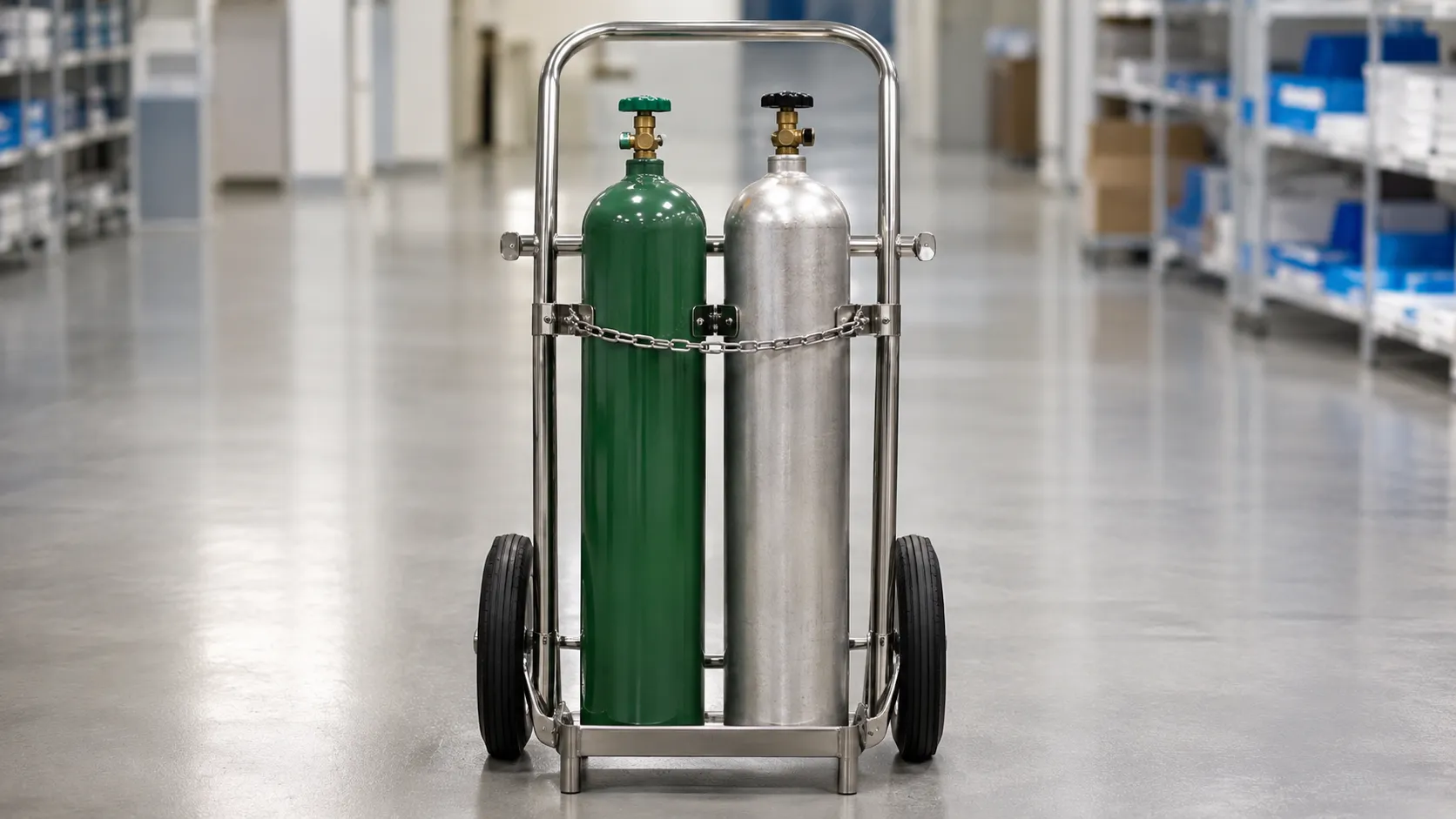
A gas cylinder trolley is a wheeled frame designed to move and hold medical gas cylinders safely, so staff don't have to lift, drag, or roll pressure vessels by hand. It cradles the cylinder in a base cup, secures it with a chain or strap and puts the load on castors, turning an awkward and hazardous manual task into a controlled push. For estates, portering and clinical teams, the trolley is the practical answer to a real problem: a full F-size cylinder is heavy and unwieldy, and the injuries that come from moving one badly are common and preventable.
This guide is about the carrier, not the cylinder. The focus is on restraint, size compatibility, stability, wheels and the manual-handling case – the things that decide whether a trolley actually keeps people and gas safe.
Trolley types and how they differ
Trolleys range from a simple single-cylinder upright sack-style trolley, ideal for moving one cylinder from store to bedside, through twin-cylinder trolleys that let a department carry a spare, to multi-cylinder cages and pallets used to shift stock in bulk within a hospital. Purpose-built ambulance and vehicle mounts also double as transport restraints. The right choice depends on how many cylinders move at once, over what distance and on what surface. A ward that swaps a single portable cylinder needs something very different from a porter feeding a manifold room.
Restraint: the feature that matters most
The single most important job of a trolley is to stop the cylinder falling. A dropped cylinder can damage the valve, and a sheared valve on a pressurised cylinder is dangerous. Look for a secure base cup that locates the cylinder foot, plus at least one retaining chain or strap – ideally two at different heights for taller cylinders – with a quick, positive fastening staff will actually use every time. A readily get-restraint is left undone, so ease of use is a safety feature, not a convenience. Confirm the restraint suits the height and diameter of the cylinders you run.
Matching the trolley to your cylinder sizes
Trolleys are built around particular cylinder diameters and heights, so compatibility isn't guaranteed. A cradle sized for a slim CD or D cylinder will not hold a fat F securely, and vice versa. Before buying, list the cylinder sizes each area uses and check the trolley's stated diameter range and base-cup dimensions against them. Some trolleys take a single fixed size; others include adjustable cradles or reducing collars to cover a range. Getting this wrong leaves a cylinder rattling loose or not fitting at all, so treat size compatibility as a first filter, not an afterthought.
The safe-movement advice here draws on the HSE's guidance for the safe use of gas cylinders and the Manual Handling Operations Regulations 1992. It is written for estates and portering teams rather than clinicians. As a UK distributor, MediGear helps facilities match trolleys to the cylinder sizes already on site.
Stability and centre of gravity
A trolley must stay upright while loaded and moving. Stability comes from a wide wheelbase, a low centre of gravity and a base that keeps the heavy cylinder foot near the ground. Tall single-cylinder trolleys are more prone to tipping on slopes or thresholds, so look at the base footprint and how the cylinder sits within it. For trolleys that will cross ramps, kerbs or lift thresholds, a design with a slight backward tilt in transit and large wheels keeps the load controlled. Ask about the tested load rating and the maximum cylinder size the frame is stable with, not just the size it physically accepts.
Wheels, castors and the surfaces you cross
Wheel choice depends on the route. Smooth internal floors suit hard castors that roll easily and clean well; rough ground, thresholds and outdoor yards call for larger pneumatic or semi-pneumatic wheels that ride over obstacles without jolting the load. At least one braked castor is worth having so a parked trolley cannot roll, especially on any incline. For infection-control areas, confirm the wheels and frame are easy to wipe down and that the finish resists the cleaning agents your facility uses.
The manual-handling case
Moving cylinders by hand is a well-known source of musculoskeletal injury, and the Manual Handling Operations Regulations 1992 require employers to avoid or reduce that risk where reasonably practicable. A good trolley is a direct control measure: it removes the lift, keeps the load stable and lets one person move a cylinder that would otherwise need two or risk a strain. When you build the business case, weigh the modest cost of a trolley against the real cost of back injuries, sickness absence and the handling assessments the HSE expects. The HSE publishes practical guidance that supports this approach.
Frame material, finish and durability
Trolleys are usually steel for strength, either powder-coated for a hard-wearing finish or stainless where corrosion resistance and easy cleaning matter, with some lighter aluminium designs. In damp stores, outdoor yards or wash-down areas, a corrosion-resistant finish earns its cost by lasting longer and staying safe. Check welds, the integrity of the base cup and the fixing points for the restraint chain, because these are the parts that take the strain and fail first if the build is poor. A trolley is a long-life asset, so buying a sturdier frame usually works out cheaper over its service life.
Storage handling and everyday use
Trolleys also help keep the cylinder store safe. Cylinders should be kept secured and upright, and a trolley provides a stable way to hold and move them without laying them down or standing them unrestrained. In practice, a well-chosen trolley is left in the store or department, ready to take the next cylinder, which needs a small footprint when parked and must not become a trip or obstruction hazard. Consider how many trolleys each area needs so a cylinder is never moved without one to hand.
Ambulance and vehicle-mounted options
Moving cylinders on the road is a distinct case. Ambulances and patient-transport vehicles use fixed brackets or vehicle-mounted restraints that hold the cylinder securely against acceleration, braking and cornering, so an unrestrained cylinder cannot become a heavy projectile in a collision. Some of these mounts double as a carrier the crew can lift out with the cylinder, bridging transport and bedside use. If your remit covers vehicles, specify restraints designed and rated for in-transit forces rather than a static store trolley, and confirm the mount suits the cylinder sizes each vehicle carries. Coordinate this with your fleet and clinical teams, because the fixing has to work with the vehicle's layout as well as the cylinder.
Training, checks and daily use
A trolley only reduces risk if it is used correctly and kept in good order. Staff who move cylinders should be briefed on loading the cylinder into the base cup, fastening the restraint every time, and pushing rather than pulling the loaded trolley to keep control. A quick pre-use glance for damaged wheels, a frayed strap, or a cracked weld catches problems before they cause an incident, and a faulty trolley should be taken out of use until repaired. Building these habits into local manual-handling training turns the trolley from a piece of kit into a reliable, everyday control measure that protects the people doing the lifting.
Before you buy a gas cylinder trolley
-
List the cylinder sizes each area uses and check the trolley's diameter range and base cup against them.
-
Confirm a secure base cup plus one or two retaining chains or straps that fasten quickly.
-
Check the tested load rating and the largest cylinder size the frame can support stably; match wheel type to your routes: hard castors indoors, larger pneumatic wheels for rough ground.
-
Specify at least one braked castor for parking on any slope.
-
Choose a corrosion-resistant, wipe-clean finish for damp or infection-control areas.
-
Inspect welds, base cup and restraint fixing points for build quality.
-
Decide how many trolleys each department and store needs so cylinders never move unrestrained.
Moving cylinders without the risk
A gas cylinder trolley is a small purchase that removes a large hazard, but only if it fits your cylinders, holds them securely and rolls well over the ground your teams actually cross. Specify restraint, size compatibility and stability first, then wheels and finish to suit the environment, and you turn a risky lift into a routine push. If you are standardising cylinder handling across sites or matching trolleys to a mixed cylinder fleet, our team can help you compare options. Talk to us via the MediGear contact page or set out your needs through MediGear for buyers.
Disclaimer
This article is for informational purposes only. It is published by MediGear (medigear.uk) for general information and procurement guidance, andd is not clinical, diagnostic, treatment, technical, engineering, legal, o regulatory advice, nor a product endorsement, guarantee, o substitute for professional assessment. MediGear does not provide medical consultations. Buyers should consult their clinical, biomedical, estates and regulatory contacts, the manufacturer's documentation, and independently verify all specifications, certifications, compatibility and suitability before purchase. Specifications, certifications and availability are correct at the time of publication and may change without notice. MediGear is a medical-equipment distributor and does not sell medicines or pharmaceutical products.