Selecting a medical equipment supplier can influence far more than the purchase price of a device. Supplier capability affects regulatory documentation, delivery accuracy, installation, staff training, warranty support and the availability of spare parts throughout the equipment’s working life.
For hospital equipment buyers and sourcing managers, the selection process should begin with a controlled clinical and technical requirement. Suppliers should then be assessed against the same evidence-based criteria rather than through informal comparisons or sales presentations.
A supplier offering a recognised product may still be unsuitable if it cannot support the hospital’s destination, installation programme or maintenance requirements. Similarly, a competitive quotation may become expensive when essential accessories, software or service costs are excluded.
This guide explains how hospitals can verify medical equipment suppliers, compare proposals and select organisations capable of supporting equipment from order placement through commissioning and long-term operation.
Define the Hospital’s Requirements Before Evaluating Suppliers
Supplier selection becomes more reliable when the hospital clearly defines its needs before entering the market.
Clinical purpose — State the examination, procedure, monitoring activity or operational function the equipment must support. The relevant clinical department should approve the requirement.
In practice, hospital buyers often find that supplier proposals cannot be compared because each company has interpreted a broad request differently.
Technical performance — Define measurable requirements such as capacity, accuracy, throughput, battery duration, image quality or operating range.
Complete configuration — List all required probes, sensors, cables, batteries, trolleys, software, licences and starter consumables. Suppliers should quote the complete usable package.
Expected workload — Estimate patient volumes, tests, procedures and operating hours. This helps suppliers propose equipment suited to actual demand.
Infrastructure conditions — Confirm electrical supply, network access, ventilation, medical gases, water, drainage and structural requirements where relevant.
User and training needs — Identify the clinical and technical teams responsible for operating or maintaining the equipment.
Implementation schedule — State the required delivery, installation, commissioning and training dates. Suppliers should confirm whether these milestones are realistic.
Lifecycle expectations — Define warranty, service response, spare-parts availability and expected support life.
A well-prepared requirements document allows the hospital to distinguish suitable suppliers from organisations that offer only readily available products.
Compare Suppliers Across Different Healthcare Settings
Supplier suitability depends partly on the hospital’s scale, location, infrastructure and technical-support capacity.
Large and teaching hospitals — Major hospitals may require suppliers with experience in complex installations, system integration and multi-department equipment programmes. Project management and technical coordination may be as important as product availability.
District and regional hospitals — Facilities located away from major service centres may place greater weight on spare-parts availability, remote diagnostics and engineer response times.
When reviewing verified healthcare equipment supply organisations, hospitals should confirm that the supplier’s claimed coverage applies to the exact destination and equipment category.
Community hospitals and clinics — Smaller facilities may need suppliers capable of providing simple configurations, user training and predictable maintenance arrangements.
Diagnostic and laboratory facilities — Supplier assessment may include reagent continuity, quality-control support, calibration, software connectivity and response to analyser downtime.
Surgical and critical care departments — Hospitals should assess urgent technical response, backup equipment availability and access to specialist accessories.
New hospital developments — Large projects may require equipment scheduling, room coordination, phased delivery, storage and commissioning support across multiple categories.
Multi-facility healthcare groups — Suppliers may need to manage standardised products, central purchasing arrangements and delivery to several locations.
Experienced hospital supply managers typically assess supplier capability against comparable operating environments rather than accepting general claims of healthcare experience.
Verify Supplier Credentials and Product Documentation
Supplier verification should establish whether the organisation is legitimate, technically capable and authorised to provide the proposed equipment.
Legal business identity — Confirm the registered company name, physical address, registration details and official contact information.
Manufacturer relationship — Determine whether the supplier is a manufacturer, authorised distributor, reseller or independent exporter. The relationship may affect warranty, software access and spare-parts support.
Product experience — Ask for evidence of experience with the equipment category, manufacturer or model. General medical trading experience may not demonstrate specialist capability.
Regulatory documentation — Equipment should meet applicable local regulatory standards, including standards such as CE, FDA or their regional equivalents where relevant.
Document consistency — Manufacturer names, model numbers and intended use should match across certificates, declarations, manuals and quotations.
Technical staff credentials — Confirm whether the supplier has trained product specialists, installation engineers or service technicians.
Customer references — References from similar healthcare facilities can provide evidence of communication, delivery, installation and maintenance performance.
Insurance and liability — Where relevant, hospitals should review product, professional or commercial insurance arrangements.
Financial and banking verification — Payment instructions should match verified supplier details. Any change to banking information should be checked independently.
Supplier approval should be based on verifiable evidence rather than website claims or catalogue presentation alone.
Review Product Compliance and Technical Documentation
The supplier must provide evidence showing that the exact product and configuration meet the hospital’s requirements.
Manufacturer identity — The manufacturer name should match across the quotation, product label, certificates, declarations and manuals.
Model verification — Hospitals should confirm that every technical and compliance document applies to the exact model being offered.
Intended-use alignment — The manufacturer’s intended use should support the hospital’s planned clinical application.
Regulatory evidence — Equipment should meet applicable local regulatory standards, including CE, FDA, or their regional equivalents, where relevant.
Document validity — Check certificate numbers, dates, issuing organisations and product scope. Expired or incomplete records should be clarified before approval.
Product registration — Some destination markets require local registration, importer appointment or authorised representation.
Technical manuals — User, installation and maintenance documents should correspond to the proposed equipment version.
Software information — Connected equipment may require software-version details, licences, cybersecurity documentation and update policies.
Accessory compatibility — Confirm that probes, sensors, cables and other accessories are approved for use with the proposed model.
Document consistency — Product descriptions, manufacturer addresses and model references should remain consistent throughout the supplier submission.
Any discrepancy should be recorded as a formal clarification rather than resolved through an informal verbal assurance.
Compare Quotations and Commercial Commitments
Price comparison should only begin after the hospital confirms that suppliers are proposing technically equivalent equipment packages.
Controlled quotation format — Every supplier should respond to the same specification and identify compliance, partial compliance or deviation for each requirement.
Equipment package — The quotation should clearly separate the base unit, accessories, software, consumables and optional components.
Public product information — Healthcare equipment advertising products to international hospital buyers should ensure that technical and compliance claims match formal documentation. Hospitals should verify marketing statements before using them in an evaluation.
Freight and logistics costs — Packaging, insurance, transport, customs handling and final delivery should be identified separately.
Installation costs — The proposal should state whether unloading, positioning, assembly, configuration and calibration are included.
Training costs — Clinical and technical training should be itemised with the proposed number of sessions and participants.
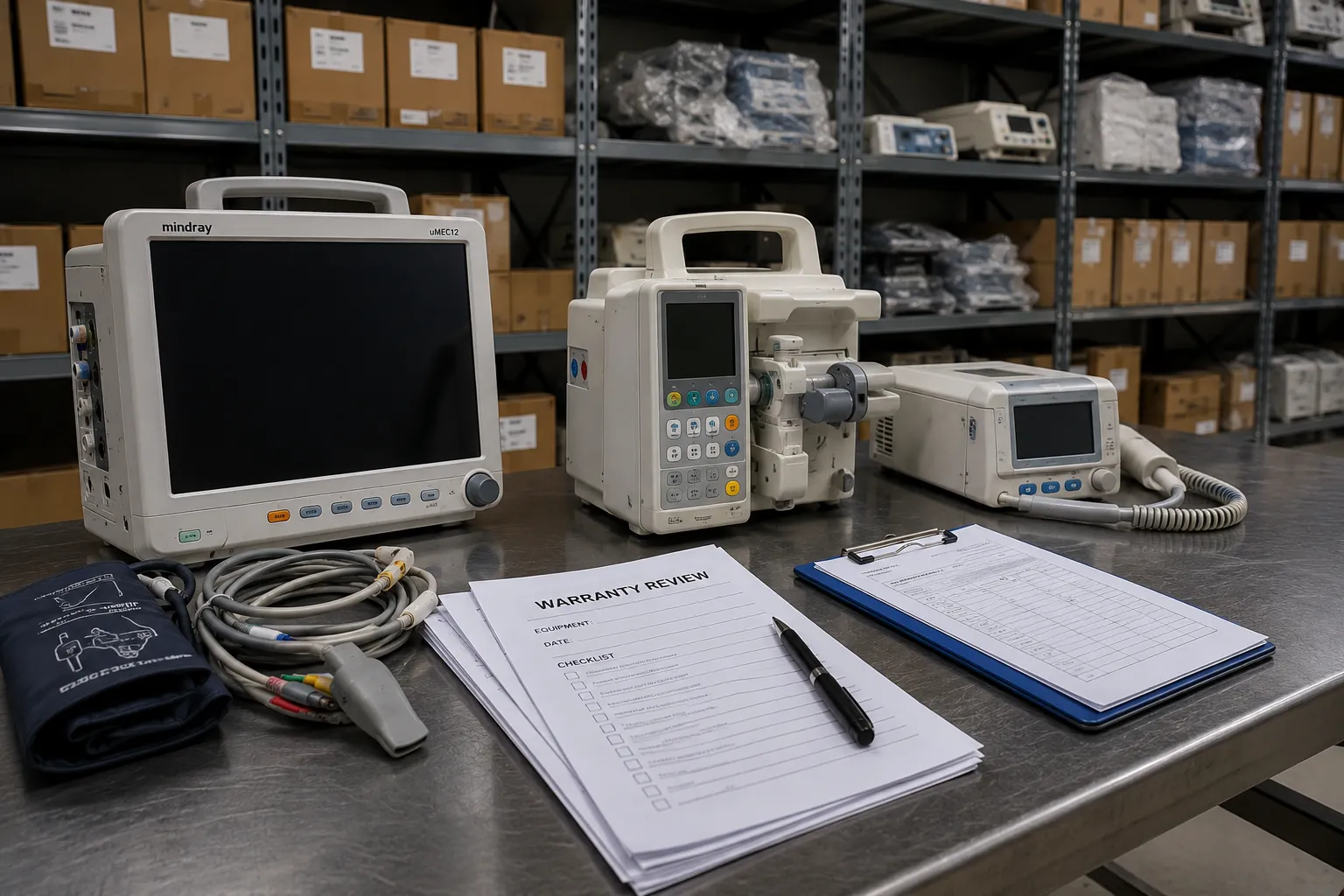
Warranty terms — Hospitals should compare the warranty start date, duration, exclusions, and coverage for parts, labour, software, and engineer travel.
Maintenance commitments — Preventive and corrective maintenance pricing should be clear, including travel and spare-parts charges.
Payment milestones — Payments may be linked to order confirmation, document approval, shipment, delivery, installation or commissioning.
Contract protections — The agreement should address delays, incorrect models, incomplete delivery, unauthorised substitutions and warranty failures.
Hospital groups seeking repeat-sourcing arrangements may consider structured international equipment-supply partnerships. Each order should still use documented specifications, transparent pricing and formal approval.
Evaluate Delivery, Installation and Training Capacity
A supplier’s practical implementation capability can determine whether equipment becomes operational on schedule.
Production and stock status — Confirm whether the equipment is available, manufactured to order or dependent on another distributor.
Delivery planning — The supplier should provide realistic dispatch and arrival dates while accounting for documentation, freight and customs requirements.
Protective packaging — Sensitive devices may require specialist crates, moisture protection, shock indicators or temperature control.
Site preparation information — Model-specific requirements should be supplied early enough for the hospital to prepare rooms, utilities and access routes.
Installation responsibility — Confirm who will position, assemble, connect, configure and test the equipment.
Commissioning process — The supplier should explain how the product will be checked against the approved specification before acceptance.
Clinical training — User training should cover operation, alarms, cleaning, routine checks and basic fault reporting.
Technical training — Biomedical engineers may require maintenance instructions, diagnostic information and service documentation.
Training records — Attendance, materials and competency checks should be documented where appropriate.
Handover documentation — Manuals, certificates, warranty records, service contacts and acceptance reports should be supplied before the project is closed.
A supplier should only be selected when its delivery and implementation plan is compatible with the hospital’s operational timeline.
Evaluate Delivery, Installation and Training Capacity
A supplier’s practical implementation capability can determine whether equipment becomes operational on schedule.
Production and stock status — Confirm whether the equipment is available, manufactured to order or dependent on another distributor.
Delivery planning — The supplier should provide realistic dispatch and arrival dates while accounting for documentation, freight and customs requirements.
Protective packaging — Sensitive devices may require specialist crates, moisture protection, shock indicators or temperature control.
Site preparation information — Model-specific requirements should be supplied early enough for the hospital to prepare rooms, utilities and access routes.
Installation responsibility — Confirm who will position, assemble, connect, configure and test the equipment.
Commissioning process — The supplier should explain how the product will be checked against the approved specification before acceptance.
Clinical training — User training should cover operation, alarms, cleaning, routine checks and basic fault reporting.
Technical training — Biomedical engineers may require maintenance instructions, diagnostic information and service documentation.
Training records — Attendance, materials and competency checks should be documented where appropriate.
Handover documentation — Manuals, certificates, warranty records, service contacts and acceptance reports should be supplied before the project is closed.
A supplier should only be selected when its delivery and implementation plan is compatible with the hospital’s operational timeline.
Control International Supplier and Delivery Risks
Hospitals purchasing from overseas suppliers should apply additional commercial, regulatory and logistics checks.
Destination-market acceptance — Confirm that the equipment, labelling and documentation meet the receiving market’s requirements.
Export experience — The supplier should understand packing lists, invoices, certificates of origin and other relevant shipping documents.
Shipping responsibility — Establish who arranges freight, insurance, customs clearance, unloading and final delivery.
Import obligations — Identify importer responsibilities, local registrations and required approvals before shipment.
Pre-shipment inspection — High-value equipment may require model, serial number, accessory, and document verification before dispatch.
New and refurbished products — Refurbished systems should include condition reports, testing records, equipment history, software information and warranty details.
International warranty — Confirm whether remote support, parts delivery and engineer attendance apply at the final hospital location.
Payment risk — Use verified bank details and payment milestones connected to measurable delivery stages.
Documentation consistency — Manufacturer, model, quantity and product descriptions should match across quotations, invoices, packing lists and certificates.
Hospitals seeking supplier comparisons, equipment quotations or international sourcing support can contact the Medigear.uk team for supplier evaluation assistance. Enquiries should include the equipment category, intended use, quantity, condition and destination.
A supplier should receive final approval only after technical, commercial, compliance and support risks have been reviewed together.
Final thoughts
Medical equipment supplier selection should be treated as a structured hospital decision rather than a simple price comparison.
Hospitals should begin with clear clinical, technical and implementation requirements. Suppliers should then be verified through business records, manufacturer relationships, technical capability and customer references.
Equipment quotations must be compared as complete packages that include accessories, software, freight, installation, training and warranty support.
Long-term service, spare parts availability, and software support can have a greater operational impact than a small difference in purchase price.
A documented supplier-selection process helps hospitals appoint dependable organisations that can provide suitable equipment and support it throughout its working life.
Disclaimer
Medigear.uk is a global medical equipment supplier, exporter, and distributor. The content published on this site is intended for educational and product awareness purposes only. Nothing on this page constitutes medical advice, clinical guidance, or treatment recommendations. All healthcare procurement and clinical decisions should be made by qualified medical professionals and compliant procurement teams operating within the regulatory frameworks of their respective countries.