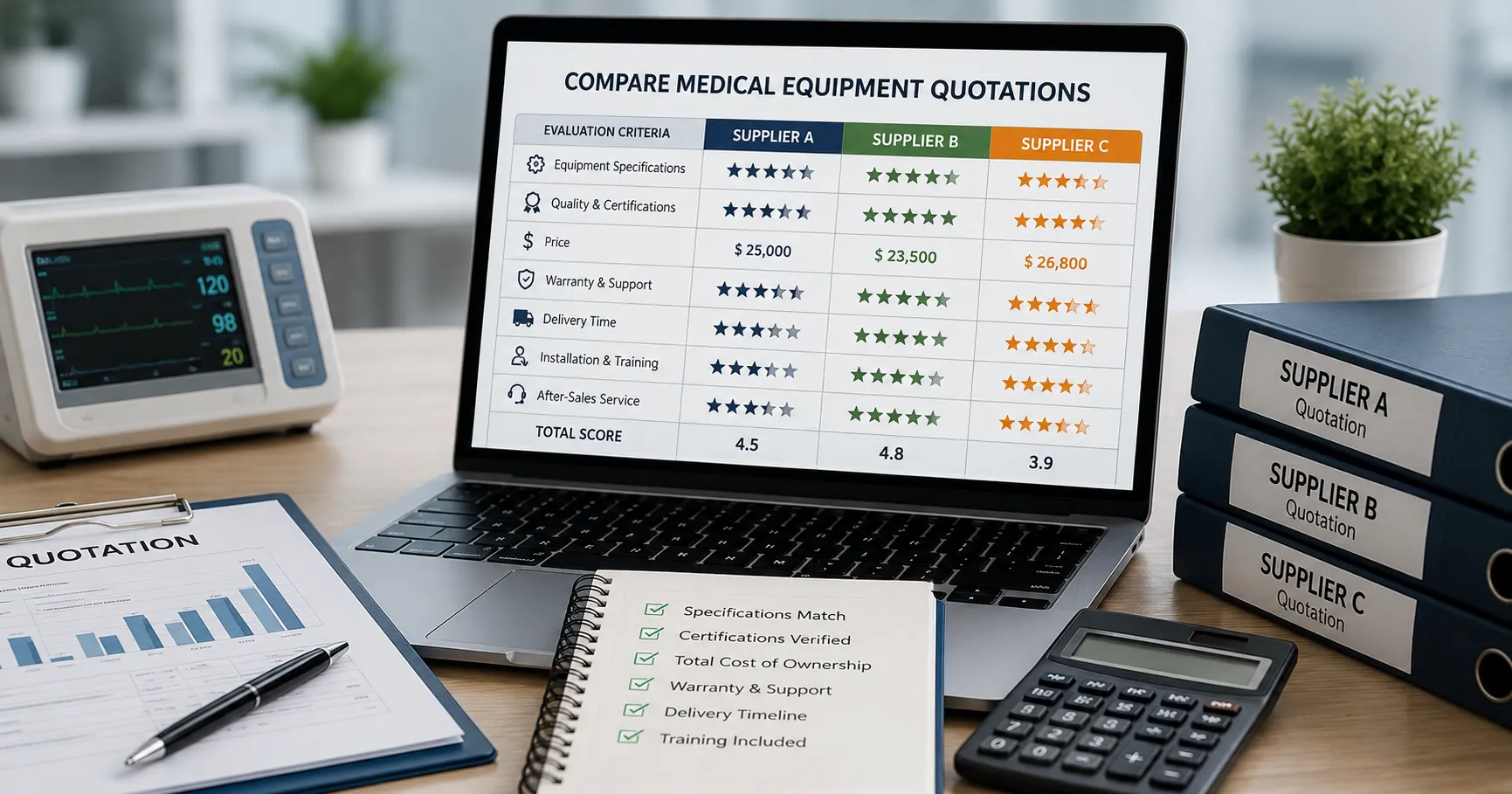
Medical equipment quotations often appear comparable because they use similar product names and headline prices. A closer review may reveal different models, accessory quantities, software licences, delivery responsibilities, warranty terms and service commitments.
For hospital buyers and healthcare purchasing teams, comparing only the final quoted amount can create significant procurement risk. One supplier may provide a complete operating package, while another may exclude installation, training or accessories required for clinical use.
The comparison process should therefore begin with technical compliance rather than price. Clinical users, biomedical engineers, facilities representatives and commercial reviewers should assess the parts of the quotation relevant to their responsibilities.
A structured comparison helps healthcare organisations identify missing costs, document supplier deviations and select an equipment package that remains practical and supportable after delivery.
Prepare One Clear Request for Every Supplier
Accurate comparison begins before quotations are received. Suppliers should be given the same information and asked to respond in a consistent format.
Controlled technical specification — Issue one approved document describing the required clinical function, performance criteria and operating conditions. Avoid sending different versions to different suppliers.
In practice, healthcare buyers often find that substantial price differences exist because suppliers have interpreted an unclear request differently.
Defined clinical purpose — State the examination, monitoring activity, procedure or operational function the equipment must support. The manufacturer’s intended use should match the planned application.
Required equipment quantity — Confirm the number of main units, accessories and consumable starter packs. Suppliers should determine whether unit prices vary with order volume.
Mandatory requirements — Separate essential technical criteria from desirable functions. A proposal that fails a mandatory requirement should not receive an advantage because of a lower price.
Accessory schedule — List required probes, cables, batteries, sensors, trolleys, mounts and other components. Do not allow suppliers to interpret “standard accessories” independently.
Delivery destination — Provide the exact facility or project location so suppliers can accurately estimate logistics and service responsibilities.
Required implementation dates — State expected delivery, installation, commissioning and training milestones.
Standard quotation headings — Ask suppliers to separate equipment, accessories, software, freight, installation, training, warranty and maintenance.
Quotation validity — Require a clear expiry date for pricing and delivery commitments.
A consistent request allows healthcare teams to compare equivalent packages rather than unrelated offers.
Confirm That Every Proposed Product Meets the Need
Price comparison should begin only after clinical and technical suitability have been established.
Manufacturer and model — The quotation should show the legal manufacturer, the exact model number, and the relevant product version. General descriptions are not sufficient.
Intended clinical use — Confirm that the manufacturer’s documented purpose supports the healthcare facility’s planned application.
Expected workload — Review whether the equipment can accommodate anticipated patient volumes, tests, procedures, or operating hours.
Performance capability — Compare accuracy, measurement range, capacity, throughput, image quality, battery duration or other relevant criteria.
User requirements — Controls, languages, alarms and operating workflows should suit the intended clinical and technical staff.
Patient suitability — Weight capacity, measurement limits, accessibility and patient-group requirements should be reviewed where relevant.
Physical suitability — Confirm equipment dimensions, mobility, storage space and access-route requirements.
Infrastructure compatibility — Check electrical supply, ventilation, medical gases, water, drainage, network connections and structural requirements.
When requesting proposals from established global healthcare equipment suppliers, buyers should confirm that each supplier understands the receiving facility’s workload, infrastructure and support environment.
Experienced clinical equipment managers usually complete the technical review before viewing the commercial ranking. This helps prevent price from influencing the assessment of suitability.
Convert Every Offer Into the Same Configuration
The most common cause of misleading comparisons of quotations is differences in included accessories and services.
Main equipment unit — Establish exactly what the base price covers. Some systems require additional modules or components before they can perform the required function.
Patient-use accessories — Compare probes, transducers, sensors, patient cables, cuffs, electrodes and other clinical components.
Mobility and mounting equipment — Review trolleys, stands, wall mounts, shelves, carrying cases and storage accessories.
Power components — Check batteries, chargers, adapters, power cables, and backup power arrangements.
Software package — Confirm whether operating software, reporting functions, user licences and interface modules are included.
Connectivity requirements — Review network interfaces, data-transfer formats, licences, cybersecurity controls and integration services.
Starter consumables — Determine whether reagents, filters, cartridges, paper, electrodes or other initial supplies are included.
Quantities — Suppliers may include different quantities of the same accessory. Every item should be compared line by line.
Optional products — Separate genuine optional upgrades from components required for normal operation.
Replacement pricing — Buyers may also request future prices for frequently replaced accessories and consumables.
One aspect that surprises first-time buyers is that completing a low-priced base unit can cost more than selecting a quotation that included the required configuration from the start.
A normalised comparison should show the cost of bringing every offer to the same complete and clinically usable standard.
Identify Inclusions, Exclusions and Commercial Conditions
Once the proposed configurations are equivalent, the healthcare team can evaluate commercial terms.
Unit pricing — Confirm whether the price applies to one unit, the complete quantity or a specific volume range.
Itemised costs — Equipment, accessories, and software should be listed separately rather than combined into a single unclear amount.
Consistency of supplier claims — Healthcare equipment vendors advertising products to global purchasing teams should ensure that public product descriptions match their formal quotations and technical evidence.
Packaging charges — Confirm whether normal packaging, export crates, pallets, moisture protection and specialist handling are included.
Transport and insurance — Determine whether freight and cargo insurance cover the complete journey to the healthcare facility.
Import responsibilities — Clarify customs clearance, duties, taxes, brokerage and importer obligations.
Unloading and positioning — Heavy equipment may require lifting services, specialist handling or movement to a designated room.
Installation services — Review whether assembly, connection, configuration, calibration and safety testing are included.
Training services — Compare training duration, participant limits, materials, location and additional travel charges.
Payment milestones — Assess advance payments, pre-shipment balances, delivery payments and commissioning retention where applicable.
Commercial exclusions — Record every excluded item in the evaluation. Verbal explanations should be converted into written clarifications.
Healthcare groups managing recurring purchasing requirements may benefit from formal international medical equipment supply partnerships. Individual quotations should still undergo independent technical, commercial and risk review.
The evaluated price should represent the complete cost required to deliver operational equipment.
Calculate Warranty and Lifecycle Costs
Initial purchase price represents only part of the financial impact of medical equipment.
Warranty duration — Compare the length of coverage for the main unit, accessories and software.
Warranty activation — Confirm whether the warranty begins at dispatch, delivery, installation or commissioning. Early activation can reduce useful coverage.
Parts and labour — Determine whether replacement parts, diagnostic work and engineer labour are included.
Travel and freight — International warranties may exclude engineer travel or the cost of returning equipment for repair.
Preventive maintenance — Compare service frequency, calibration requirements, included visits and planned downtime.
Corrective repair costs — Review labour rates, diagnostic fees and replacement-parts charges after warranty expiry. Spare parts availability — Suppliers should confirm the expected support period and typical lead times for key components.
Consumable expenditure — Sensors, reagents, filters, electrodes and other recurring items can significantly affect long-term cost.
Software expenditure — Connected equipment may require subscriptions, interface fees, storage charges or security updates.
Infrastructure costs — Power, cooling, water and medical gases may create additional operating expenditure.
Expected service life — Compare product support periods, durability and likely replacement timing.
In locations where qualified local engineers are limited, international parts freight and technical travel can substantially increase total ownership costs.
A lifecycle analysis may show that a higher initial quotation provides better overall value through stronger support and lower operating expenses.
Review Logistics, Documentation and Approval Risk
The preferred commercial offer should not be approved until delivery and compliance details have been checked.
Availability status — Confirm whether the equipment is in stock, manufactured to order or sourced through another distributor.
Lead-time breakdown — Separate manufacturing time, document preparation, international transport, customs and local delivery.
Shipping responsibility — The quotation should identify who manages freight, insurance, clearance, unloading and final delivery.
Protective packaging — Sensitive devices may require specialist crates, moisture control, shock indicators or temperature monitoring.
Regulatory records — Equipment should meet applicable local regulatory standards, including standards such as CE, FDA or their regional equivalents where relevant.
Document consistency — Manufacturer details, model numbers, quantities and descriptions should match across quotations, invoices, manuals and compliance records.
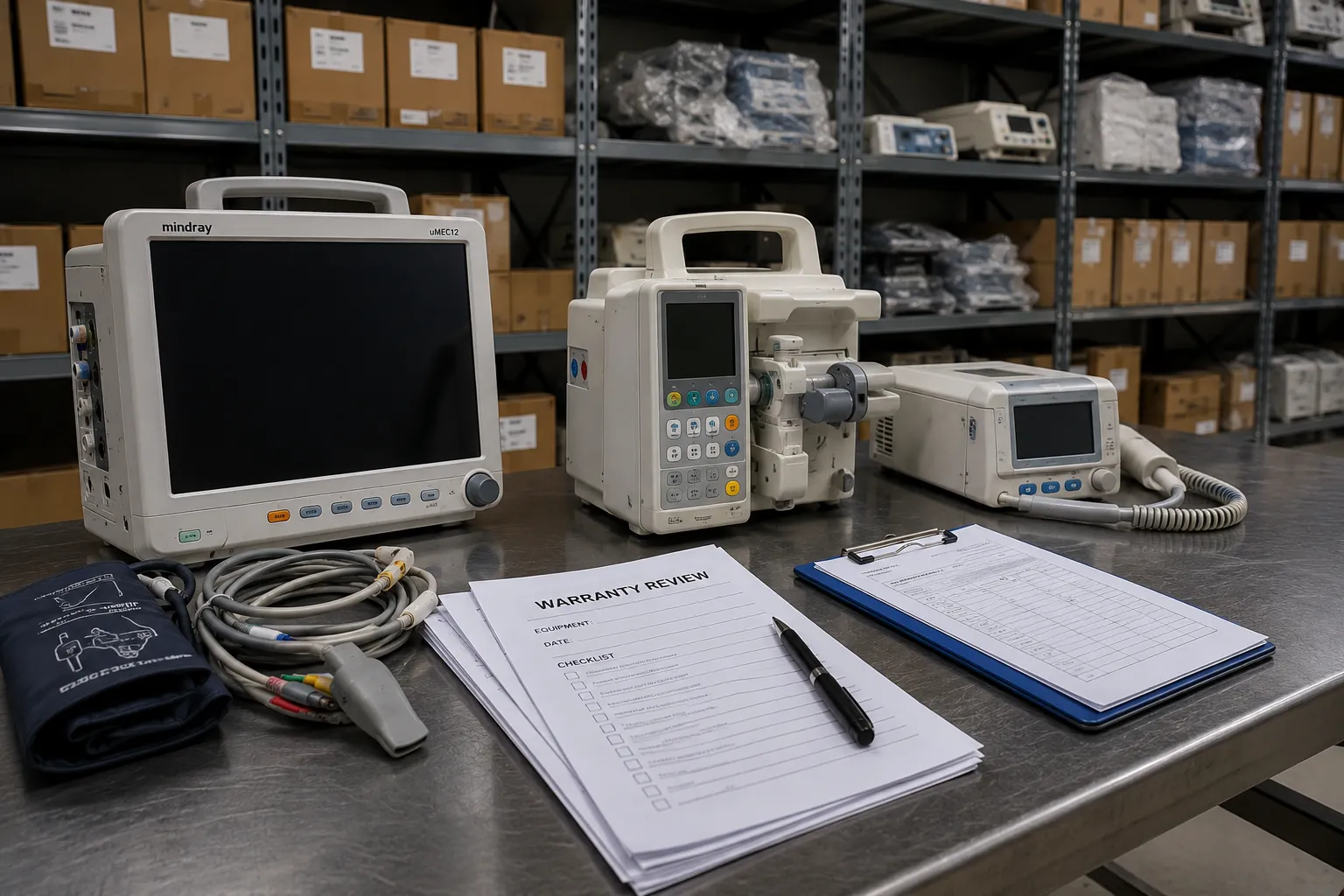
Pre-shipment inspection — High-value equipment may require serial-number checks, configuration confirmation, functional testing and accessory verification.
Site readiness — Rooms, access routes, electrical connections and other utilities should be prepared before delivery.
Commissioning criteria — Define how the equipment will be inspected, tested and accepted after installation.
Clarification control — Revised prices and supplier commitments should be incorporated into the final quotation or contract.
Healthcare teams seeking support with supplier offers can contact the Medigear.uk team for medical equipment quotation comparison. Enquiries should include the equipment category, quantity, intended use, destination and available quotations.
Final approval should reflect technical compliance, complete evaluation of cost, delivery risk, and lifecycle support.
Final thoughts
Medical equipment quotations should be compared as complete clinical and operational packages rather than as headline prices.
Healthcare buyers should first verify the proposed model, technical performance and accessory configuration. Only technically suitable offers should progress to detailed commercial comparison.
Packaging, freight, customs, installation, training, software, warranty and maintenance can create major differences between supplier totals.
A structured evaluation helps healthcare organisations identify missing items, calculate lifecycle expenditure and document why the selected quotation provides the strongest overall value.
Disclaimer
Medigear.uk is a global medical equipment supplier, exporter, and distributor. The content published on this site is intended for educational and product awareness purposes only. Nothing on this page constitutes medical advice, clinical guidance, or treatment recommendations. All healthcare procurement and clinical decisions should be made by qualified medical professionals and compliant procurement teams operating within the regulatory frameworks of their respective countries.