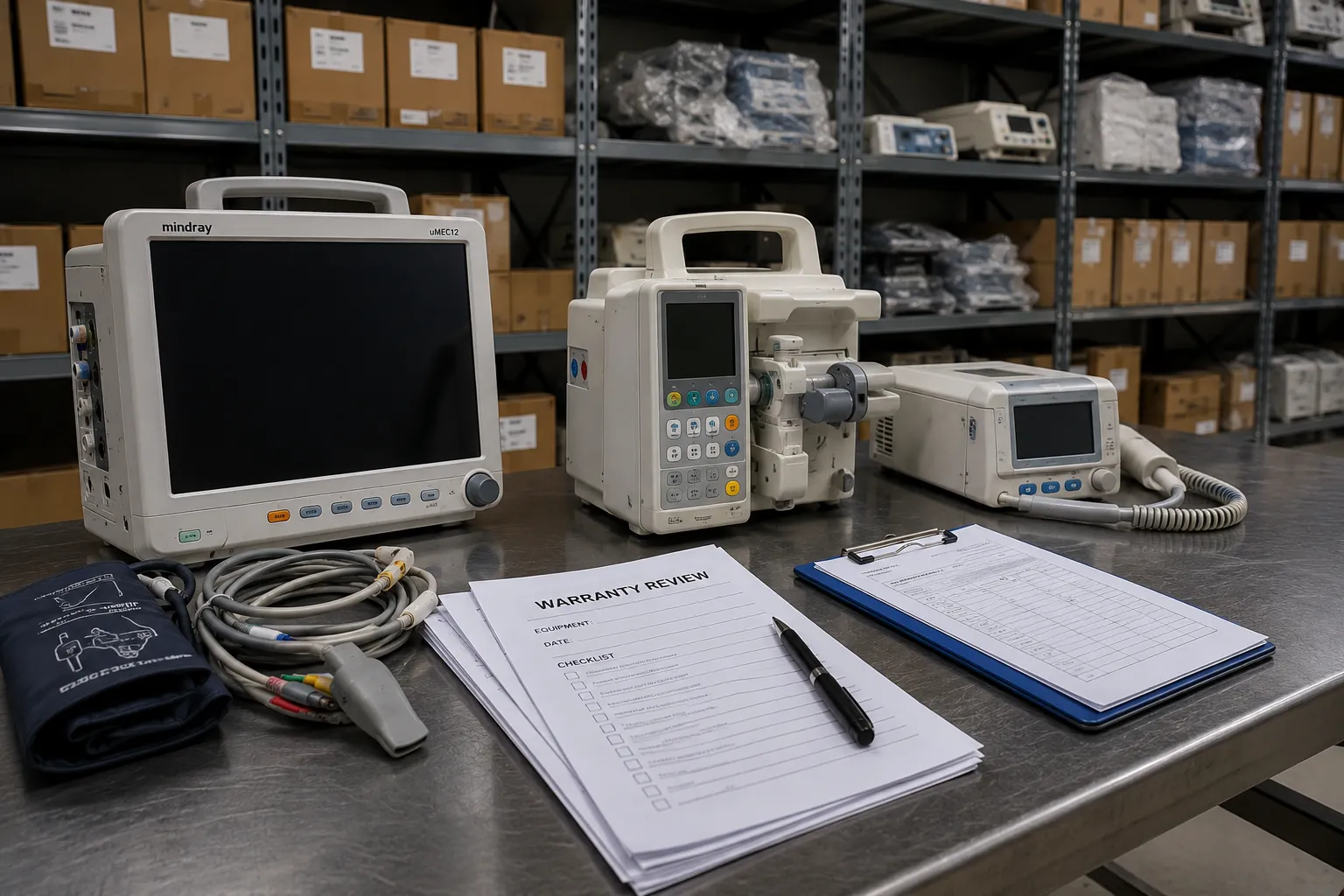
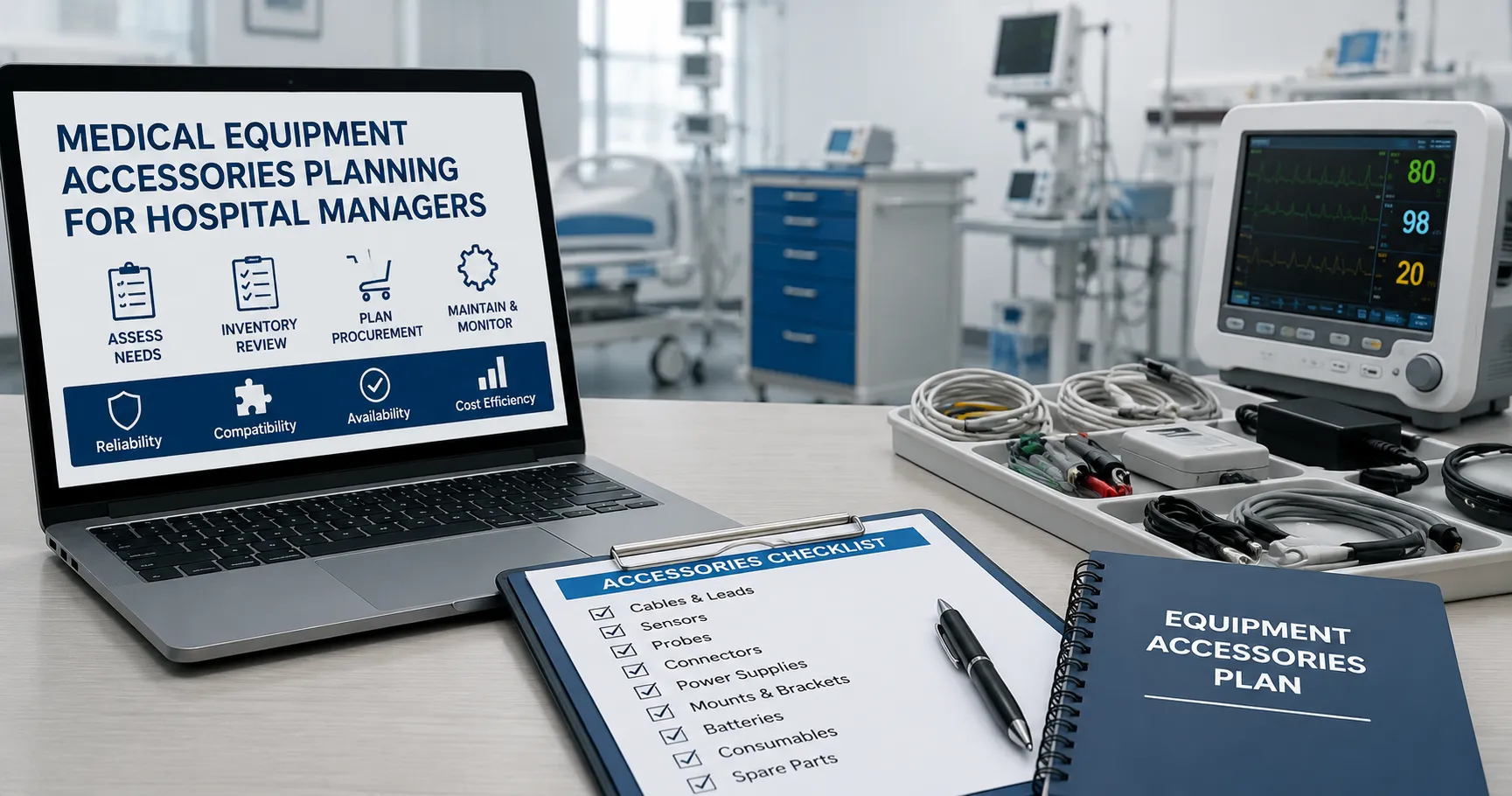
Medical equipment can be installed, tested and technically functional yet remain unavailable because a sensor, cable, battery or mounting component is missing. Accessories are often treated as minor additions during procurement, but they directly affect whether equipment can support routine clinical work.
For hospital and clinic procurement teams, planning medical equipment accessories should begin with the main equipment specifications. Buyers need to identify every item required for installation, patient use, cleaning, charging, transport and maintenance before approving a quotation.
Accessory requirements vary according to equipment type, workload and clinical setting. A patient monitor may require several sensor types, while laboratory equipment may depend on racks, adapters, printers or reagent-handling components.
A structured plan helps hospital managers avoid incomplete deliveries, incompatible replacements and unplanned recurring expenditure. This guide explains how to identify accessory requirements, calculate quantities and maintain reliable availability throughout the equipment lifecycle.
How Accessories Affect Clinical Equipment Readiness
Accessories connect the main device to the patient, the operator, the facility infrastructure, or the clinical workflow. Missing components can reduce performance or prevent the equipment from being used at all.
Complete clinical configuration — Procurement teams should define what is required for the device to perform its intended clinical purpose. This may include patient leads, probes, sensors, tubing, cuffs, foot controls or treatment attachments.
In practice, procurement teams often find that a low quotation covers the main device but excludes several components needed for routine operation.
Correct patient application — Equipment may require different accessory sizes or configurations for adult, paediatric or specialised use. One standard accessory may not support every patient group.
Power and charging support — Batteries, chargers, power cables and adapters should match the device and destination infrastructure. Additional batteries may be required when equipment moves frequently or operates away from a fixed power source.
Mounting and mobility — Trolleys, wall mounts, stands, rails and carrying cases can affect safe placement and movement. These items should be included in room and workflow planning.
Cleaning and turnaround capacity — Reusable accessories may need cleaning or disinfection between patients. Hospitals may require several sets to keep equipment available while other components are being processed.
Backup readiness — Critical accessories can fail due to wear, fluid exposure, or repeated handling. Spare components reduce downtime where immediate replacement is clinically important.
Accessory planning should therefore focus on the complete clinical package rather than the main device alone.
Accessory Requirements Across Healthcare Departments
Each clinical setting uses accessories differently. Hospital managers should review departmental workflows before standardising quantities or configurations.
Critical care and patient monitoring — Monitors may require ECG leads, blood pressure cuffs, temperature probes, oxygen saturation sensors, and mounting systems. Buyers should plan for different patient sizes and replacement intervals.
When working with specialist medical equipment supply networks, procurement teams should confirm whether quoted accessories are original, approved alternatives or optional additions.
Experienced clinical supply managers typically request an itemised accessory schedule rather than accepting the description “standard accessories included.”
Operating theatres and procedure rooms — Surgical equipment may include handpieces, electrodes, foot switches, cables, patient plates, and sterile or reusable attachments. Accessories should match the planned procedures and sterilisation processes.
Diagnostic imaging services — Imaging equipment may require detectors, coils, positioning aids, protective items, workstation accessories, and data storage components. Some accessories may have long replacement lead times.
Laboratory departments — Analysers may require racks, trays, pipettes, barcode readers, printers, sample adapters and quality-control components. Equipment and accessory compatibility should be verified as one system.
General wards and outpatient clinics — Examination devices, vital-sign equipment and treatment systems may require portable stands, reusable cuffs, probes and protective covers. Standardisation can simplify stockholding and training.
Rehabilitation and mobility services — Equipment may use straps, supports, slings, cushions, footrests and positioning components. Sizing and patient-weight limits should be recorded.
Mobile healthcare services — Portable devices may require charging cases, protective bags, vehicle adapters and additional batteries. Transportation and environmental exposure can increase demand for accessory replacement
Departmental accessory lists should be consolidated into one controlled schedule to prevent duplication and inconsistent purchasing.
Technical Compatibility Checks Before Purchasing Accessories
Accessories that appear physically similar may have different electrical, software or performance characteristics. Buyers should not assume that matching connectors confirm safe compatibility.
Manufacturer and model reference — Every accessory should be linked to the exact equipment manufacturer and model. Product codes and approved compatibility information should appear in procurement records.
Connector compatibility — A connector may fit physically while using different wiring or data protocols. Compatibility should be confirmed using formal technical information.
Software and firmware support — Connected accessories may require specific software or firmware versions. Hospitals should understand whether updates affect existing components.
Measurement and performance range — Sensors, probes and cuffs should support the required patient group and clinical measurement range. Inappropriate accessories may reduce accuracy or create unreliable readings.
Material and cleaning compatibility — Reusable accessories should be compatible with approved cleaning products and processes. Repeated chemical exposure can damage cables, seals and sensor surfaces.
Compliance requirements — Accessories should meet applicable local regulatory standards and remain suitable for use with the certified equipment configuration. Unverified substitutions may affect safety, performance or warranty.
Electrical and battery specifications — Batteries, chargers, and adapters should match the required voltage, capacity, chemistry, and protection features. Incorrect components may damage the equipment.
Mounting and load limits — Stands, brackets and rails should safely support the device and accessories. Buyers should check weight limits, locking systems and installation requirements.
Technical compatibility should be confirmed before purchase, not after an accessory fails to operate with the equipment.
How Managers Should Build an Accessory Procurement Plan
The accessory plan should identify initial requirements, recurring replacements and emergency backup quantities. It should remain connected to equipment and members, and meet the expected clinical workload.
Create an itemised accessory schedule — Each main device should have a list of mandatory, optional, reusable and disposable components. Suppliers should quote every item separately.
Review product information carefully — Suppliers and manufacturers advertising to global healthcare buyers should present accurate compatibility, quantity and configuration details. Hospital managers should verify these claims against formal manufacturer documentation before approval.
Calculate quantities by workflow — Accessory quantities should reflect the number of devices, patient turnover, cleaning time and replacement frequency. One accessory per device may not provide sufficient operating capacity.
Separate capital and recurring costs — Initial accessory packages may be part of capital purchases, while batteries, cables, sensors, and consumables constitute recurring expenditure. Both budgets should be approved.
Define minimum stock levels — Frequently used or clinically critical accessories should have reorder points and minimum quantities. Longer supplier lead times may require larger safety stocks.
Control approved alternatives — Where third-party accessories are accepted, the approval process should document compatibility, safety, performance and warranty implications.
Include accessories in quotation comparison — Suppliers should quote identical configurations. Comparing only the main device's price can lead to an inaccurate purchasing decision.
Healthcare groups that repeatedly purchase equipment and accessories may benefit from long-term medical equipment supply partnerships. These arrangements should retain transparent accessory pricing, verified compatibility and measurable delivery performance.
Storage, Inspection and Replacement of Accessories
Accessory management continues after delivery. Poor storage, handling and inspection can create shortages even when purchasing quantities were adequate.
Clear identification — Accessories should be labelled or stored with information linking them to the correct equipment model. Similar-looking items should not be mixed without compatibility controls in place.
Clean and used separation — Reusable accessories awaiting cleaning should remain separate from components ready for clinical use. Equipment status should be clearly visible.
Environmental protection — Sensors, cables, batteries and electronic accessories may require protection from heat, moisture, dust and impact. Manufacturer storage guidance should be followed.
Battery condition control — Rechargeable batteries should be inspected, charged, and replaced according to the manufacturer's guidance. Storage periods and charging cycles can affect capacity.
Routine physical inspection — Staff should check cables, connectors, seals, straps and sensor surfaces for wear. Damaged components should be removed before they affect performance.
Expiry and batch management — Disposable or sterile accessories may have expiry dates and batch information. Stock rotation and traceability should form part of inventory control.
Replacement history — Hospitals should record which accessories fail frequently and why. Repeated damage may indicate handling, cleaning or compatibility problems.
Obsolete accessory planning — Manufacturers may discontinue accessories before the main equipment reaches the end of its service life. Support status should be reviewed during replacement planning.
A controlled accessory inventory helps equipment remain complete and available while reducing emergency purchasing.
International Sourcing and Accessory Supply Risks
International equipment purchases can create accessory shortages when the main device is delivered without a complete supporting package,e or replacement components are difficult to import.
Complete quotation verification — Buyers should confirm whether cables, probes, batteries, mounts, software and starter supplies are included. General wording such as “standard accessories” should be replaced with an itemised list.
Shipping and packaging — Fragile probes, sensors and electronic accessories may require protective packaging. Delivery inspections should check quantities, product codes and physical condition.
Customs classification — Accessories may require separate product descriptions or customs classifications. Documentation should remain consistent with the shipment contents.
Regional availability — Hospitals should determine whether replacement accessories are held locally or require international shipping. Lead times should influence safety-stock levels.
New and refurbished equipment — Professionally refurbished equipment should include compatible, inspected accessories. Buyers should verify whether components are new, refurbished or previously used.
Warranty responsibility — The equipment warranty may not cover every accessory. Coverage, exclusions and replacement responsibilities should be documented.
Supplier change risk — Accessories tied to one supplier or platform may become difficult to source if distribution arrangements change. Alternative sourcing options should be considered before standardisation.
Specialist procurement assistance — Hospital managers planning equipment packages or replacement accessory requirements can submit a medical equipment enquiry to Medigear.uk contact. A useful enquiry should include the equipment model, accessory type, quantity, destination and required delivery period.
International accessory planning should begin before the main equipment ships so that complete clinical configurations arrive together.
Final thoughts
Medical equipment accessories planning helps hospital managers ensure that every device arrives complete, compatible and ready for clinical use. Accessories should not be treated as minor additions after the main purchase has been approved.
Managers should create itemised accessory schedules covering patient-use components, batteries, cables, mounts, reusable items and initial consumables. Quantities should reflect workload, cleaning cycles, replacement rates and backup requirements.
Compatibility must be verified using the exact manufacturer, model and technical documentation. Similar appearance or matching connectors do not provide sufficient evidence.
A controlled accessory plan reduces equipment downtime, emergency purchases and unplanned expenditure. It also supports safer equipment operation and more reliable clinical availability.
Disclaimer
Medigear.uk is a global medical equipment supplier, exporter, and distributor. The content published on this site is intended for educational and product awareness purposes only. Nothing on this page constitutes medical advice, clinical guidance, or treatment recommendations. All healthcare procurement and clinical decisions should be made by qualified medical professionals and compliant procurement teams operating within the regulatory frameworks of their respective countries.