Medical equipment can arrive with damaged packaging, missing accessories, incorrect model numbers or documents that do not match the approved order. Accepting a delivery without structured inspection may make later warranty, insurance or supplier claims more difficult.
For hospital equipment buyers and healthcare managers, delivery inspection should be planned before the shipment reaches the facility. The receiving team should have access to the purchase order, approved quotation, accessory schedule, packing list and agreed acceptance requirements.
Biomedical engineers, receiving staff, healthcare buyers and supplier representatives may need to participate depending on the equipment’s value and complexity. Their responsibilities should be defined before unloading begins.
The purpose of delivery inspection is to confirm that the correct equipment has arrived in acceptable condition with the required accessories and documentation. Installation, safety testing and functional commissioning should follow as separate controlled stages.
Prepare the Receiving Team Before the Shipment Arrives
A successful inspection begins before the delivery vehicle reaches the healthcare facility.
Confirm the expected delivery date — The supplier or logistics company should provide a realistic arrival window. The receiving team should be available during unloading and initial inspection.
In practice, healthcare facilities often experience problems when equipment arrives outside working hours or without biomedical engineering staff present.
Review the approved order — Inspectors should have the final purchase order, quotation, specification and accessory schedule. Older versions should not be used for acceptance.
Obtain the packing list — The packing list should identify the number of packages, equipment descriptions, quantities and accessories included in the shipment.
Assign inspection responsibilities — Receiving staff may check package quantities and visible condition, while biomedical engineers verify models, serial numbers and technical components.
Prepare the inspection area — The area should be clean, secure, dry and large enough to open packages safely. Sensitive equipment should not be unpacked outdoors or in uncontrolled environments.
Arrange handling equipment — Forklifts, pallet trucks, lifting equipment and trained operators may be required for large or heavy devices.
Confirm storage conditions — If immediate installation is not possible, the facility should prepare suitable temporary storage with appropriate temperature, humidity and security.
Prepare documentation tools — Inspection forms, cameras, asset labels and discrepancy reports should be available.
Review claims procedures — The team should understand how quickly visible or concealed damage must be reported to the carrier, insurer or supplier.
Delivery should not proceed without suitable receiving personnel, space and handling resources.
Adapt Inspection Controls to the Equipment and Facility
Inspection depth should reflect the equipment category, clinical risk, shipment route and receiving environment.
Large hospitals and teaching facilities — These organisations may have dedicated logistics, biomedical engineering, and asset management teams. Responsibilities should be coordinated so that no package is accepted without technical verification.
District and regional hospitals — Facilities with limited engineering staff may need advance support from the supplier. When working with trusted international healthcare supply partners, the hospital should confirm whether remote or on-site delivery support is available.
Experienced healthcare supply managers typically request photographs of packed equipment before dispatch, particularly for high-value international shipments.
Community clinics and outpatient facilities — Smaller sites may lack specialised loading areas or storage space. Delivery size, lifting requirements and access routes should therefore be checked in advance.
Laboratories and diagnostic centres — Reagents, calibration materials and temperature-sensitive components may require additional receiving controls.
Surgical and critical care departments — Urgent equipment deliveries may still need formal inspection. Clinical urgency should not remove the requirement to verify identity, condition and accessories.
New hospital projects — Multiple shipments may arrive from different suppliers. A central delivery register can help track packages, rooms, installation status and outstanding discrepancies.
Mobile and remote healthcare services — Equipment may travel through several transport stages. Shock, moisture and environmental indicators require careful review.
Multi-facility healthcare groups — The delivery location should be confirmed before shipment because equipment sent to the wrong site can create handling, insurance and warranty issues.
Inspection procedures should be detailed enough to control risk without causing unnecessary delay.Inspect Packaging Before Opening the Shipment
The external packaging can provide early evidence of poor handling or exposure during transport.
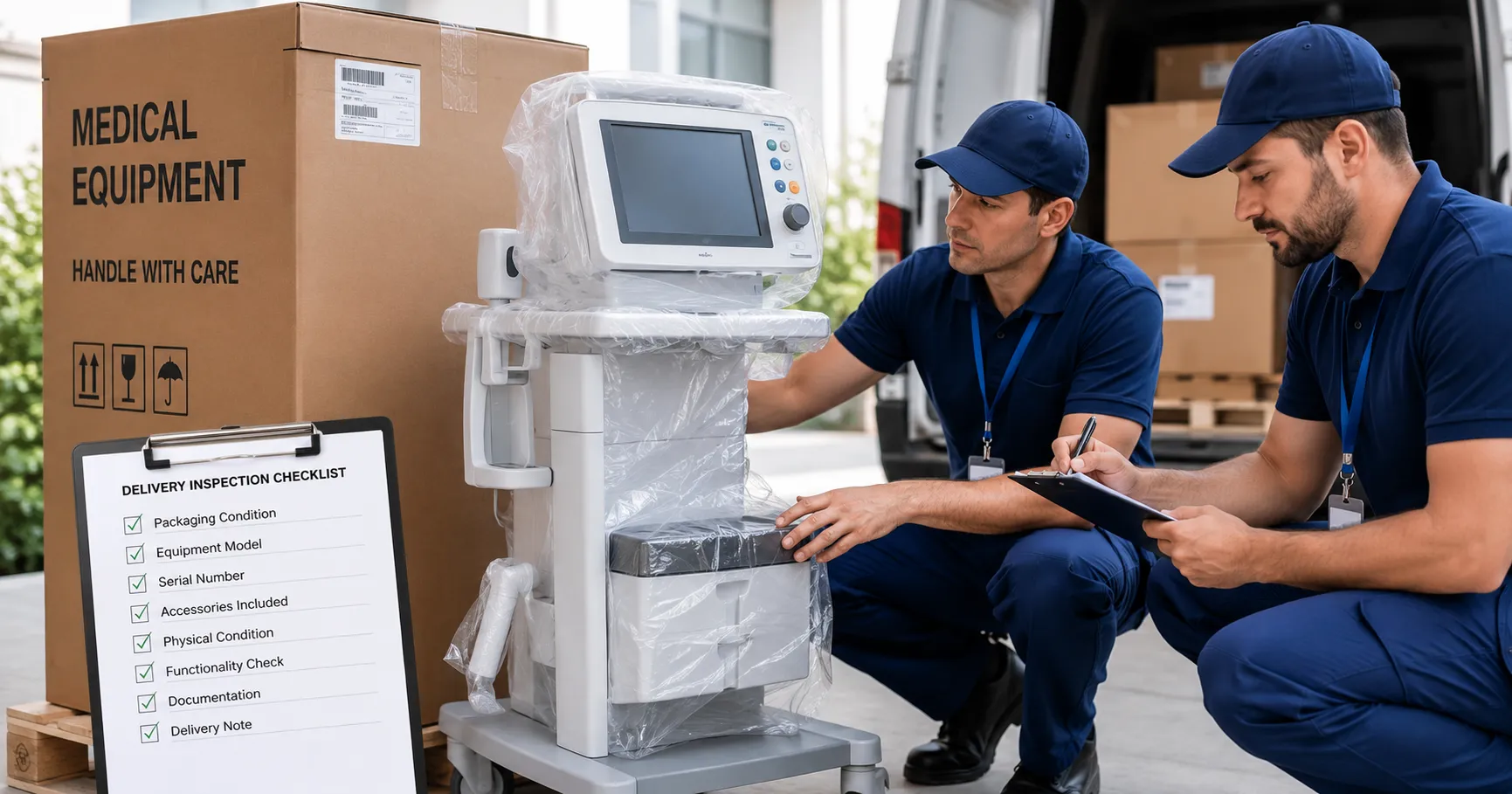
Count every package — Compare the number of cartons, pallets or crates with the packing list and transport documents. Record any missing package before signing.
Check shipping labels — Confirm the consignee, delivery location, package numbers and handling instructions.
Review seals and security tape — Broken seals, replaced tape or signs of opening may indicate that the package was accessed during transport.
Inspect for impact damage — Look for crushed corners, dents, punctures, cracks and damaged pallets. Heavy impacts can affect equipment even when the outer package remains mostly intact.
Check for moisture exposure — Water marks, damp cardboard, mould or damaged moisture barriers may indicate unsafe storage or transport.
Review tilt and shock indicators — Where fitted, record indicator status before moving or opening the package.
Check the crate's condition — Wooden crates should be stable and free of major splits, loose panels or protruding nails.
Look for incorrect stacking — Damage may occur when heavy packages are placed on equipment that should remain upright or unstacked.
Photograph the package — Take clear images of all sides, labels, seals and visible damage before unpacking.
Record carrier observations — If damage is visible, note it on the delivery document before the driver leaves. Avoid signing that the shipment is received in good condition when inspection has identified concerns.
The packaging inspection creates evidence for any later freight, supplier or insurance claim.
Verify Equipment Identity, Documents and Accessories
After external inspection, the team can open the shipment according to the manufacturer’s handling instructions.
Confirm the manufacturer and model — Compare the equipment label with the purchase order, quotation and technical approval. Similar model names may represent different specifications.
Record serial numbers — Serial numbers support warranty registration, asset tracking, service records and future recalls.
Check equipment configuration — Confirm installed modules, software options, ports, batteries and other ordered features.
Compare supplier claims with delivered items — Medical equipment advertisers presenting products to healthcare decision-makers should ensure that advertised and quoted configurations match the delivered product.
Inspect all accessories — Check probes, sensors, patient cables, cuffs, batteries, chargers, trolleys, mounts and starter consumables against the approved accessory schedule.
Confirm quantities — A shipment may include the correct accessory type but fewer units than ordered.
Review expiry dates — Reagents, electrodes, sterile accessories and other dated items should have sufficient remaining shelf life.
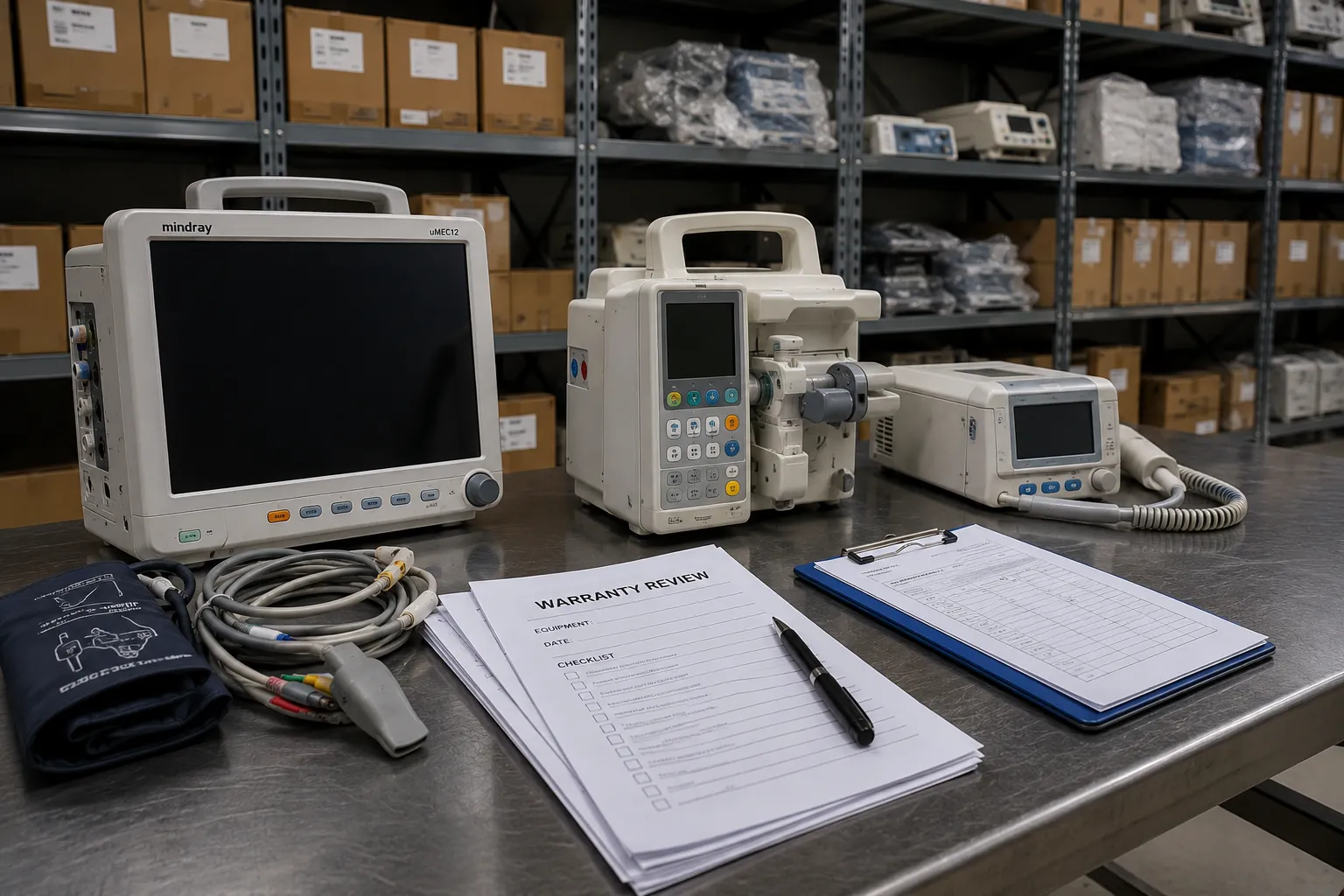
Check documentation — User manuals, installation instructions, conformity records, warranty documents and software information should be present where required.
Verify document consistency — Manufacturer names, model numbers and product descriptions should match across invoices, packing lists, manuals and equipment labels.
Inspect software licences — Licence keys, activation details and interface information should be identified and stored securely.
Healthcare organisations receiving equipment through ongoing programmes may benefit from long-term international equipment supply partnerships. Each shipment should still undergo independent delivery inspection and documented acceptance.
Missing items and inconsistencies should be recorded before the supplier considers the delivery complete.
Record Damage and Control Conditional Acceptance
Not every problem can be identified before unpacking. Concealed damage may only become visible when internal packaging is removed.
Inspect equipment surfaces — Look for cracks, dents, scratches, broken panels, loose components or signs of previous use.
Check displays and controls — Screens, buttons, connectors and switches should be intact. Protective films should not conceal visible damage.
Inspect moving parts — Wheels, brakes, drawers, arms, stands and adjustment mechanisms should move correctly without obvious damage.
Review internal packing — Broken foam, displaced restraints or loose components may indicate impact during transport.
Do not power equipment unnecessarily — Initial energisation should follow the manufacturer’s instructions and may require waiting for installation or environmental stabilisation.
Separate damaged items — Move affected components to a secure area without discarding packaging or labels.
Create a discrepancy report — Record the package number, product, serial number, issue, photographs and immediate action taken.
Notify relevant parties — Inform the supplier, carrier, insurer or project manager according to the agreed reporting procedure.
Use conditional acceptance carefully — If the shipment must remain at the facility, state that acceptance is subject to technical inspection and resolution of documented discrepancies.
Protect claim evidence — Retain packaging, damaged components, delivery notes and photographs until the claim is resolved.
Prevent clinical use — Damaged or incomplete equipment should not enter service until its safety, function and configuration have been verified.
Clear records help distinguish transport damage from manufacturing, installation or later handling issues.
Complete Technical Checks Before Final Acceptance
Delivery inspection confirms what has arrived, but it does not replace installation and commissioning.
Allow environmental stabilisation — Some equipment should reach room temperature before unpacking fully or applying power, particularly after extreme transport conditions.
Confirm electrical compatibility — check voltage, frequency, plugs, power ratings, and grounding requirements before connecting.
Review battery condition — Inspect batteries for damage, swelling, leakage or incorrect type. Charging should follow manufacturer instructions.
Check physical completeness — Verify covers, panels, fuses, filters, wheels, brakes and removable components.
Confirm installation readiness — Rooms, utilities, network connections and access routes should be ready before equipment is moved into position.
Perform authorised safety testing — Biomedical engineers or qualified technicians should complete applicable electrical and safety checks.
Complete functional commissioning — The equipment should be tested against the approved specification after installation.
Verify calibration status — Calibration certificates or initial performance tests may be required before clinical use.
Register the asset — Record manufacturer, model, serial number, location, warranty dates and maintenance requirements.
Confirm warranty activation — Establish whether coverage begins at delivery, installation or commissioning.
Close delivery discrepancies — Missing or damaged items should be replaced, repaired or formally resolved before final acceptance.
Healthcare facilities requiring support with equipment delivery, international sourcing or supplier coordination can submit a medical equipment delivery enquiry to the Medigear.uk contact. The enquiry should include the equipment category, quantity, destination, supplier details and identified delivery issue.
Final acceptance should occur only when the shipment is complete, documented, and ready for controlled installation.
Final thoughts
Medical equipment delivery inspection protects healthcare facilities from accepting damaged, incomplete or incorrectly documented shipments.
The inspection should begin with external packaging and continue through model verification, serial-number recording, accessory checks and document review. Photographs and discrepancy reports should be prepared before packaging is discarded.
Delivery acceptance should remain separate from commissioning. Equipment may appear undamaged while still requiring installation, electrical safety checks, calibration and functional testing.
A structured receiving process improves equipment traceability, supports warranty and insurance claims and helps healthcare teams place the correct equipment into service.
Disclaimer
Medigear.uk is a global medical equipment supplier, exporter, and distributor. The content published on this site is intended for educational and product awareness purposes only. Nothing on this page constitutes medical advice, clinical guidance, or treatment recommendations. All healthcare procurement and clinical decisions should be made by qualified medical professionals and compliant procurement teams operating within the regulatory frameworks of their respective countries.