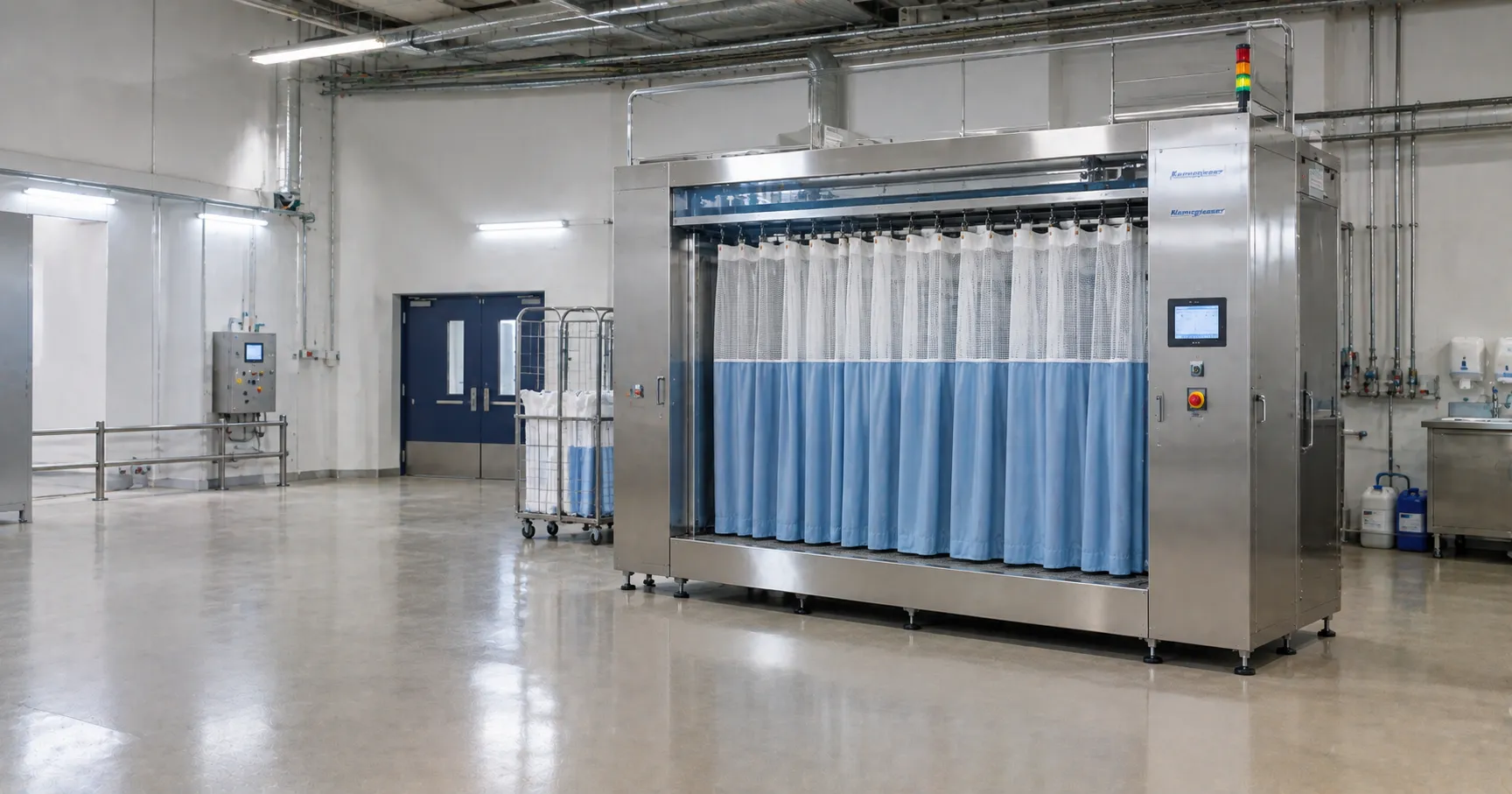
Curtain cleaning systems manage the hygiene of cubicle and privacy curtains, either by replacing disposable curtains on a schedule or by removing launderable curtains for thermal disinfection, so these high-touch fabrics stop acting as a reservoir for micro-organisms. Cubicle curtains are handled by dozens of pairs of hands a day yet changed infrequently, which is precisely why studies repeatedly find them contaminated. A curtain system exists to make changing them routine, tracked and easy rather than an afterthought.
For infection-prevention and procurement teams, the choice between disposable and launderable, and the change regime around it, is a genuine cost and compliance decision. This guide explains the risk, the two approaches, and what to specify.
Why cubicle curtains are an infection risk
A privacy curtain sits at hand height and is grabbed at the leading edge every time someone enters or leaves a bed space, so the same few centimetres of fabric collect hand-transferred organisms all day. Because curtains are out of sight in cleaning schedules and awkward to take down, they are often left up for months, accumulating contamination including organisms of infection-control concern. The curtain then becomes a vehicle: clean hands touch it on the way to a patient. Breaking that chain is the whole point of a managed cleaning system, and it sits within the wider hand-hygiene and cleaning expectations set out by the NHS.
Disposable curtains and the change-by date tab
Disposable curtains are single-use, lightweight fabric or non-woven curtains hung on the existing track an, then taken down and discarded at the end of their life, and replaced with a fresh one. Their defining feature is a date tab: staff write the installation or change-by date on a printed label so anyone can see at a glance whether a curtain is overdue. Many are treated with an antimicrobial agent within the fabric. The appeal is workflow — no laundry logistics, no take-down and rehang of heavy drapes, and an unambiguous visual prompt to change on time. This single-use textile logic mirrors the disposable barriers of surgical draping systems used to build a sterile field.
Launderable curtains and thermal disinfection
Launderable curtains are reusable textile drapes that are taken down, laundered and thermally disinfected — the same 71 °C for 3 minutes (or 65 °C for 10 minutes) parameters used by linen disinfection machines for bed linen — then rehung. They need a stock rotation so replacements go straight up while soiled ones are processed, plus the laundry capacity to handle them. Over many cycles they can be lower-cost per use than disposables, but only if the take-down, laundering and rehang actually happen on schedule rather than slipping.
Antimicrobial fabrics and their limits
Both disposable and reusable curtains are often made from or treated with antimicrobial fabrics that suppress microbial growth on the surface between changes. This slows recontamination but does not remove the need to change curtains — an antimicrobial finish is a supplement to a change regime, not a replacement for it. Treating it as a licence to leave curtains up longer defeats the purpose, and any antimicrobial claim should be understood as a maintenance aid with a defined lifespan, not permanent protection. Fire performance matters just as much: curtains and drapes in healthcare should meet the flammability requirements of BS 5867 Part 2, and the fire rating must be confirmed alongside the infection-control specification.
Setting a curtain change frequency
A curtain system needs a defined change trigger, not just a maximum interval. Curtains are typically changed on a routine cycle (commonly every few months), and always on top of that when they are visibly soiled, when a patient in isolation or with a known infection is discharged, during an outbreak, or when a bed space is deep-cleaned. Building these triggers into ward routine — and making the date visible — is what keeps changes happening rather than drifting. Document the regime so compliance can be audited.
Tracking, colour-coding and audit
Knowing when every curtain was last changed is the practical heart of the system. Date tabs on disposables, colour-coded tags rotated by change month, or a simple ward log all serve the same end: making an overdue curtain obvious to staff and auditors. Some sites colour-code by area or change period so a wrong or expired curtain stands out. Whatever the method, the audit trail turns curtain hygiene from a vague intention into a checkable routine, which is what infection-prevention teams need to demonstrate.
Hooks, tracks and airflow
A curtain system has to fit the estate it hangs in. Most wards use a fixed ceiling track with hooks or universal glides, so replacement curtains — disposable or launderable — must match that spacing or the change becomes a re-fitting job rather than a quick swap. A mesh top panel is often specified so the curtain does not block sprinkler coverage or the ventilation airflow a bay relies on, which matters where the space is designed for a set number of air changes. Controlled airflow is a broader infection-control tool, from ward air changes to the contained flow of a biosafety cabinet in the lab. Getting fit and airflow right at the specification stage means staff can change a curtain in minutes without tools, which is exactly what stops the change regime from slipping.
Matching the approach to the area
Not every bed space carries the same risk, and the curtain approach can follow suit. In isolation rooms, high-dependency areas and any bay managing a known infection, disposables give certainty that a curtain is changed on discharge without waiting for a laundry turnaround, and the discarded curtain removes the contamination entirely. In lower-risk general areas, launderable curtains rotated on a routine cycle can be the more economical option. Deciding this area by area, rather than imposing one system across a whole site, usually delivers both tighter infection control where it counts and lower overall cost across the estate. Where several infected patients are grouped, the curtain regime forms part of the wider spacing measures behind cohort nursing.
Specifying a curtain management system
-
Decide between disposable and launderable based on your laundry capacity, ward workflow, and volume.
-
For disposables, confirm a clear date or change-by tab and antimicrobial treatment within the fabric.
-
For launderable curtains, confirm they withstand thermal disinfection and plan stock rotation for take-down.
-
Check curtains fit your existing track and hook or universal-glide system to avoid re-fitting.
-
Confirm flame retardancy to BS 5867 Part 2 for the healthcare setting.
-
Specify a mesh top section where airflow or sprinkler coverage must not be blocked.
-
Set documented change triggers — routine interval, soiling, isolation discharge and outbreaks — and an audit method.
Disposable versus launderable: the cost comparison
The economics turn on volume and logistics. Disposables carry a recurring purchase and disposal cost but no laundry overhead, no take-down labour and no risk of a change being skipped because the curtain is awkward to remove. Launderable curtains have a higher upfront and laundry cost but can be cheaper per use at scale, provided the rotation is disciplined. Many sites blend the two — disposables in high-risk and isolation areas where certainty of change matters most, launderables elsewhere. The real cost of any curtain system is dominated less by unit price than by whether changes actually occur on time, every time.
Choosing well for curtain hygiene
A curtain cleaning system works when changing curtains is routine, visible and audited — a dated disposable swapped on schedule, or a launderable drape rotated through thermal disinfection without slipping. Match the approach to your laundry capacity and risk areas, confirm the fire and fit requirements, and build change triggers into ward practice. To specify disposable or launderable curtain systems for your wards, speak to the MediGear buyers' team or contact us
Disclaimer
This article is for informational purposes only. It is published by MediGear (medigear.uk) for general information and procurement guidance. It is not clinical, diagnostic, treatment, technical, engineering, legal or regulatory advice, nor a product endorsement, guarantee or substitute for professional assessment. MediGear does not provide medical consultations. Buyers should consult their clinical, biomedical, estates and regulatory contacts, and the manufacturer's documentation, and independently verify all specifications, certifications, compatibility and suitability before purchase. Specifications, certifications and availability are correct at the time of publication and may change without notice. MediGear is a medical-equipment distributor and does not sell medicines or pharmaceutical products.