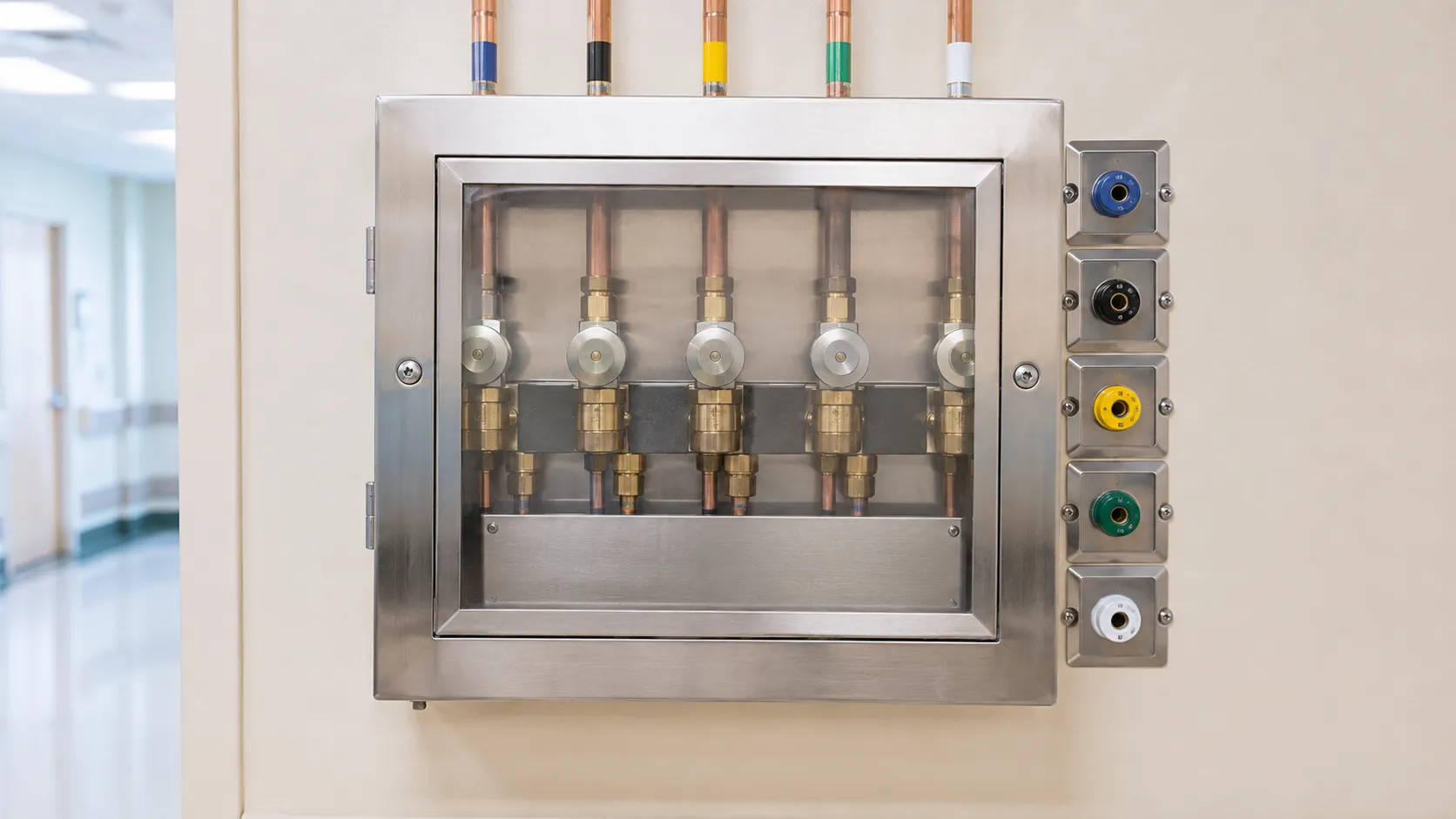
An area valve service unit, or AVSU, is a boxed shut-off assembly that connects a ward or department branch to the main medical gas pipeline and allows that branch to be isolated. Inside a single enclosure, it carries a shut-off valve for each gas service, a pressure indicator or gauge showing the line pressure, and a break-glass or removable front that gives fast access in an emergency. Gas reaches the area's outlet points through the AVSU, so closing its valves cleanly cuts supply to everything downstream.
This guide is about the AVSU as a piece of hardware — what is inside the box, what its pressure indicators tell you, and how a branch pipeline and its terminal units connect through it. It is the physical unit that makes sectioned isolation possible on the ward.
What sits inside the box
An AVSU is more than a valve. Within the enclosure, each medical gas service has its own full-bore ball valve, arranged in a row and clearly labelled and colour-identified for the gas it controls. Alongside the valves, a pressure indicator or gauge for each service shows the pressure on the downstream side, so anyone at the unit can read the state of the supply. The front is a hinged door or a break-glass panel: in an emergency the glass is broken to reach the valve handle immediately, while for planned work the panel is opened in a controlled way.
Pressure indicators and what they tell you
The pressure indicators are what distinguish an AVSU from a plain isolation valve. Each gauge or digital indicator reads the line pressure for its service — for example the oxygen and medical air lines feeding the ward — letting staff confirm at a glance that supply is present and within its normal band before and after any valve operation. During maintenance, the indicators confirm a line has been isolated and, where fitted, vented before work begins. They are a local, immediate check that complements the area alarm panel rather than replacing it.
How the branch connects through the AVSU
The AVSU is the junction between the main pipeline and the area it serves. Upstream, degreased copper pipework from the site distribution main connects to the inlet side of each valve. Downstream, the outlet side carries the gas on to the branch pipework that runs to every terminal outlet in the ward. Because all of the area's gas passes through the unit, the AVSU is the single point at which that whole branch can be opened or closed. The terminal units at each bedspace are the end of that same run, fed through the valves inside the box.
One unit, several gas services
A typical ward AVSU handles the services that the area needs — commonly oxygen, medical air at 4 bar and medical vacuum, with nitrous oxide, surgical air or carbon dioxide added where clinical use requires. Each service is fully independent inside the box, with its own valve and indicator, so oxygen can be isolated without touching vacuum. Specify the service list against the clinical function of the area, because fitting a unit with the wrong combination of gases means either missing a required supply or paying for services that will never be used. The order and grouping of services within the box also matters for clarity: a consistent left-to-right arrangement across a site helps staff find the right valve quickly, and it reduces the risk that someone isolates oxygen when they meant to shut air. Where an area's use is expected to change, it can be worth confirming whether the unit and its pipework allow a service to be added later without replacing the whole assembly.
Construction and materials
AVSU hardware is built for medical gas duty. Pipework and fittings are degreased copper suitable for oxygen service, valves are full-bore ball type for low flow resistance and positive shut-off, and the enclosure is finished for a clinical environment and marked for the gases it contains. The break-glass mechanism has to be reliable — easy to break in an emergency yet secure against accidental operation. Build quality here directly affects both safety and the effort of routine testing, so it is worth examining rather than assuming. The enclosure itself should be sized so the valves and indicators can be operated and read without difficulty, and mounted at a height that suits quick use. Where the same run of wall carries several units, consistent layout and labelling across them reduces the chance of the wrong box being opened under pressure.
AVSU standards and conformity
An AVSU is a component of a medical gas pipeline system and is governed accordingly. Its design, valve arrangement, pressure indication and installation fall under Health Technical Memorandum HTM 02-01 and BS EN ISO 7396-1, and as part of a medical device system it should carry UKCA or CE marking under the UK Medical Devices Regulations with a declaration of conformity. Rather than restating a specification from memory, this overview is assembled from those standards and manufacturer installation data, and buyers should verify current requirements with their authorised person and the guidance published via GOV.UK.
Installation, testing and access
An AVSU is installed and commissioned as part of the pipeline, with each valve and indicator proven beforehand and included in the planned maintenance regime under HTM 02-01. Practical access matters: the unit must be mounted where staff can operate it quickly, kept unobstructed, and clearly labelled so the correct service is closed without hesitation. Because the break-glass and valves are periodically function-tested, consider how easily the panel is opened and reset, and whether spare glass and seals are readily available for the model.
Reading the unit during a real isolation
The value of an AVSU shows in how it behaves during an actual shutdown. To isolate a maintenance service, the relevant valve is closed, and its pressure indicator watched: the reading confirms the valve has sealed and, where a vent is provided, that the downstream line has been safely brought to atmospheric pressure before anyone works on it. Reinstating supply is the reverse — the valve is reopened,d and the indicator confirms the line has repressurised to its normal band before the area is handed back. Because these steps rely on the indicators being accurate and clearly readable, the quality and calibration of the gauges is not a cosmetic detail but part of how safely the unit does its job.
Avoiding accidental and unauthorised operation
An AVSU has to be instantly usable in an emergency yet protected from casual interference, and the design balances the two. The break-glass front resists accidental knocks while breaking cleanly when a handle must be reached fast; valve handles are arranged so the correct service is closed without confusion; and clear per-gas labelling stops the wrong line being isolated under pressure. Siting the unit where it is visible to staff but not in a thoroughfare where trolleys strike it, and controlling who opens it for planned work, keeps the hardware dependable. A unit that is easy to knock, hard to read, or unclear about which valve does what undermines the very isolation it exists to provide.
Specifying an area valve service unit
-
Confirm the exact gas services the unit must carry and that each has its own valve and pressure indicator.
-
Check the pressure indicators are clear, correctly ranged and readable at the mounting height.
-
Verify full-bore ball valves and degreased copper suitable for oxygen service.
-
Confirm the break-glass or access panel is easy to operate in an emergency yet secure against accidental use.
-
Check compliance with HTM 02-01 and BS EN ISO 7396-1 and UKCA or CE marking.
-
Ensure clear, permanent gas labelling and colour identification on the fascia.
-
Confirm the mounting position gives unobstructed access and correct signage.
-
Ask about spare glass, seals and indicator parts, and the testing procedure.
Choosing the right AVSU for the ward
The area valve service unit is the hardware that makes ward-level isolation real: valves to shut each service, indicators to prove the pressure, and break-glass access for the moment it is needed. Match the gas services to the clinical area, insist on the correct standards and clear indication, and check that testing and spares are practical. Buyers comparing AVSU models can use Medigear.uk to review specifications and connect with verified suppliers, or reach the team via the contact page.
Disclaimer
This article is for informational purposes only. It is published by MediGear (medigear.uk) for general information and procurement guidance, and is not clinical, diagnostic, treatment, technical, engineering, legal or regulatory advice, nor a product endorsement, guarantee or substitute for professional assessment. MediGear does not provide medical consultations. Buyers should consult their clinical, biomedical, estates and regulatory contacts, and the manufacturer's documentation, and independently verify all specifications, certifications, compatibility and suitability before purchase. Specifications, certifications and availability are correct at the time of publication and may change without notice. MediGear is a medical-equipment distributor and does not sell medicines or pharmaceutical products.