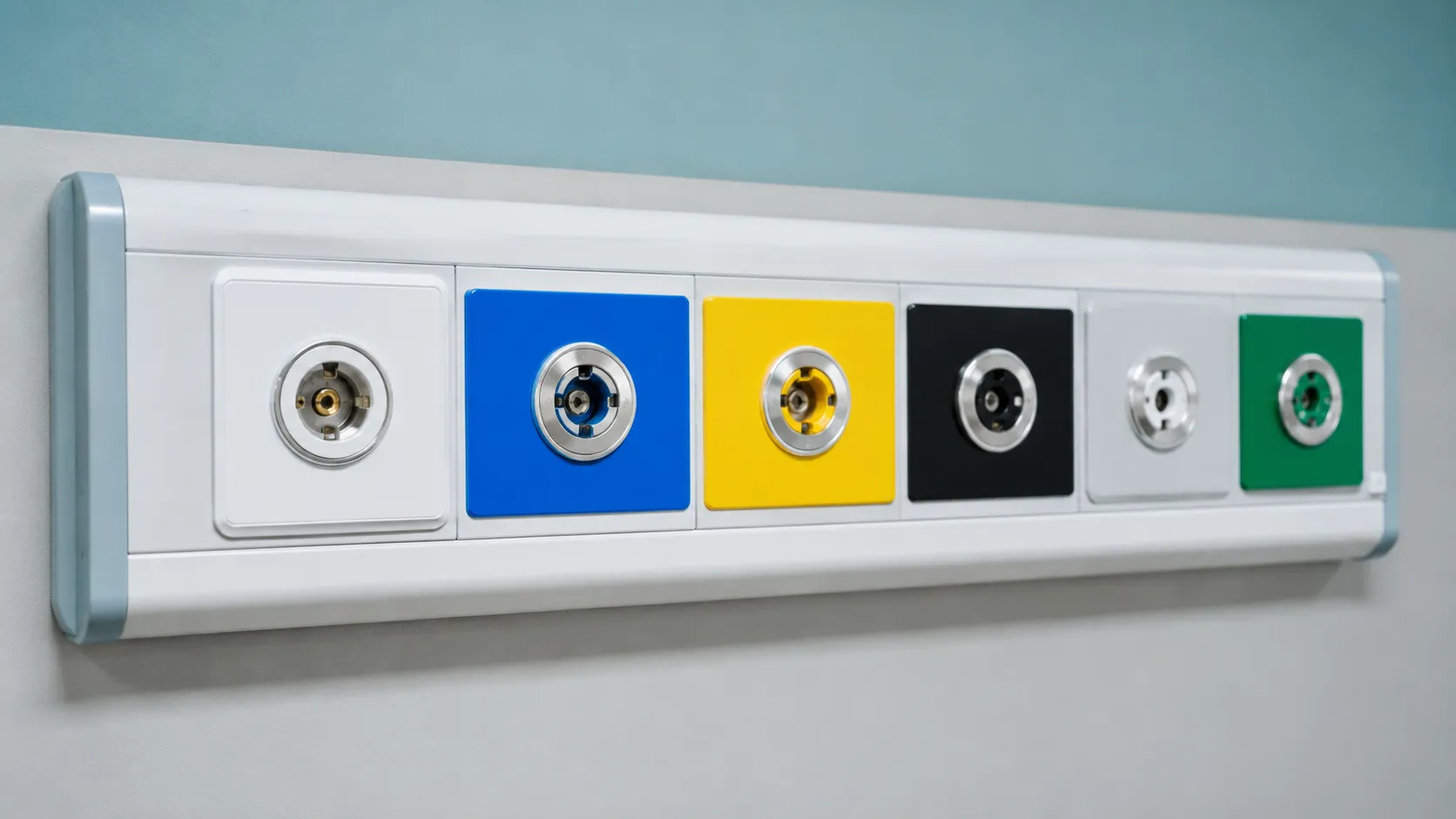
A medical gas outlet point, or terminal unit, is the wall, pendant or bed-head socket where clinical equipment plugs into a hospital's piped gas supply. It is the last component in the pipeline — the point at which oxygen, medical air, nitrous oxide or vacuum is drawn off at the bedside. Each outlet is gas-specific and self-sealing: a probe only fits its matching gas, and the socket shuts automatically when the probe is removed, so gas cannot flow to an empty outlet and equipment cannot be connected to the wrong service.
For procurement and estates teams, the terminal unit is the interface staff use dozens of times a day, so its safety keying, reliability and compatibility deserve real attention. This guide covers indexing, the governing standard, mounting options and what to verify before buying.
Gas-specific indexing that prevents wrong connection
The defining safety feature of a terminal unit is that it is non-interchangeable. Every gas service has a unique probe and socket geometry, so an oxygen probe physically cannot enter a medical air or vacuum outlet. This mechanical keying, not colour or labelling alone, prevents a device from being connected to the wrong gas. Colour coding and gas identification are added on top as a visual aid, but the indexing is the barrier that matters. Because the keying is standardised, equipment from different suppliers connects reliably to the correct service.
The standard that governs terminal units
Medical gas terminal units in the UK are made to BS EN ISO 9170-1, the standard for terminal units in medical gas pipeline systems, which sets out the gas-specific indexing, self-sealing function and performance each outlet must meet. Their installation sits within the wider pipeline framework of Health Technical Memorandum HTM 02-01 and BS EN ISO 7396-1. As part of a medical device system, the units carry UKCA or CE marking under the UK Medical Devices Regulations. This overview is drawn from those published standards together with manufacturer data; because probe systems and requirements vary, buyers should confirm details with the manufacturer and the current guidance from the MHRA.
How a terminal unit works
A terminal unit is built in two parts. A first-fix block is installed with the pipework during construction, connecting to the branch pipe; a second-fix faceplate with the gas-specific socket and self-sealing valve is fitted later. When a probe is pushed in, it opens the internal valve and gas flows; when it is withdrawn, a spring closes the valve and seals the outlet. A one-handed push-to-connect and pull-to-release action lets staff make and break the connection quickly, which matters when equipment is being set up in a hurry. The self-sealing valve is central to safety: because the outlet stays shut whenever no probe is inserted, an unused socket does not leak gas into the room, and a probe pulled out in an emergency seals instantly rather than venting. This behaviour is tested at commissioning and through the unit's life, since a valve that no longer seals cleanly both wastes gas and, for oxygen, raises the local oxygen concentration in a way that should be avoided.
Mounting options across care areas
Outlets are provided wherever gas is needed, and the mounting reflects the setting. On a general ward, they are commonly set into a horizontal bed-head trunking unit alongside power and data. In theatres and critical care they are frequently on ceiling pendants or booms that bring services down to the working height and keep floors clear. Individual flush or surface wall plates suit smaller rooms and refurbishments. The number and mix of gases at each bedspace — how many oxygen, air and vacuum outlets — is a design decision driven by the clinical dependency of the area.
Probe and adaptor compatibility
While the standard defines gas-specific keying, UK healthcare uses more than one probe pattern, and probes are not always interchangeable between systems. Equipment such as flowmeters, suction regulators and ventilators connects through a probe that must match the installed outlet pattern. When buying equipment or replacing outlets, confirm the probe system in use so new items connect without adaptors. Where adaptors are unavoidable, they should be proper medical gas fittings, not improvised connectors. Standardising on one probe pattern across a site simplifies stock and reduces error.
Flow, pressure and downstream equipment
The terminal unit delivers gas at the pipeline distribution pressure — nominally 4 bar for oxygen and medical air — and the device connected to it, such as a flowmeter or regulator, sets the delivered flow to the patient. Vacuum outlets provide the suction source for a regulator and collection jar. Buyers should check that outlets are rated for the flows the clinical area demands, because high-dependency areas can draw significant simultaneous flow, and that the faceplate suits the equipment that will hang from it. Remember that the outlet itself does not regulate flow to the patient; that is the job of the flowmeter or regulator plugged into it. The terminal unit's duty is to deliver the pipeline gas cleanly and to hold the connecting device securely. Hence, a worn socket that lets a probe rock or leak is a genuine problem even if the supply pressure is correct.
Maintenance, seals and infection control
Terminal units are worked hard and are maintained under the operational side of HTM 02-01. The self-sealing valve, seals and probe latch wear with repeated use, so periodic function testing and seal replacement keep the outlet gas-tight and the probe secure. Faceplates must be a wipe-clean clinical surface that tolerates routine disinfection, and a worn outlet that grips a probe poorly or leaks should be serviced promptly. Confirm that service kits and faceplates are supported for the model rather than assuming any part fits.
How many outlets each area needs
Specifying the right number and mix of outlets per bedspace is a clinical-dependency decision, and getting it wrong is expensive to correct once the walls are closed. A general ward bay may need a modest provision of oxygen, medical air and vacuum. At the same time, a critical care bedspace can require several oxygen and air outlets plus multiple vacuum points to run a ventilator, humidification and suction at once. Under-provisioning forces staff to share or improvise; over-provisioning wastes cost and wall space. The safe approach is to base outlet counts on the highest-dependency use the area is intended for, informed by the clinical team, rather than a generic default applied across every room.
Retrofitting and standardising outlets
Replacing or adding terminal units in an existing building brings its own considerations. An older ward may carry a probe pattern that differs from newer equipment. Hence, refurbishment is often the moment to standardise an entire area on one system rather than leave a mix that invites error and complicates stock. Second-fix faceplates can frequently be updated where the first-fix block is compatible, which reduces disruption, but this must be confirmed rather than assumed for the specific model. Planning retrofits with the clinical team, and phasing them so a bay is never left without the outlets it needs, keeps the ward usable while the work proceeds. Consistency across a site pays back every day in fewer connection errors and simpler maintenance.
Before you buy medical gas outlet points
-
Confirm the units meet BS EN ISO 9170-1 with correct gas-specific indexing and self-sealing action.
-
Check the probe pattern matches the equipment and outlets already in use across the site.
-
Decide the number and mix of gas and vacuum outlets per bedspace against clinical dependency.
-
Choose the mounting — bed-head trunking, pendant or wall plate — to suit each area.
-
Verify UKCA or CE marking and a declaration of conformity for the pipeline system.
-
Confirm flow ratings suit the demand in high-dependency areas.
-
Check faceplates are cleanable and validated for your disinfectants.
-
Ensure service kits, seals and spare faceplates are supported for the model.
Getting the bedside connection right
Terminal units are small, but they are where the whole pipeline meets the patient, and their gas-specific keying is a front-line safety barrier. Match the probe system to your equipment, specify the right outlets for each area, and keep them tested and cleanable. Buyers comparing terminal units and bed-head services can use Medigear.uk to review specifications and reach verified suppliers, or contact the team through the contact page for sourcing help.
Disclaimer
This article is for informational purposes only. It is published by MediGear (medigear.uk) for general information and procurement guidance and is not clinical, diagnostic, treatment, technical, engineering, legal, or regulatory advice, nor a product endorsement, guarantee, or substitute for professional assessment. MediGear does not provide medical consultations. Buyers should consult their clinical, biomedical, estates, and regulatory contacts and the manufacturer's documentation, and independently verify all specifications, certifications, compatibility, and suitability before purchase. Specifications, certifications and availability are correct at the time of publication and may change without notice. MediGear is a medical-equipment distributor and does not sell medicines or pharmaceutical products.