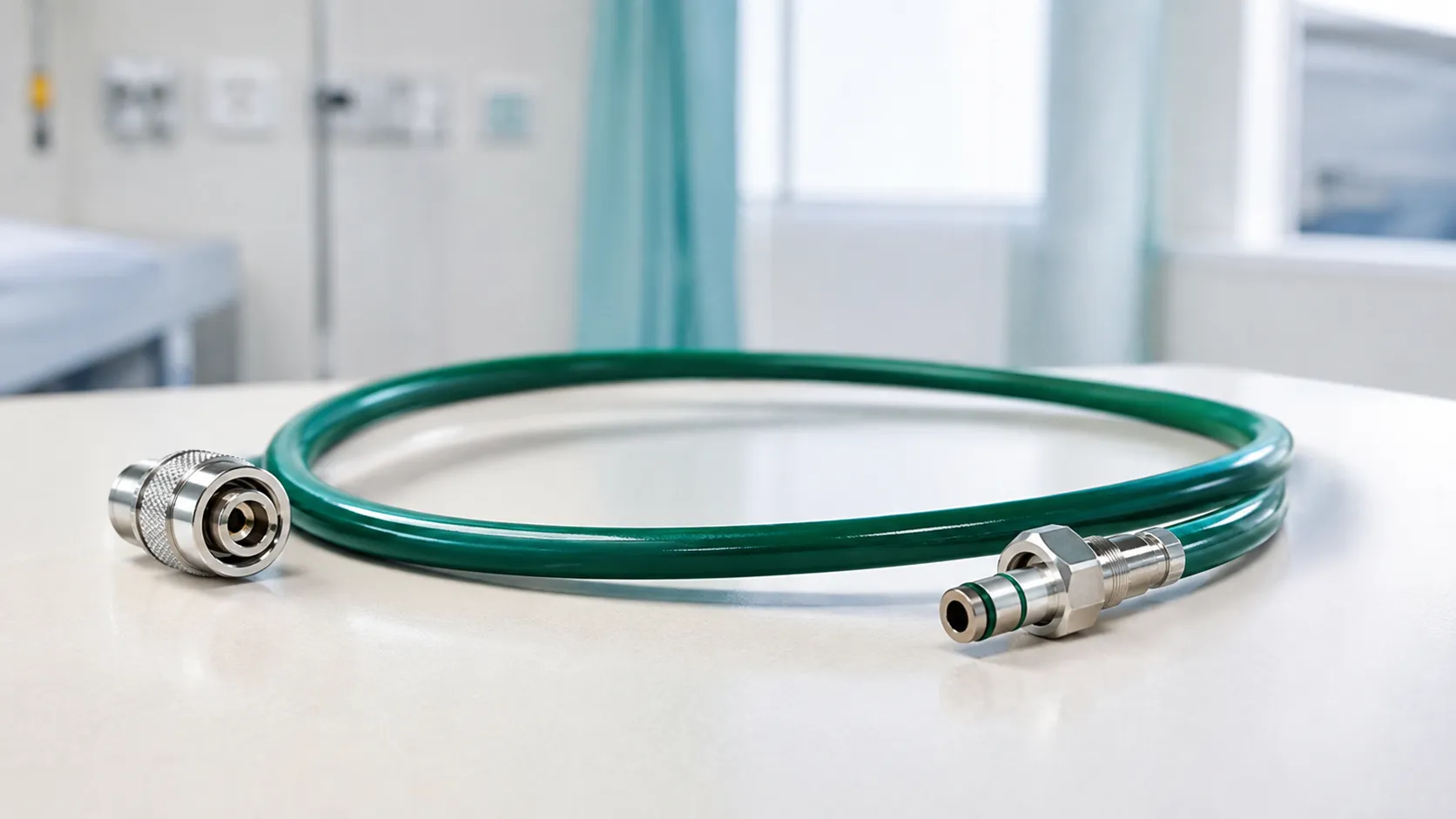
A medical gas hose assembly is the flexible, low-pressure hose that connects a device – a flowmeter, ventilator, anaesthetic machine or suction regulator – to the fixed pipeline at the wall. One end plugs into the terminal unit; the other carries a gas-specific, non-interchangeable connector that mates only with equipment for the same gas. Colour-coded and pressure-rated, it is the removable link between a permanent piped supply and the movable equipment that uses it. Unlike the rigid pipeline buried in the wall, the hose assembly is a consumable-adjacent item that is inspected, tested and replaced on a schedule.
For a buyer, the hose is small but safety-critical. Its whole purpose is to make sure the right gas reaches the right device and cannot be cross-connected, so specifying it correctly is less about price than about matching gas, connector and standard exactly.
How the hose connects at each end
The two ends of a hose assembly do different jobs. The wall end usually terminates in a probe that locks into a self-sealing terminal unit; in the UK these probes follow BS 5682 and are keyed so an oxygen probe fits only an oxygen outlet, and so on for each gas. The equipment end typically carries a NIST connector – a Non-Interchangeable Screw Thread specified in ISO 18082 – whose thread and shoulder geometry differ by gas so a nitrous hose cannot be screwed to an oxygen inlet. This deliberate non-interchangeability is the core safety principle: the hardware itself prevents a wrong connection that a busy person might otherwise make.
Colour coding by gas
Hoses are colour-coded to make the gas obvious at a glance, reinforcing the mechanical keying. In UK practice, oxygen hoses are white, nitrous oxide blue, medical air black and white, medical vacuum yellow, and carbon dioxide grey, with higher-pressure surgical air identified separately. The colour is an aid, not the safeguard – the non-interchangeable connectors are what actually prevent a mistake – but consistent colour helps staff spot a hose routed to the wrong device before it is ever connected. When ordering, specify the gas and the colour together to avoid ambiguity.
Pressure ratings and the standard that governs them
Medical pipelines run at defined pressures: most gases are supplied at a nominal 4 bar (about 400 kPa) at the terminal, while surgical air for powered tools runs higher, and vacuum is a negative pressure. Hose assemblies must be rated for the pressure of the gas they carry, which is why they are matched to the specific service rather than treated as generic tubing. The relevant standard is ISO 5359, which covers low-pressure flexible hose assemblies for use with medical gases, including their connectors, marking, and testing. Buying to ISO 5359 with ISO 18082 NIST connectors is how you know a hose is fit for a medical pipeline and not merely an industrial lookalike.
The connector and colour conventions here are set by ISO 5359 for low-pressure hose assemblies and ISO 18082 for NIST fittings, with UK terminal-unit probes to BS 5682; the wider pipeline sits under HTM 02-01 and MHRA oversight. MediGear draws this together from those references so buyers can match a hose to the exact gas and device.
Materials, antistatic construction and length
The hose itself is a flexible medical-grade tube, commonly reinforced and sometimes antistatic where required, with connectors crimped on by ferrule rather than clamped by hand. Antistatic construction matters in environments where a static discharge would be a concern. Length is a practical decision: too short and equipment is tethered awkwardly to the wall; too long and hoses trail, kink and become a trip and infection risk. Specify the length each application needs, and prefer a smooth, kink-resistant hose that coils tidily and cleans easily, because a hose that is hard to route is a hose that gets abused.
Testing, inspection and replacement
A hose assembly is not fit-and-forget. It is leak- and pressure-tested at manufacture, should be inspected regularly in service for cracking, kinking, perished ferrules or a worn probe, and is replaced on a planned cadence rather than run to failure. Manufacturers state a recommended service life, and estates teams schedule replacement to match. Never allow oil or grease near oxygen fittings, and withdraw any hose whose connector shows wear that could leak or fail to seat. Build the replacement schedule and the cost of periodic renewal into your medical-gas maintenance plan from the outset.
Keeping the hose distinct from the fixed pipeline
It helps to be clear about where the hose sits in the system. The vacuum or gas pipeline, its plant and its terminal units are fixed infrastructure installed and validated to HTM 02-01. The hose assembly is the flexible, replaceable tail that bridges from a terminal unit to a device – and it is distinct again from the suction regulator or flowmeter it feeds. Keeping these boundaries clear matters at procurement: you buy pipeline work as an installed system, but you buy hose assemblies as specified, gas-matched items you will replace over the life of the equipment.
Standards, marking and regulation
A hose assembly is a medical device and should carry UKCA or CE marking, be manufactured to ISO 5359 with ISO 18082 NIST connectors and UK BS 5682 probes, and be traceable to the gas it serves. UK device regulation sits with the MHRA, and the pipeline it connects to is governed by HTM 02-01; general guidance is published at GOV.UK. Ask the supplier for the declaration of conformity, the gas and pressure rating, and the recommended replacement interval, and confirm the connectors exactly match both your terminal units and your devices before ordering in quantity.
Where hose assemblies are used
Hose assemblies appear wherever movable equipment meets a fixed supply. A flowmeter delivering oxygen to a patient connects through one; an anaesthetic machine draws oxygen, nitrous oxide and air through several; a ventilator is fed by gas-specific hoses; and a wall suction regulator connects to the vacuum outlet by the same kind of flexible tail. Each application dictates the gas, the connectors and the length, which is why a hospital rarely buys a single generic hose but instead a small range matched to its equipment. Keeping an accurate record of which hose serves which device makes reordering and scheduled replacement far simpler, and reduces the chance of an incorrect part reaching a critical machine.
Storage, cleanliness and handling in service
Between uses and in stock, hoses need sensible care. They should be stored coiled without tight kinks, kept clean and free of oil and grease – especially anything destined for oxygen service – and protected from being crushed under equipment or trapped in bed mechanisms. In use, route hoses so they are not stretched taut, trodden on or repeatedly flexed at the connector, since that is where fatigue and leaks begin. External surfaces should be wipeable for infection control. Small handling disciplines like these extend a hose's service life and mean it reaches its planned replacement date in sound condition rather than failing early, which protects both budget and safety.
Specifying a medical gas hose assembly
-
State the gas and match the colour code so ordering is unambiguous.
-
Confirm the wall-end probe fits your BS 5682 terminal units.
-
Confirm the equipment-end NIST connector (ISO 18082) matches your device inlets.
-
Check the hose is rated for the correct pipeline pressure for that gas.
-
Require manufacture to ISO 5359 and UKCA or CE marking with a declaration of conformity.
-
Specify antistatic construction where your environment requires it.
-
Choose a length that avoids both tethering and trailing, and a kink-resistant hose.
-
Agree the recommended replacement interval and build renewal into maintenance costs.
Getting the connection right
A medical gas hose assembly does one job supremely well: it delivers the right gas to the right device and makes the wrong connection physically impossible. That safety depends entirely on matching gas, connector, pressure and standard when you buy – and on replacing hoses before they wear out. Specify to ISO 5359 with the correct BS 5682 and NIST connectors, confirm the fit both ends, and plan renewal, and the hose becomes the reliable, invisible link it should be. If you are matching hose assemblies to existing terminal units and devices, our team can help you get the specification exactly right. Contact us through the MediGear contact page or list your requirements via MediGear for buyers.
Disclaimer
This article is for informational purposes only. It is published by MediGear (medigear.uk) for general information and procurement guidance, and is not clinical, diagnostic, treatment, technical, engineering, legal or regulatory advice, nor a product endorsement, guarantee or substitute for professional assessment. MediGear does not provide medical consultations. Buyers should consult their clinical, biomedical, estates and regulatory contacts, and the manufacturer's documentation, and independently verify all specifications, certifications, compatibility and suitability before purchase. Specifications, certifications and availability are correct at the time of publication and may change without notice. MediGear is a medical-equipment distributor and does not sell medicines or pharmaceutical products.