
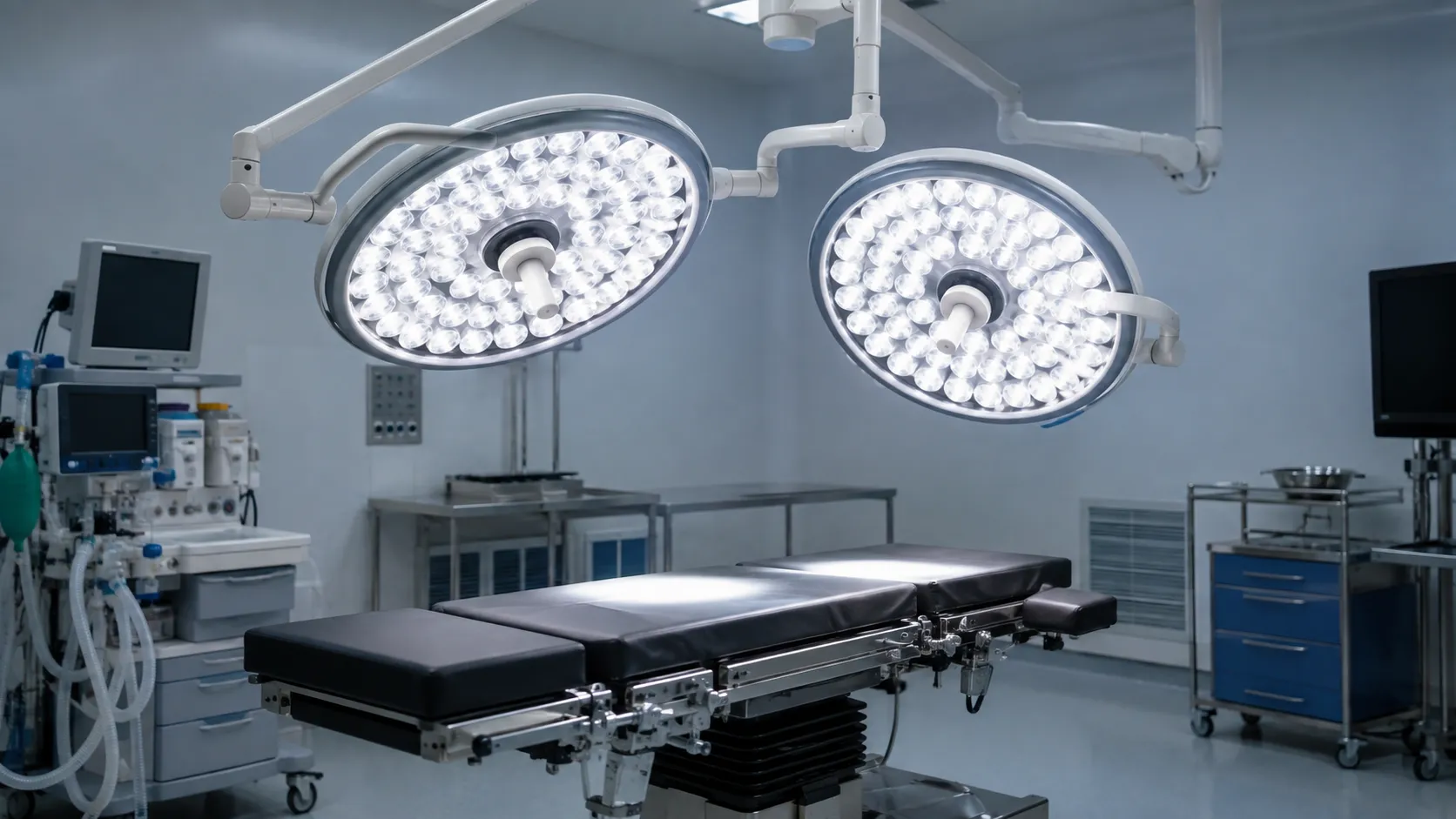
What are operating theatre lights?
Operating theatre lights, or surgical luminaires, are high-intensity, colour-accurate lights that illuminate the surgical field without casting shadows on the surgeon's hands or instruments. They deliver a bright, focused pool of light with true colour rendering and, critically, control shadows so the site stays clearly visible however staff and equipment move around it. A modern theatre light is an engineered optical instrument, not a bright lamp, and the way it manages illuminance, shadow, colour and heat is exactly what a buyer is paying for.
The governing standard is BS EN 60601-2-41, the standard for the particular requirements for the safety and performance of surgical luminaires, and it frames almost every specification worth comparing. This guide explains those specifications so that a procurement or theatre team can judge one luminaire against another based on more than just brightness.
Illuminance and why more is not simply better
Central illuminance – the light delivered at the centre of the field at a set distance – is the headline figure, and surgical lights reach very high levels, with BS EN 60601-2-41 setting a maximum central illuminance of 160,000 lux. That ceiling exists because excessive light causes glare and, with older technology, heat. What matters as much as peak output is that the light is adjustable: surgeons dim and brighten to suit the tissue and the task, so a smooth, wide dimming range and a stable output at every level are more useful than a single big number. Look at the usable range, not just the maximum.
Shadow control and the shadowless field
The defining trick of a surgical light is shadow dilution. Hands, heads, and instruments block light and cast shadows; a well-designed luminaire fills those shadows from multiple directions, keeping the field evenly lit. This is achieved with multiple LED clusters or reflector segments arranged across the light head, each casting light from a slightly different angle, so that if one path is blocked, others still reach the site. Some systems maintain illumination even when much of the head is obscured. When comparing luminaires, ask how shadow dilution is achieved and how the light performs with realistic obstruction, not just with a clear path.
Colour temperature and colour rendering
Seeing tissue accurately depends on the colour of the light. Colour temperature, measured in kelvin, falls within a daylight-like range (typically 3,500 to 5,000 K), and some luminaires allow the surgeon to adjust it. More important clinically is the colour rendering index (CRI, or Ra): a high CRI means colours appear true, which helps distinguish tissue types and perfusion. The R9 value, which renders deep reds, deserves particular attention in surgery because much of the field is red tissue and blood. A luminaire with a high Ra but poor R9 can still make the field hard to read, so ask for both figures.
The illuminance and colour-rendering figures here are framed by BS EN 60601-2-41, the particular safety standard for surgical luminaires, alongside the general IEC 60601-1 electrical requirements, with UK device regulation resting with the MHRA. MediGear's role is to help theatres compare luminaires against these criteria, not to endorse one make.
LED versus halogen
Modern surgical lights are almost universally LED, and for practical reasons. LEDs run far cooler than the halogen lamps they replaced, which reduces the drying of exposed tissue and the heat load on staff working under the light for hours. They last for many thousands of hours – typically tens of thousands – so lamp changes mid-list are rare, and they draw less power. They also allow features halogen could not, such as adjustable colour temperature and instant, flicker-free dimming. For a buyer replacing older halogen heads, the lower heat, longer life, and reduced maintenance usually justify LEDs based on total cost of ownership alone.
Sterilisable handles and the sterile field
Surgeons reposition the light themselves during a procedure, so the central handle must be usable within the sterile field. Look for a removable, sterilisable handle that can be autoclaved between cases, or a system that accepts single-use sterile handle covers. Confirm the sterilisation method and cycle the handle tolerates, how many handles come with the light, and the ongoing cost of covers if disposables are used. A handle that is awkward to remove or slow to reprocess becomes a daily source of friction, so treat it as a genuine specification rather than an accessory.
Field size, focus and depth of illumination
Beyond brightness, the shape of the light matters. An adjustable light-field diameter lets the surgeon match the lit area to the incision, concentrating light where needed. Depth of illumination describes how far the light remains useful within a cavity – important for deep surgery – and is often expressed as the rate at which illuminance falls with distance. Some luminaires focus manually, others electronically. For minimally invasive work, an endoscopic or low-level mode reduces glare on monitors. Match these capabilities to the procedures your theatres run, because a general-surgery list and a deep-cavity backup have different needs.
Mounting, configuration and backup power
Theatre lights are usually ceiling-mounted on spring-balanced arms as single, double, or triple-satellite arrays, letting staff position several heads around the field; mobile, backup, or standing units suit clinics, minor-ops rooms, and backup. Because a light-failure backup procedure is unacceptable, theatres require a reliable backup power arrangement to ensure illumination continues during a mains interruption – confirm how the theatre's emergency supply supports the luminaire. Many heads also integrate a camera for teaching and records; if that matters, check the integration rather than assuming it. Ceiling mounting is an installation project, so involve estates early.
Standards, regulation and servicing
A surgical luminaire is a medical device built to BS EN 60601-2-41 and the general IEC 60601-1 electrical safety requirements, and it should carry UKCA or CE marking with oversight from the MHRA; further guidance is available on GOV.UK. Servicing covers the arm mechanics, electrical safety testing and, occasionally, LED modules or drivers. Ask about warranty length, LED module life, spares availability, and the recommended service interval, and confirm that the tested performance figures – illuminance, CRI, R9, and shadow behaviour – are stated against the standard rather than quoted loosely.
Heat, energy and theatre comfort
The heat and light a light casts on the field and the staff below are easy to overlook yet important in practice. Older halogen luminaires radiated significant heat, drying exposed tissue over the course of a long procedure and adding to the discomfort of a gowned team working directly beneath. LED heads cut that radiant heat markedly, which is better for tissue and for the surgeons and scrub staff who stand under the light for hours. Lower power draw also eases the load on theatre electrical and cooling systems. When you weigh models, ask about the radiant heat delivered to the field as well as illuminance, because a cooler light of equal brightness is the more comfortable and clinically kinder choice.
Positioning, drift and manoeuvrability
A light that will not stay where it is put is a constant irritation in a live procedure. The spring-balanced arm should let staff move the head easily and then hold position without drifting, even after years of use, so ask about the arm mechanism, its range of movement and how it resists sagging over time. The head should rotate and angle enough to light the field from the directions a procedure demands without colliding with other pendants or a second light head. On multi-head arrays, check that the arms reach their intended positions together without fouling, and that a single person can reposition a head smoothly, one-handed, on the sterile handle.
Choosing an operating theatre light
-
Confirm central illuminance and the usable dimming range within the 160,000 lux BS EN 60601-2-41 ceiling.
-
Ask how shadow dilution is achieved and how the field performs under realistic obstruction.
-
Check colour temperature, CRI (Ra) and especially the R9 deep-red rendering.
-
Confirm a removable sterilisable handle or single-use covers, and the sterilisation method.
-
Check the adjustable field diameter, illumination depth, and any endoscopic mode.
-
Match the mounting (single, dual, or triple array backup mobile) to the room and workload.
-
Confirm a reliable backup power arrangement for the luminaire.
-
Verify UKCA or CE marking, LED module life, warranty, spares and service interval.
Lighting the field with confidence
A good operating theatre light is judged not by how bright it is but by how clearly and truly it shows the field, how well it fills shadows and how easily surgeons can control it – all of which BS EN 60601-2-41 lets you compare objectively. Weigh illuminance range, shadow control, colour rendering, backup, and sterilisation together. Factor LED life and backup power into the whole-life cost, and you buy a luminaire your theatres can rely on for years. If you are replacing halogen heads or specifying lights for a new theatre, our team can help you compare models against the standard. Reach us via the MediGear contact page, or submit your requirements through MediGear for buyers.
Disclaimer
This article is for informational purposes only. It is published by MediGear (medigear.uk) for general information and procurement guidance. It is not clinical, diagnostic, treatment, technical, engineering, legal or regulatory advice, nor a product endorsement, guarantee or substitute for professional assessment. MediGear does not provide medical consultations. Buyers should consult their clinical, biomedical, estates and regulatory contacts, and the manufacturer's documentation, and independently verify all specifications, certifications, compatibility and suitability before purchase. Specifications, certifications and availability are correct at the time of publication and may change without notice. MediGear is a medical-equipment distributor and does not sell medicines or pharmaceutical products.