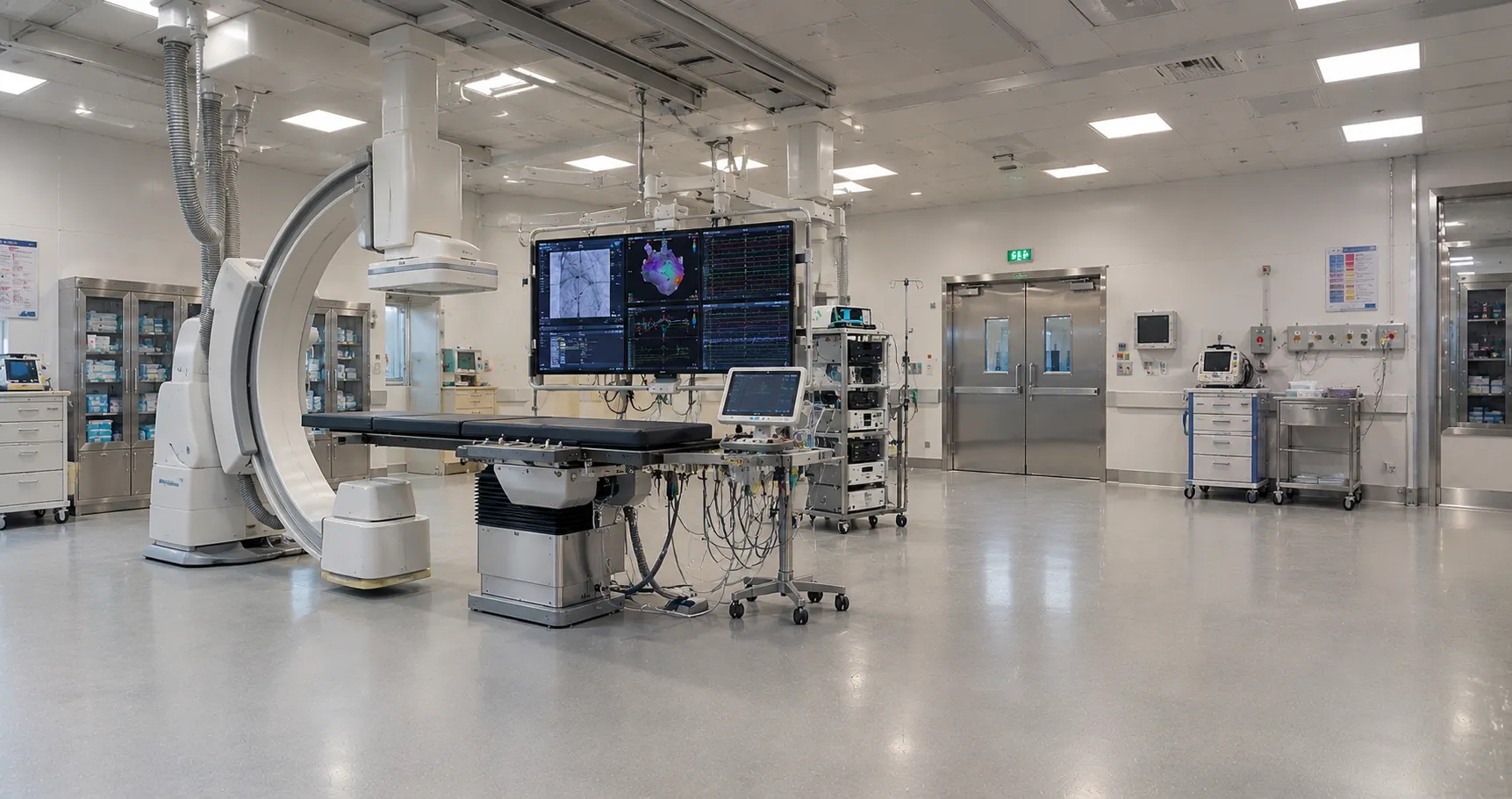
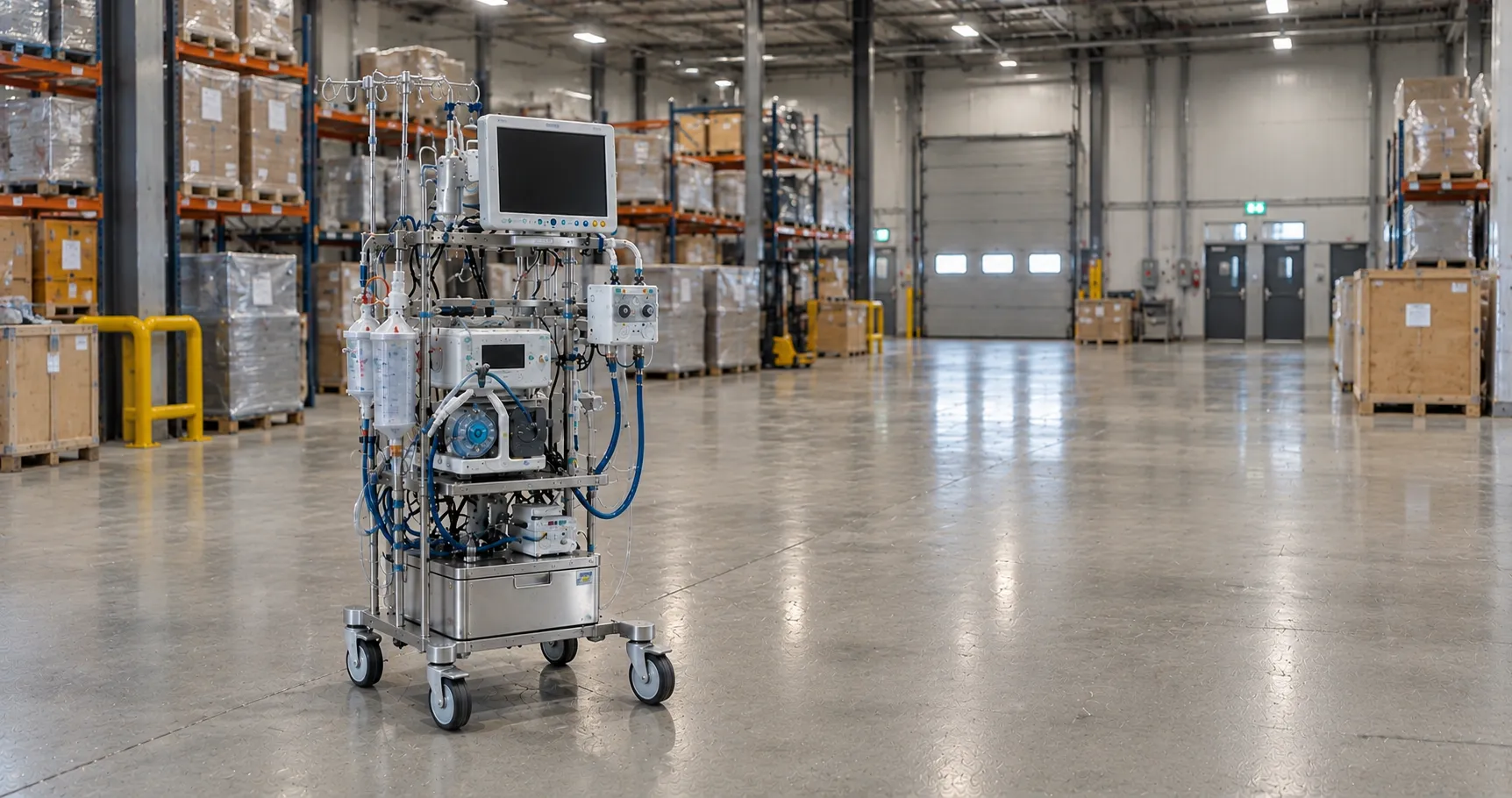
An ECMO machine takes over for failing lungs or a failing heart by drawing a patient's blood out of the body, passing it across an artificial membrane that adds oxygen and removes carbon dioxide, then pumping it back in warmed and reoxygenated. ECMO stands for extracorporeal membrane oxygenation, and in a UK intensive care unit an ECMO machine is prolonged life support that can run for days or even weeks while the underlying illness is treated. That is the key point for anyone specifying one: it is critical-care equipment, not a theatre bypass procedure.
Because it runs continuously at the bedside rather than for a couple of hours in an operating room, an ECMO machine is bought, staffed and serviced very differently from a surgical pump. The buyer is commissioning a small life-support programme: a console, a disposable circuit for every patient, and a rota of trained specialists around it.
Life support in the ICU, not a theatre procedure
The setting shapes everything. A team deploys an ECMO machine when a patient is so sick that a ventilator alone cannot keep their blood oxygenated, or when the heart cannot maintain circulation. There is a realistic prospect of recovery or a bridge to another treatment. Severe ARDS, refractory respiratory failure and cardiogenic shock are the common reasons a unit reaches for one. Referral into an ECMO centre often follows agreed critical-care pathways, and the NHS commissioned respiratory ECMO service concentrates the sickest respiratory patients in a handful of designated centres. A buyer at one of those centres is planning for continuous, round-the-clock running rather than scheduled lists.
VV versus VA: two ways to configure an ECMO machine
How an ECMO machine is plumbed into the patient defines what it can do. Veno-venous (VV) ECMO drains and returns blood to the venous system; it supports only the lungs, oxygenating the blood while the patient's own heart still pumps. Veno-arterial (VA) ECMO drains from a vein and returns to an artery, so it supports both heart and lungs and provides a mechanical circulation. VV is the mainstay for respiratory failure; VA is used when the heart is also failing. A console you buy should support both configurations, because a patient can deteriorate and need to be switched, and the cannulation strategy has to follow the clinical picture.
The membrane oxygenator and centrifugal pump at the heart of it
Two components do the real work. A centrifugal pump spins to move blood without the crushing action of older roller pumps, which matters over the long run because it is gentler on blood cells. A hollow-fibre membrane oxygenator then acts as the artificial lung: blood flows on one side of thousands of microporous fibres while a blended oxygen supply flows on the other. Gas exchange occurs across the membrane. A heat exchanger built into the oxygenator keeps the returning blood at body temperature. The oxygenator is a single-patient disposable with a rated service life, and its gas-transfer performance and resistance to plasma leakage over many days are what separate a good circuit from a marginal one.
Cannulation and keeping the circuit safe over days
Access is through large-bore cannulae placed in the femoral or jugular vessels, sized to the patient's flow needs. Once running, the circuit demands constant vigilance: systemic anticoagulation to prevent blood clotting on the foreign surfaces, monitoring pump speed and blood flow, and watching for air, clots, or a drop in the oxygenator's efficiency. Clinicians change circuits and oxygenators if they clot or degrade, so a long ECMO run requires more than one disposable set. This continuous, high-acuity workload is why you can't judge an ECMO machine on purchase price alone.
Adult, paediatric and neonatal circuits
An ECMO machine is not one size. Adult respiratory and cardiac patients need high-flow circuits and large cannulae. At the same time, paediatric and neonatal ECMO uses much smaller oxygenators, lower priming volumes and finer cannulae to suit tiny vessels and blood volumes. A neonatal circuit that primes with minimal volume matters because diluting a baby's blood is far more consequential than in an adult. If your service covers more than one age group, the console and its consumable range must span that spread, and the manufacturer should offer oxygenators and cannulae rated for the sizes you treat. Getting the sizing wrong forces workarounds mid-run, which is the last thing a critical-care team needs.
Retrieval and moving a patient on ECMO
Many ECMO patients are cannulated and stabilised at a referring hospital before transfer to a specialist centre, so portability is part of the specification. A retrieval service needs a console light and compact enough to travel by ambulance or aircraft, with battery endurance to survive the journey and a hand-crank as a last resort. Transport also demands a secure oxygen supply, cannula fixation that will not dislodge in transit, and staff trained to troubleshoot a circuit on the move. If your centre runs retrieval, weigh transport ruggedness and battery life as heavily as bedside performance.
Weaning and decannulation
Coming off an ECMO machine is a gradual clinical decision, not a switch. As the lungs or heart recover, support is reduced in steps: on VV ECMO the gas flow to the oxygenator is turned down in a trial to see whether the patient's own lungs can cope, while on VA ECMO the pump flow is lowered as the heart takes back the circulation. Only when the patient tolerates minimal support are the cannulae removed; arterial access may then require a short surgical repair. A run rarely ends tidily on a timetable, so staffing and consumable planning must allow for weaning trials and the possibility of resuming support.
Standards and regulation an ECMO machine must meet.
An ECMO Inritain is regulated under the Medical Devices Regulations 2002, with the Medicines and Healthcare products Regulatory Agency (MHRA) overseeing it and handling incident reporting. The console meets the general safety standard for medical electrical equipment, IEC 60601-1, while the disposable oxygenator meets ISO 7199, the standard for extracorporeal blood-gas exchangers. Confirm UKCA or CE marking, the oxygenator's declared maximum run time and the manufacturer's electromagnetic-compatibility statement before anything reaches a patient. This guide is compiled from manufacturer instructions for use and UK regulatory guidance and is written for procurement teams; clinical decisions rest with the ECMO consultant and perfusion staff.
Before you commission an ECMO machine
Treat the console and its ecosystem as one purchase rather than a single box:
-
Whether one console supports both VV and VA configurations and easy conversion between them.
-
The oxygenator's rated maximum run time and its documented gas-transfer performance.
-
Integral battery backup and hand-crank capability for transport and power failure.
-
Disposable circuit cost per patient and typical circuit-change frequency on long runs.
-
Cannula range and sizing to cover adult and, where relevant, paediatric access.
-
Built-in flow, pressure and air-detection monitoring, plus alarm behaviour.
-
Training, competency and 24/7 technical support for a round-the-clock service.
-
UKCA or CE certification, ISO 7199 for the oxygenator and IEC 60601-1 for the console.
The real cost of running an ECMO service
The console is a one-off capital item; the running cost is where the money goes. Every patient needs a fresh circuit and oxygenator; long runs may burn through several, and each case ties up specialist nurses and perfusionists continuously for its duration. Add anticoagulation monitoring, blood products and the transport kit for retrieving patients from referring hospitals. When you compare consoles, weigh disposable pricing, oxygenator longevity and the depth of the vendor's support alongside the headline figure. Lining these total-cost elements up across manufacturers is where a marketplace earns its keep, and buyers can compare verified suppliers through MediGear on like-for-like terms.
The bottom line for buyers
An ECMO machine is one of the most demanding purchases a critical-care unit will make, because you are buying weeks of continuous life support rather than a procedure. Judge it on the oxygenator, the pump, the safety monitoring and the support wrapped around it, not the console price. MediGear is a UK medical-equipment distributor, and we help facilities compare compliant suppliers and their consumables; reach the team through the MediGear enquiry desk when you are ready to scope an ECMO programme.
Disclaimer
This article is for informational purposes only. It is published by MediGear (medigear.uk) for general information and procurement guidance. It is not clinical, diagnostic, treatment, technical, engineering, legal or regulatory advice, nor a product endorsement, guarantee or substitute for professional assessment. MediGear does not provide medical consultations. Buyers should consult their clinical, biomedical, estates and regulatory contacts, and the manufacturer's documentation, and independently verify all specifications, certifications, compatibility and suitability before purchase. Specifications, certifications and availability are correct at the time of publication and may change without notice. MediGear is a medical-equipment distributor and does not sell medicines or pharmaceutical products.