Transport equipment gets judged in corridors, lifts and ambulance bays rather than in a specification document. The height range determines whether transfers are safe. Wheel and brake design decides whether one person can steer a loaded trolley around a corner. Imaging compatibility determines whether a patient moves unnecessarily again.
These ten stretcher and trolley types cover emergency departments, transfers and rescue work. Each entry explains where it fits and what to confirm before purchase.
What matters when the trolley is loaded
Test with weight on. Steering effort, brake holding, height adjustment under load and the effort needed to raise the backrest all change once a patient is on board. A fifth wheel or directional lock transforms handling in long corridors, and it is worth trying before deciding.
Mattress choice deserves separate attention. Patients often remain on emergency trolleys longer than intended, which makes pressure redistribution a real consideration rather than an optional upgrade.
The ten stretcher and trolley types
1. Emergency department trolleys
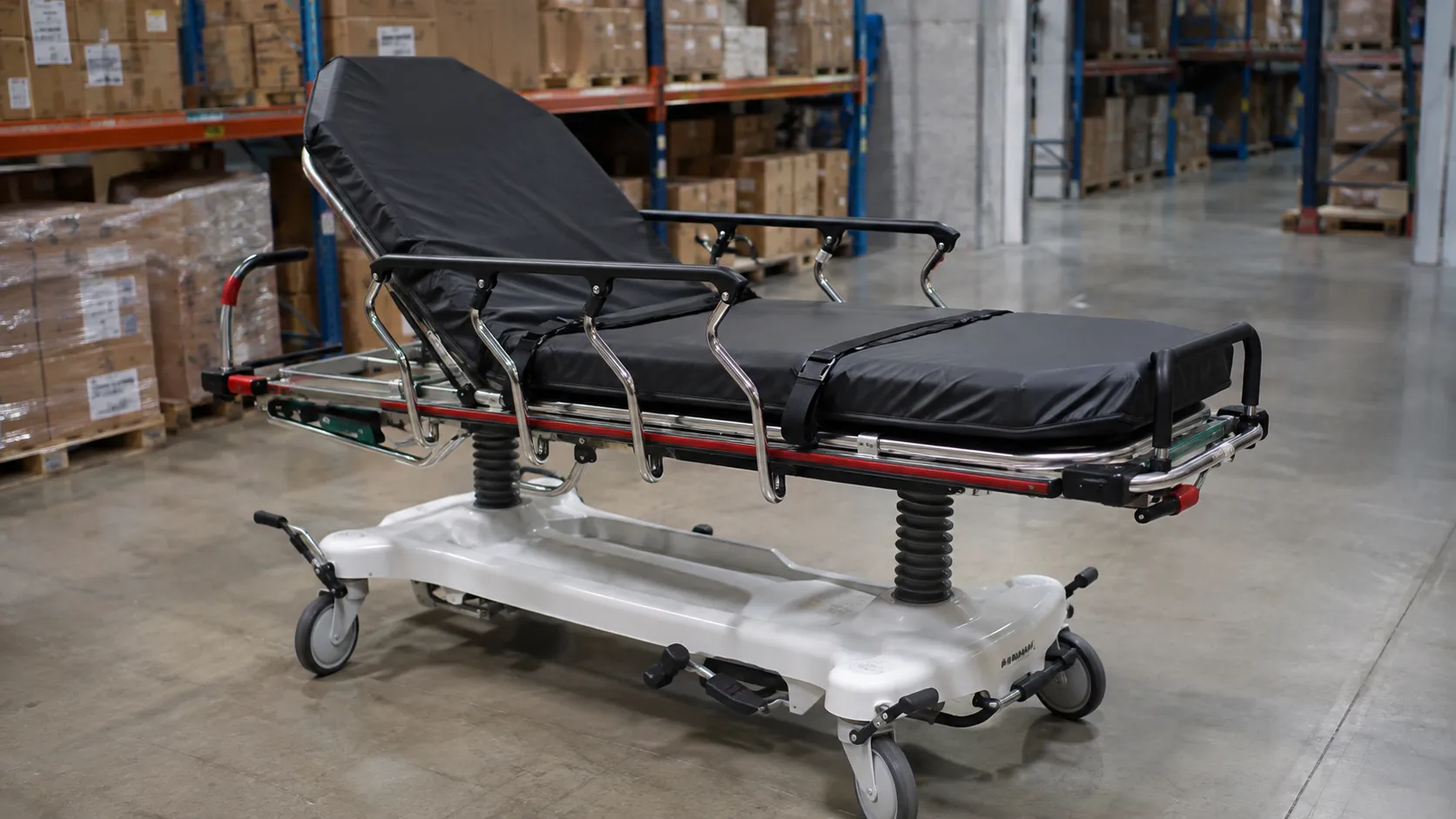
Height-adjustable trolleys with backrest, side rails and accessory mounts—the workhorse of any emergency department.
2. Transfer and transport stretchers
Built for moving patients between departments, with a stable base, secure rails and mounting for equipment carried during the move.
3. Ambulance cots
Designed to lock into a vehicle mounting system. Compatibility with the specific vehicle fixings is the decisive factor.
4. Scoop stretchers
Split longitudinally so they can be assembled around a patient with minimal movement, used for lifting onto a trolley.
5. Basket and rescue stretchers
Rigid enclosed stretchers for difficult terrain or confined space extraction, usually with lifting points.
6. Spinal boards
Rigid boards used for extrication under local protocol, with strapping and head immobilisation accessories.
7. Vacuum mattresses
Conform around the patient when air is removed, providing support during transport over rough surfaces.
8. Folding and portable stretchers
Lightweight stretchers for events, outreach and contingency stock. Setup time and stability under load are the practical measures.
9. Bariatric stretchers
Wider platforms with reinforced frames and higher safe working loads, often with powered assistance for handling.
10. Radiolucent imaging trolleys
Allow imaging without transferring the patient, using a radiolucent top and often a cassette tray. Confirm the usable imaging area against your equipment.
Lifts, corridors and vehicle bays
Measure the route before choosing the equipment. Lift depth, corridor width at the tightest turn, door thresholds, a nd the height of ambulance tail lifts all constrain which trolleys can operate in a given building. A stretcher that fits the department but not the lift creates a daily problem that no amount of training resolves, and these dimensions are far easier to check in advance than to work around afterwards.
What to confirm before ordering
-
Safe working load. Confirm the rating includes accessories, equipment and the mattress.
-
Height range. Check the lowest and highest positions against your beds, imaging tables and vehicle heights.
-
Brakes and steering. Test central braking and any directional lock with a loaded trolley.
-
Mattress. Specify pressure redistribution properties and confirm cleaning compatibility.
-
Accessory mounts—confirm the provision of oxygen cylinders, monitors, pumps, and drip poles.
-
Imaging access. Verify radiolucent area and cassette tray position where imaging on the trolley is expected.
Cleaning, training and maintenance
Turnaround cleaning is a daily reality, so confirm approved agents for the frame, mattress and any covers. Incompatible products crack mattress covers quickly, which then creates an infection prevention problem as well as a replacement task.
Training should cover height adjustment, brake use, safe patient transfer, rail operation and equipment mounting. Include porters and transport staff, not only clinical teams.
For maintenance, agree planned servicing covering hydraulic or powered actuators, brake performance, castor condition, rail security and electrical safety testing where applicable. Confirm mattress replacement supply and spare parts availability, and ensure the organisation receives published device safety alerts so that field safety notices reach the equipment team.
Route dimensions and mattress supply should be checked before any trolley order is signed. Departments replacing an ageing fleet can raise those details with the team at Medigear.uk.
Final thoughts
Choose stretchers around the journeys they make. Emergency departments need height-adjustable trolleys with pressure-redistributing mattresses and imaging access; transport services need equipment matched to their vehicles; rescue work needs purpose-built devices. Test loaded handling before committing, and settle mattress supply and servicing before delivery.
This article provides general procurement guidance for healthcare organisations. It is not clinical advice and does not replace manufacturer instructions, training or local transfer policy.