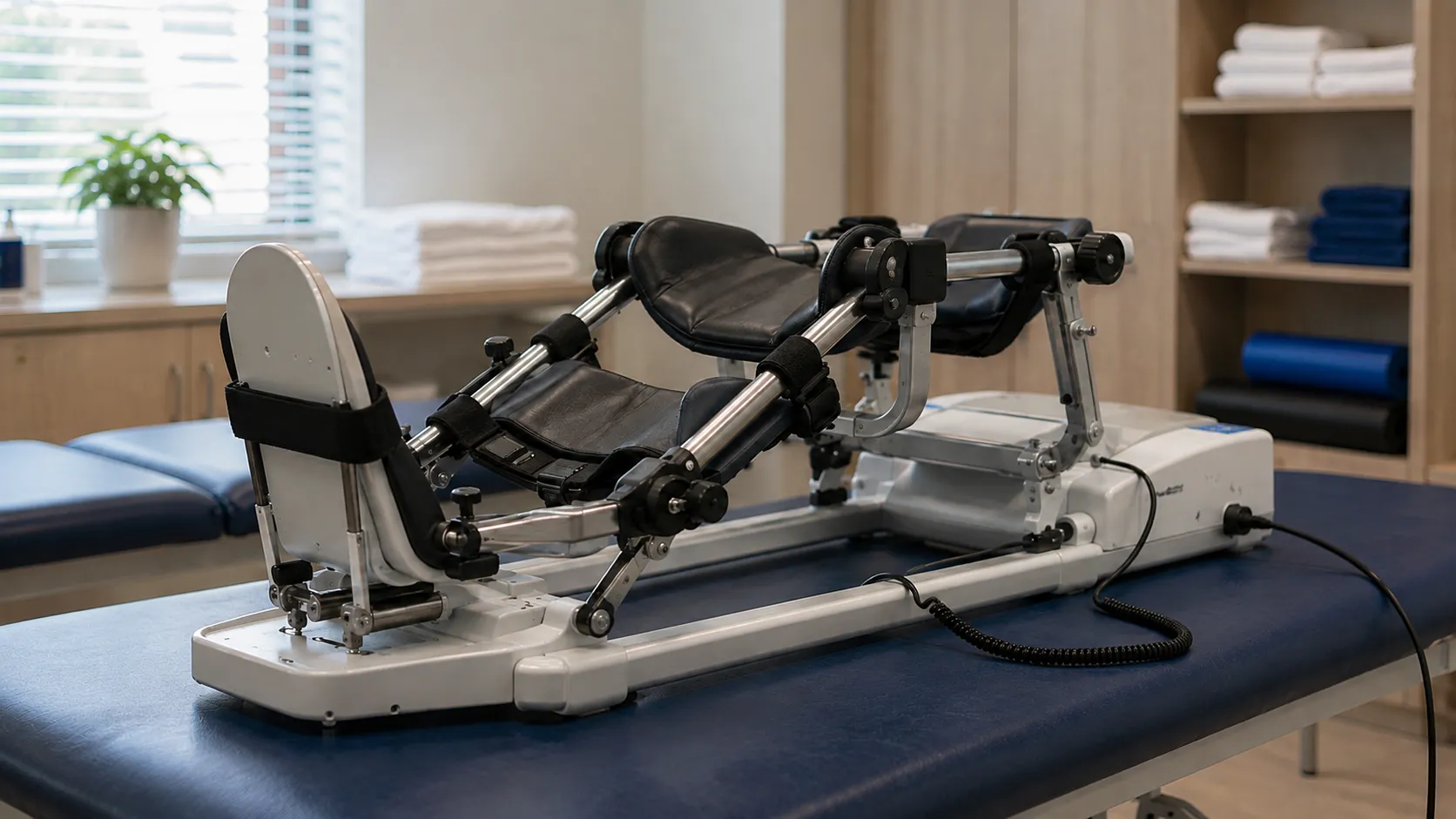
A continuous passive motion machine gently moves a joint through a set range of motion without the patient's muscular effort. It is used in some rehabilitation pathways after knee surgery or injury. Its usefulness depends on comfortable, secure positioning, straightforward range setting, and suitability for ward, home, or hire use, since these determine whether the patient tolerates and benefits from the therapy.
The ten machine types below cover knee-focused and related lower-limb use. Each entry explains its role and what to confirm before purchase.
Range control, comfort and fit
Setting the movement range clearly and safely is central, since therapy follows a prescribed range that may progress over time. Controls that are easy to set and reliably hold the range support consistent therapy and reduce the risk of error.
Comfort and fit determine tolerance. The machine cradles the limb, so padding, adjustment for limb length and secure yet comfortable positioning affect whether a patient tolerates extended use. A machine that fits poorly will be used less than prescribed.
The ten machine types
1. Standard knee CPM machines
Move the knee through a set range with adjustable parameters, the general configuration for knee rehabilitation.
2. Machines with wide range capability
Offer a broad range of motion to accommodate progression through a rehabilitation pathway.
3. Machines with adjustable limb length
Adjust to different limb lengths for a proper fit, improving comfort and the accuracy of the applied range.
4. Machines with patient-held controls
Provide simple patient control, sometimes with a pause or comfort stop, to support use when the patient manages sessions.
5. Machines with progress recording
Record range and usage to support review of progress. Confirm what is recorded and how it is retrieved.
6. Lightweight machines for home use
Reduced weight and simpler setup for home and hire programmes, where the patient or a carer sets the machine up.
7. Machines with quick range adjustment
Allow the range to be changed quickly and safely as therapy progresses, saving time on a ward round or clinic visit.
8. Machines with comfort padding options
Offer padding and support options improving tolerance for extended sessions.
9. Machines for hire and pooled use
Built for repeated setup, cleaning and reissue across many patients, suited to hire and equipment library provision.
10. Combined lower-limb motion machines
Support related lower-limb movement beyond the knee alone, where a service's pathway requires it.
Home use, hygiene and reissue
Many continuous passive motion machines are used at home or issued through an equipment library, so the setup, cleaning and reissue cycle matters as much as the therapy itself. A machine used at home needs a simple setup that a patient or carer can manage safely, with the prescribed range clearly set or explained, and a support route in place if difficulties arise. For pooled and hire machines, cleaning between patients and reliable reissue are central, so the machine should be dismantled or wiped down effectively and reassembled without difficulty. Padding and any patient-contact components need a clear hygiene policy, with single-patient items where appropriate, so that a machine returned from one patient is safe and ready for the next.
What to confirm before ordering
-
Range control. Confirm the range setting is clear, safe and reliably held.
-
Fit. Establish limb length adjustment and padding for comfort.
-
Patient controls. Check the patient control suits home or supervised use.
-
Home suitability. For home use, confirm weight and ease of setup.
-
Cleaning. Verify cleaning and any single-patient components for reissue.
-
Recording. Establish progress recording where required.
Training, hygiene and servicing
Training should cover setting the prescribed range, fitting the limb comfortably and securely, using the patient control and cleaning. When patients or carers set up the machine at home, clear guidance and a support plan are essential.
Hygiene centres on patient-contact components and on cleaning between patients for pooled machines, with an explicit policy applied consistently.
For servicing, agree on planned maintenance, range accuracy checks, mechanical inspection, and electrical safety testing, since a machine applying an incorrect range would be clinically unsafe. Ensure the service receives MHRA medical device alerts. Hence, any field safety notices should be sent to the rehabilitation team.
Range control and the cleaning and reissue cycle should be settled for pooled or home use. Services can review configurations through buyer services.
Final thoughts
Choose the machine based on clear range control, comfortable fit, and the setting in which it is used, giving home and pool use the attention they need. Most rehabilitation services are best served by machines that set range reliably, fit comfortably, clean and re-issue cleanly, and have built-in range accuracy servicing.
This article provides general procurement guidance for healthcare organisations. It is not clinical or rehabilitation advice, and it does not replace manufacturer instructions or professional judgement.