Oxygen pipeline systems for hospital supply
An oxygen pipeline system is the source and distribution arrangement that delivers medical oxygen from a central store to every terminal unit in a hospital. Oxygen is usually the highest-volume medical gas a hospital consumes, so the supply source is engineered for both capacity and continuity. Most acute sites take oxygen from a bulk liquid store, backed by a second independent source and a cylinder reserve, and distribute it through the pipeline at a nominal 400 kPa (4 bar). This guide focuses on the oxygen source and its distribution; the wider pipeline framework is covered separately.
The first question for any oxygen supply is resilience: oxygen must not run out, so the design always provides a primary source, a secondary source and a reserve.
The terms and figures used here — VIE storage, the Oxygen 93 purity specification and the pipeline distribution pressure — follow ISO 7396-1, HTM 02-01 and the European Pharmacopoeia, compiled for procurement and estates readers evaluating an oxygen source rather than for bedside use.
The vacuum insulated evaporator (VIE)
The primary source in most large hospitals is a vacuum insulated evaporator — a bulk vessel holding liquid oxygen at around minus 183 degrees Celsius under vacuum-jacketed insulation. Liquid oxygen is extremely space-efficient: a large volume of gas is stored as a much smaller volume of liquid. As demand draws gas off, liquid is drawn from the vessel, passed through ambient or heated vaporisers that turn it back into gas, and regulated down to pipeline pressure. A VIE is refilled by tanker and telemetry-monitored, so the supplier can schedule deliveries before the level runs low.
The VIE and its vaporisers sit in a secure, ventilated external compound with defined separation distances, because oxygen enrichment raises fire risk. Frost on a vaporiser is normal, so the design usually duplicates vaporisers, letting one defrost while the other carries the load.
PSA oxygen concentrator plant
An alternative or complementary source is a pressure swing adsorption (PSA) plant, which generates oxygen on site by passing compressed air through a molecular sieve that adsorbs nitrogen and lets oxygen through. PSA plant produces oxygen at a purity of around 93 per cent — the Oxygen 93 specification recognised in the European Pharmacopoeia — rather than the higher purity of liquid oxygen. On-site generation reduces dependence on tanker deliveries, which suits sites where bulk logistics are difficult, but the plant needs its own compressors, monitoring and backup. Whichever primary source is chosen, the system still needs an independent secondary supply and a cylinder reserve.
Choosing between a VIE and a PSA plant
The choice of primary source is a real procurement decision, not a formality. A VIE gives high-purity oxygen and large capacity in a small footprint. Still, it ties the site to tanker deliveries and a supply contract, and it needs an external compound with separation distances. A PSA plant removes the delivery dependency and can lower long-run supply cost. However, it draws electricity continuously, occupies plant-room space, delivers lower oxygen purity (93%), and still needs cylinder backup. Many large hospitals keep a VIE as the primary source precisely because capacity and purity are decisive for critical care; smaller or remote sites may find on-site generation more practical. The honest comparison weighs purity, capacity, resilience, energy and logistics against the site's clinical profile.
Cylinder manifold backup and reserve
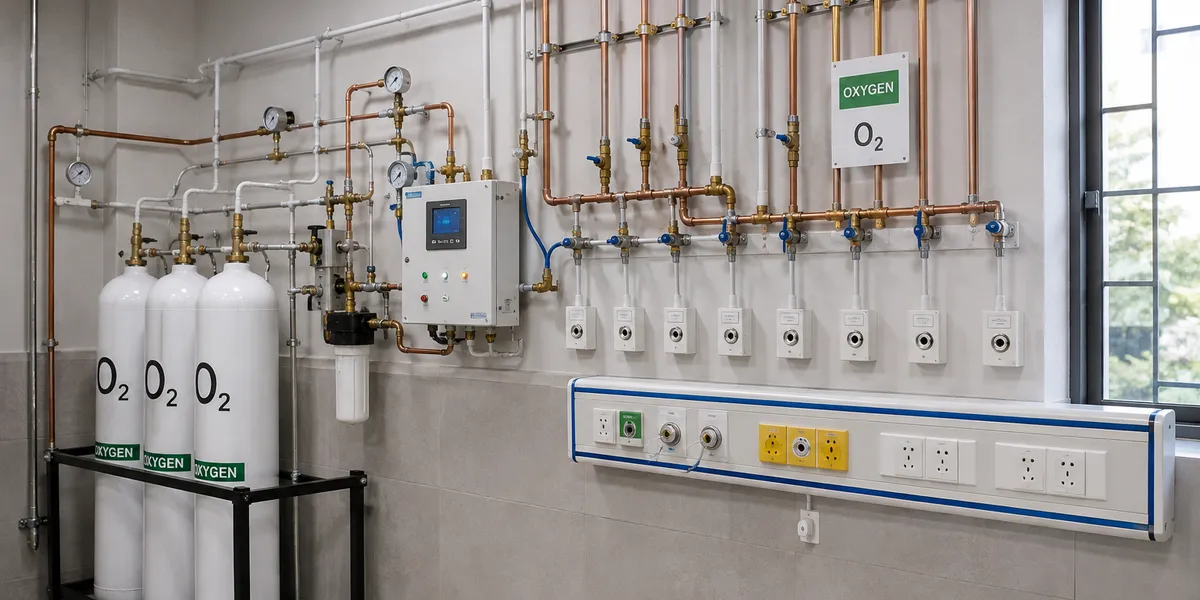
Behind the primary source sits an automatic cylinder manifold — banks of high-pressure oxygen cylinders arranged in duty and standby groups with automatic changeover, providing the secondary or reserve supply. If the VIE or PSA plant is interrupted, the manifold takes over without a break in pipeline pressure. An emergency reserve manifold and defined low-level and changeover alarms complete the resilience picture required for a breathing-gas source.
Cylinder manifold rooms and gas handling
The reserve and secondary cylinder banks live in a dedicated, ventilated manifold room or external enclosure, sized for safe cylinder storage and changeover. Full and empty cylinders are segregated, secured against falling and handled with proper trolleys, because a high-pressure oxygen cylinder is heavy and its contents support combustion. Reorder is driven by the manifold's content alarms and by stock control, so a bank is never allowed to run down without a replacement to hand. For procurement, confirming the storage arrangement, the cylinder supply contract and the handling equipment is part of specifying a safe oxygen supply, not an afterthought.
Distributing oxygen and keeping it pure
Oxygen pipework is degreased and specially prepared, because oil or grease in an oxygen-enriched line is a fire hazard. Distribution follows the general pipeline arrangement — regulated pressure, area valve service units to isolate departments, line-pressure indicators and alarms — with oxygen identified in white throughout and gas-specific terminal units that cannot accept another gas's probe. Purity is confirmed at validation and monitored in service; oxygen delivered to the ward must meet the pharmacopoeial specification for medical oxygen, or the Oxygen 93 specification for a PSA supply.
Standards, regulation and safety
Oxygen source and pipeline design in the UK follow HTM 02-01 and ISO 7396-1, which set out source redundancy, storage, monitoring and testing. A complete oxygen system is a medical device regulated by the MHRA and carries UKCA or CE marking. Oxygen's fire risk means bulk storage siting, ventilation and staff awareness are safety-critical, and demand planning has to account for surge events: during periods of high respiratory demand the NHS found peak oxygen draw can exceed a system's original design assumptions. Reviewing worst-case demand against source and pipeline capacity is now a standard practice in oxygen planning.
Planning for peak oxygen demand
Sizing an oxygen supply on average consumption is a mistake the sector has learned from. Oxygen demand is driven by the sickest patients and by how many need high-flow therapy at once, and it can rise sharply during a respiratory surge. The pipeline itself has a finite flow capacity, so even a well-stocked source can be constrained by pipe sizing if too many high-flow devices run simultaneously. Modern oxygen planning therefore models worst-case simultaneous demand for the departments served, checks it against both source capacity and pipeline flow, and identifies where extra capacity or flow management would be needed. This analysis belongs in the specification, not in an emergency response.
Alarms, monitoring and staff awareness
Oxygen supply carries a full set of alarms — VIE or PSA plant status, pipeline pressure, reserve running and changeover — that should feed a central medical gas alarm panel and, increasingly, the estates monitoring system, together with tanker-level telemetry for a VIE. Beyond the hardware, staff awareness is part of the safety case: theatre and ward teams should know where the area valve service units are and how the alarm scheme signals a fault, so they recognise and escalate a supply problem quickly. Clear labelling and periodic alarm testing keep that awareness current.
Sizing an oxygen supply: what to verify
-
Primary source (VIE or PSA) sized for peak, not just average, oxygen demand including surge scenarios.
-
Independent secondary supply plus an emergency reserve manifold with automatic changeover.
-
Telemetry and level monitoring on bulk liquid storage, with a reliable refill arrangement.
-
Degreased, oxygen-clean pipework and gas-specific white-coded terminal units confirmed.
-
Purity monitoring to the medical oxygen or Oxygen 93 specification, with validation and in-service testing.
-
Bulk storage siting, separation distances and ventilation compliant and fire-risk assessed.
-
Full alarm scheme (plant, pressure, changeover, reserve low) specified and located.
-
HTM 02-01 and ISO 7396-1 compliance and UKCA/CE conformity evidenced before handover.
Running costs and continuity
Oxygen is an ongoing operating cost dominated by liquid supply or, for PSA, the electricity to run compressors, plus vessel rental, vaporiser and manifold maintenance and cylinder handling. A sound business case compares the delivered cost per unit of oxygen, the resilience each option gives, and the supplier's monitoring and response service. For most acute sites, the decision is less about headline price and more about guaranteed continuity of a gas that patients depend on minute to minute.
Getting oxygen supply right
Oxygen is the medical gas with the least tolerance for interruption, so source resilience and honest supplier comparison are worth the effort. MediGear is a UK medical-equipment distributor that helps facilities compare verified oxygen-supply and pipeline suppliers against the standards their project must satisfy. Estates and procurement teams can start with our buyer resources and supplier network, or contact the team to talk through a specification.
Disclaimer
This article is for informational purposes only. MediGear (medigear.uk) publishes it for general information and procurement guidance. It is not clinical, diagnostic, treatment, technical, engineering, legal, or regulatory advice, nor a product endorsement, guarantee, or substitute for professional assessment. MediGear does not provide medical consultations. Buyers should consult their clinical, biomedical, estates and regulatory contacts, and the manufacturer's documentation, and independently verify all specifications, certifications, compatibility and suitability before purchase. Specifications, certifications and availability are correct at the time of publication and may change without notice. MediGear is a medical-equipment distributor and does not sell medicines or pharmaceutical products.