What a medical air plant is and how it supplies compressed air
A medical air plant is the source equipment that produces clean, dry, oil-free compressed air and supplies it to a hospital's pipeline for breathing and driving equipment. It is one of several sources on a medical gas pipeline system, and its job is specific: take ambient air, compress it, remove moisture, oil, and particulate matter, and deliver it to terminal units at the correct pressure and to a defined air-quality standard. Medical air for breathing is distributed at a nominal 400 kPa (4 bar); a separate surgical (tool) air supply runs at 700 kPa (7 bar) to power pneumatic instruments.
Unlike oxygen or nitrous oxide, medical air is not stored — it is manufactured continuously on site, so the plant's reliability and the air quality it holds are the whole story for a buyer.
The specifications summarised here are drawn from ISO 7396-1, the HTM 02-01 guidance for medical gas plant and the European Pharmacopoeia limits for medical air, gathered for estates and procurement teams comparing compressor plant rather than for clinical use.
How a duplex compressor plant is built
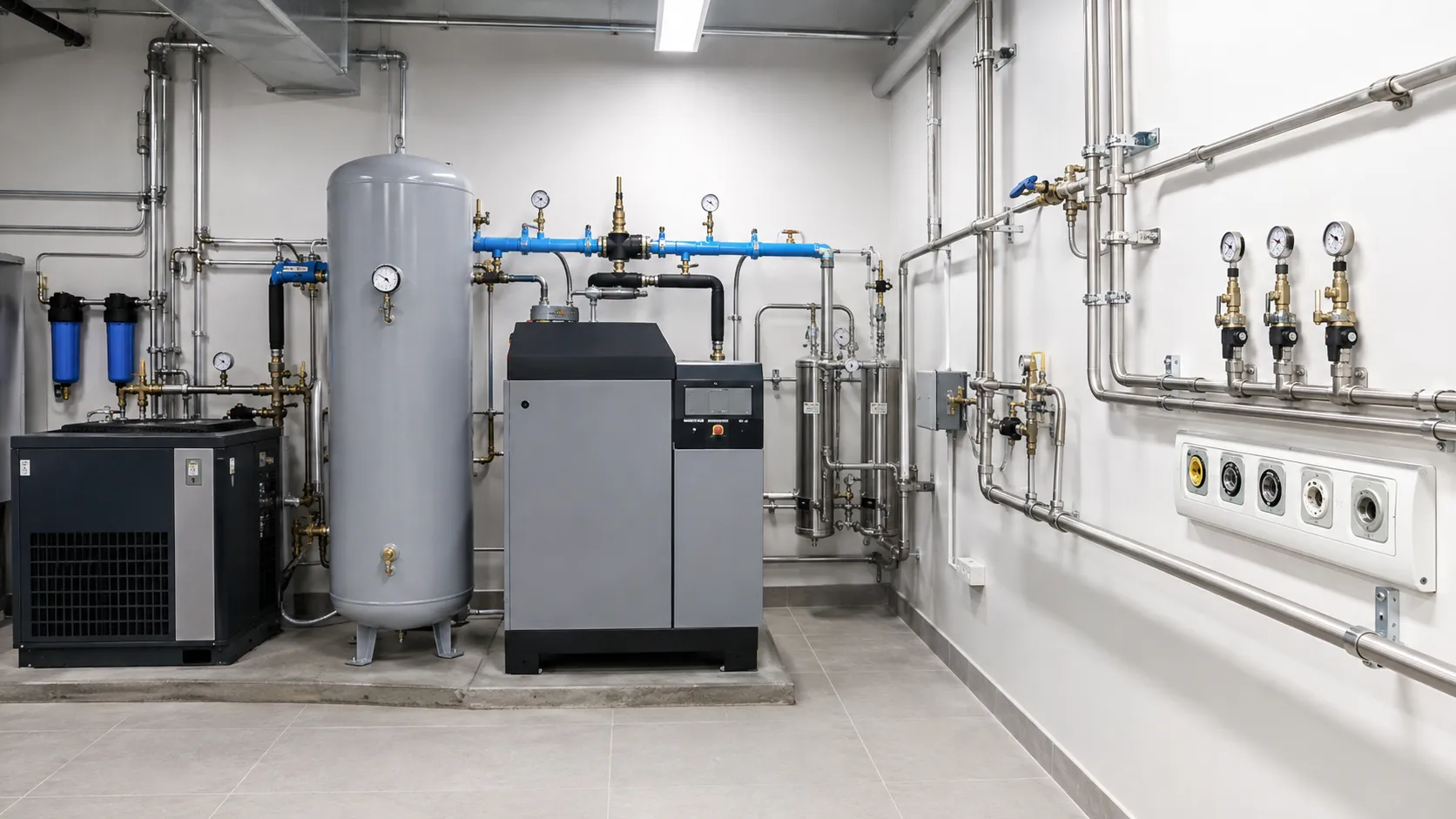
A medical air plant is normally arranged as a duplex or triplex set: two or more compressors share the load, each capable of meeting the demand, so the plant keeps running if one fails or is serviced. Compressors may be oil-free or oil-lubricated; oil-free types avoid oil carryover at the source, while oil-lubricated designs rely on downstream filtration to achieve medical-air purity. Air is drawn from a clean intake, compressed, then passed to a receiver vessel that stores a buffer of compressed air, smooths demand peaks and lets the compressors cycle rather than run constantly.
Automatic changeover and duty-sharing controls rotate which compressor leads, balancing wear across the set. The receiver is a pressure vessel with its own inspection regime, drain and safety valve.
Drying the air
Moisture is the enemy of a pipeline. Compressing air concentrates water vapour, which would otherwise condense in the pipework, corrode fittings and carry contamination towards the patient. Medical air plants therefore use dryers — commonly twin-tower desiccant (adsorption) dryers that alternate, one drying while the other regenerates — to reach a low pressure dew point. A dew point monitor is fitted so the plant can alarm if the air is not dry enough to distribute.
Filtration and quality
After drying, the air passes through staged filtration — coalescing filters for oil aerosol and water, particulate filters, and often an activated-carbon stage for oil vapour and odour. The target is medical air that meets the quality defined in ISO 7396-1 and the European Pharmacopoeia monograph for medical air, with controlled limits on water, oil, carbon monoxide and carbon dioxide. Continuous or scheduled quality monitoring confirms that the plant is meeting that specification.
Medical air (4 bar) versus surgical air (7 bar)
The two air services are distinct and must not be confused. Medical air at 400 kPa is a breathable gas used to drive ventilators, blend with oxygen and supply nebulisers and neonatal incubators. Surgical or tool air at 700 kPa is a high-pressure supply for pneumatic surgical tools, such as drills and saws, in orthopaedic and neurosurgical theatres. They have separate, non-interchangeable terminal units, so a tool line can never be connected to a patient's breathing circuit. A plant serving both may include a dedicated high-pressure compressor set or a boosted supply, sized for theatre demand.
Air intake and plant-room siting
Medical air is only as clean as the air the plant draws in, so intake location is a genuine design decision. The intake must be positioned away from vehicle exhausts, vacuum plant and generator exhausts, boiler flues, and other sources of contamination that could raise carbon monoxide or hydrocarbon levels in the compressed air. Intake filtration and, where needed, carbon monoxide monitoring guard against this. The plant room itself needs adequate ventilation and cooling, because compressors reject heat, and enough space around each unit for filter changes, element servicing and eventual replacement without shutting the whole plant.
Emergency air and business continuity
Because medical air cannot be stored as liquid oxygen can, continuity depends on plant redundancy rather than a large reserve. Some sites hold an emergency source — a bank of cylinders or an alternative compressor — to cover a total plant failure or major maintenance. The right level of backup depends on how critical the departments served are: a plant feeding intensive care and theatres warrants more resilience than one serving general wards. This is a judgement to make explicitly at design stage, not to discover during a breakdown.
Where a medical air plant fits in the pipeline
The plant is only the source. From the receiver, air is regulated and distributed through the same pipeline arrangement as the other services — area valve service units, line-pressure indicators and alarms — to black-and-white coded terminal units at the bedhead and in theatre. A buyer specifying air plant should still confirm how it integrates with the wider medical gas pipeline system and its alarm scheme, because a plant that meets spec in isolation must still deliver pressure and quality at the furthest outlet at peak demand.
Standards and regulation for medical air plant
In the UK, a medical air plant is designed, installed, and validated within the wider medical gas pipeline system in accordance with HTM 02-01 and ISO 7396-1, which cover source-plant redundancy, monitoring, alarms, and the air-quality testing regime. As part of a medical device system, it also falls under UK medical device rules overseen by the MHRA, with UKCA or CE marking and installer conformity. Compressor receivers and high-pressure vessels are also subject to general workplace pressure-equipment and safety duties enforced by the Health and Safety Executive.
Sizing and resilience
Plant sizing starts from the number of air outlets, the diversity (simultaneous-use) factor for the departments served, and the peak theatre tool-air demand. The plant must meet full demand with the largest compressor out of service — the basis of the duplex principle. A separate emergency supply and clear alarms for pressure, dew point, and plant fault provide resilience. Because compressors, dryers and filters all consume energy and wear, the plant room needs ventilation, cooling and maintenance access designed in from the start.
Specifying a medical air plant: buyer checklist
-
Duplex or triplex compressors, each rated to meet full demand alone, with automatic duty-sharing changeover.
-
Receiver vessel correctly sized, with drain, safety valve and a documented pressure-vessel inspection regime.
-
Twin-tower desiccant drying with dew point monitoring and alarm.
-
Staged filtration (coalescing, particulate, activated carbon) meeting the medical-air quality specification.
-
Separate 44-bar medical and 77-bar surgical air for theatres that need tool air, with non-interchangeable outlets.
-
Compliance with ISO 7396-1 and HTM 02-01, plus UKCA/CE conformity, evidenced in the documentation.
-
Air-quality and dew point test and monitoring plan agreed for validation and ongoing service.
-
Plant-room ventilation, energy use and maintenance access considered in the layout.
Running costs and servicing
A medical air plant is a long-term operating cost, not just a capital purchase. Compressors draw significant electricity; desiccant, coalescing, and carbon filter elements require scheduled replacement; and dryers, drains, and receivers require periodic inspection. A realistic business case compares plant energy efficiency, consumable cadence, and the maintenance provider's certification and response times because unplanned downtime on a breathing-gas source is unacceptable. Comparing suppliers on whole-life cost, not headline price, is the sensible basis for a decision.
Integration, alarms and monitoring
A medical air plant does not run in isolation. Its controls drive alarms for compressor fault, high dew point, low pressure and reserve running, and these should feed the hospital's central medical gas alarm scheme so estates staff see a fault immediately. When comparing plant, ask how the control system reports faults, whether it logs run hours and dew point for each compressor, and how it integrates with an existing building-management system. Good monitoring turns an unplanned failure into a planned intervention, which is the difference between a maintenance ticket and a clinical incident.
Getting the specification right
Because medical air is manufactured on-site and inhaled by patients, the quality of the plant and its maintenance matter most. MediGear is a UK medical-equipment distributor that helps facilities compare verified suppliers of compressed-air plant, dryers, filtration and terminal units against the standards a project must meet. Estates and procurement teams can use our buyer resources and partner network to shortlist providers and match a plant to genuine clinical demand. The gov.uk guidance sets out the wider regulatory context.
Disclaimer
This article is for informational purposes only. It is published by MediGear (medigear.uk) for general information and procurement guidance. It is not clinical, diagnostic, treatment, technical, engineering, legal or regulatory advice, nor a product endorsement, guarantee or substitute for professional assessment. MediGear does not provide medical consultations. Buyers should consult their clinical, biomedical, estates and regulatory contacts, and the manufacturer's documentation, and independently verify all specifications, certifications, compatibility and suitability before purchase. Specifications, certifications and availability are correct at the time of publication and may change without notice. MediGear is a medical-equipment distributor and does not sell medicines or pharmaceutical products.