Medical equipment procurement errors can result in incorrect models, missing accessories, unsuitable infrastructure requirements or unexpected commercial costs. These problems may delay installation and leave clinical departments without equipment that is ready for operational use.
For healthcare buyers managing medical equipment purchases, error prevention should begin before contacting suppliers. Clinical requirements, quantities, technical specifications, budgets, and delivery expectations should be approved through a single coordinated process.
Clinical users, biomedical engineers, procurement specialists, facilities personnel and finance teams may each hold essential information. When their requirements are collected separately, important details can be lost between the specification, quotation, and purchase order stages.
A controlled procurement process helps healthcare organisations improve order accuracy, supplier accountability and equipment readiness.
Define Requirements and Approval Responsibilities
Every purchase should begin with an approved statement of the healthcare organisation's requirements.
Clinical purpose — Describe the service, procedure or workflow the equipment must support.
Required quantity — Calculate quantities using rooms, beds, workload, operating hours and backup requirements.
Technical specification — Define mandatory performance, capacity, alarms, mobility, connectivity and environmental requirements.
Complete configuration — Include accessories, software, licences, trolleys, cables, batteries and reusable components.
Equipment condition — State whether new, refurbished or another approved condition will be considered.
Infrastructure requirements — Confirm electrical, network, ventilation, water, drainage, gas and room requirements.
Budget responsibility — Identify the approved funding source and complete project-cost limit.
Approval authority — Record who approves the clinical requirement, technical specification and commercial commitment.
In practice, healthcare buyers often find that errors begin when a department requests equipment without specifying the required configuration.
A controlled requirement form should be completed before quotations are requested.
Adapt Controls to Purchase Type and Clinical Setting
Procurement risks vary according to equipment complexity, condition and intended healthcare environment.
Routine replacement — Confirm whether the replacement must match existing accessories, software or department training.
New hospital project — Coordinate equipment schedules with rooms, utilities, storage and phased opening dates.
When sourcing through verified international medical equipment suppliers, buyers should confirm the supplier’s legal identity, product authority and responsibility for technical support.
Critical care equipment — Review backup capacity, alarm requirements, battery operation and service response.
Diagnostic systems — Confirm installation, calibration, digital integration and environmental requirements.
Laboratory equipment — Assess analyser throughput, reagents, quality-control materials and recurring consumables.
Mobile equipment — Review transport, charging, cleaning, storage and equipment-sharing responsibilities.
Refurbished equipment — Define condition, testing, replaced parts, software, accessories and warranty expectations.
International purchase — Include freight, insurance, customs, unloading, storage and local installation responsibilities.
Experienced procurement teams typically apply stronger controls where equipment is high-value, technically complex or clinically critical.
Standardise Technical and Document Checks
Standard forms and document controls can prevent information from changing between procurement stages.
Specification template — Use a consistent format that covers performance, accessories, infrastructure, documentation, and support.
Quotation template — Require suppliers to separate the main equipment, accessories, software, services and exclusions.
Manufacturer and model — Record the complete manufacturer, model, variant and product reference.
Model verification — Compare the quotation with the official technical documentation for the exact product being proposed.
Accessory verification — Confirm quantities and compatibility for probes, cables, batteries, modules and trolleys.
Software verification — Check versions, licences, interfaces, subscriptions and upgrade responsibilities.
Compliance documentation — Review records required under applicable local regulatory standards and, where relevant, standards such as CE, FDA or their regional equivalents.
Manual review — Confirm that operating and technical documents match the supplied model and language requirements.
Quotation revision control — Identify the final approved quotation and clearly mark older versions as superseded.
Purchase-order accuracy — Transfer the approved model, configuration, quantity and commercial terms without abbreviation or omission.
Change approval — Require written review for substitutions, revised quantities or altered delivery terms.
Document retention — Keep requirements, quotations, approvals and supplier clarifications within one procurement file.
One aspect that surprises first-time buyers is that one missing model suffix can change the equipment configuration or regional compatibility.
Technical identifiers should therefore be copied exactly across all approved documents.
Evaluate Supplier and Commercial Risk
Supplier evaluation should examine the complete offer rather than only the quoted equipment price.
Supplier identity — Verify the legal business name, address, contacts and payment information.
Manufacturer relationship — Confirm whether the company is a manufacturer, an authorised distributor, or an independent supplier.
Accuracy of commercial information — Medical equipment companies advertising solutions to healthcare buyers should ensure that product, pricing and support claims match their formal quotations.
Complete cost — Include accessories, software, delivery, installation, training, maintenance and initial consumables.
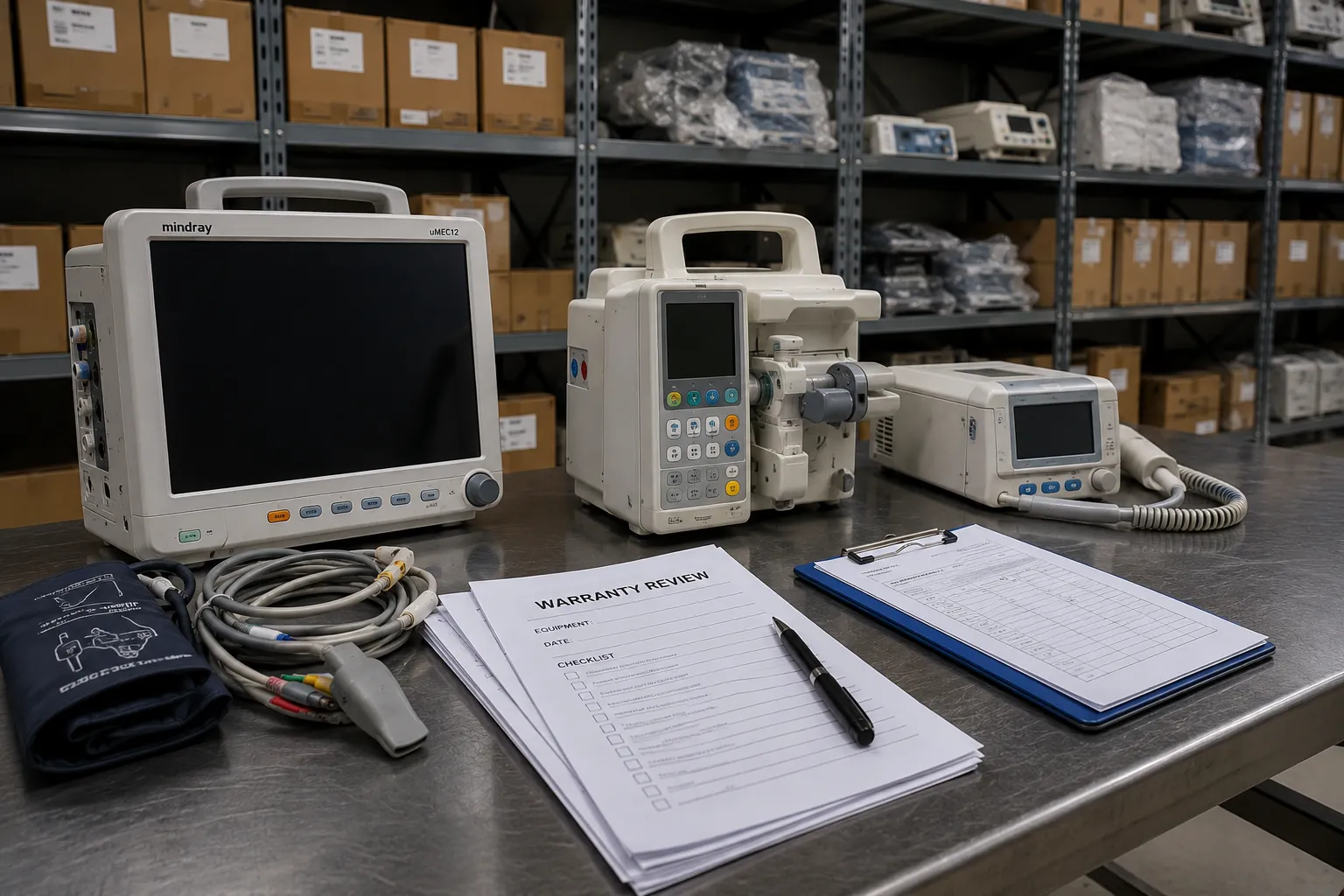
Warranty coverage — Check the start date, duration, parts, labour, travel, freight and exclusions.
Delivery responsibilities — Define packaging, freight, insurance, customs, unloading and final positioning.
Installation scope — Confirm assembly, connections, testing, calibration and commissioning responsibilities.
Training commitment — Record sessions, participants, trainers and included materials.
Service capability — Review engineer access, response times, spare-parts availability and technical escalation.
Payment milestones — Link payments to verifiable stages such as shipment, delivery, installation and acceptance.
Commercial exclusions — Require every excluded cost, service and component to be listed clearly.
Healthcare organisations that manage repeat purchases may benefit from structured international medical equipment sourcing partnerships.
Each order should still have its own approved specification, quotation, purchase order and acceptance criteria.
Control Delivery, Installation and Handover
Procurement controls should continue after the supplier receives the order.
Pre-shipment confirmation — Ask the supplier to confirm the models, quantities, accessories and package details before dispatch.
Shipping-document review — Compare invoices, packing lists and freight records with the purchase order.
Receiving preparation — Ensure that unloading equipment, storage space and inspection personnel are available.
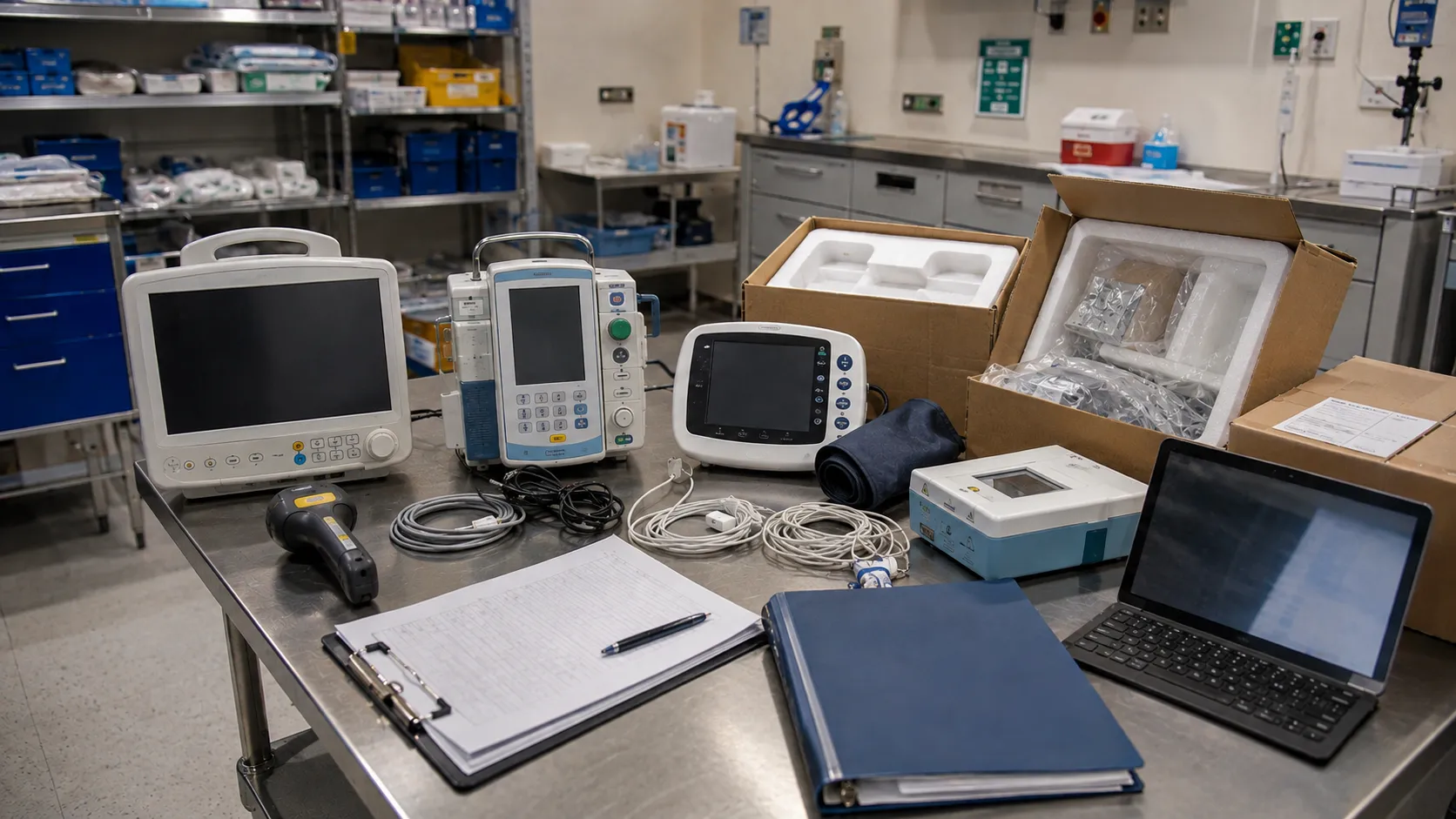
Delivery inspection — Check packaging, manufacturer, model, quantity, serial numbers and visible condition.
Accessory reconciliation — Compare delivered probes, cables, batteries, software and manuals with the approved quotation.
Discrepancy record — Photograph and document missing, damaged or incorrect items before final acceptance.
Installation verification — Confirm that the equipment is assembled, connected and configured according to the approved scope.
Commissioning checks — Complete required functional, safety and calibration checks.
Training confirmation — Record completed sessions and unresolved training requirements.
Asset registration — Add the manufacturer, model, serial number, condition, warranty and location to the asset register.
Payment control — Release milestone payments only after the relevant evidence has been approved.
Final handover — Obtain clinical, technical and procurement confirmation that the order is complete.
Delivery should be treated as a verification stage rather than automatic proof that the supplier has fulfilled the order.
Monitor Procurement Performance and Correct Recurring Errors
Healthcare organisations should use procurement outcomes to strengthen future purchasing controls.
Error register — Record incorrect models, missing accessories, documentation gaps, delays and commercial discrepancies.
Root-cause review — Determine whether the issue began during requirement planning, quotation, approval, ordering or delivery.
Supplier performance — Track quotation accuracy, delivery completeness, response time and corrective-action quality.
Department feedback — Ask clinical and technical teams whether the equipment matches operational requirements.
Specification improvement — Update templates when recurring technical information is missing or unclear.
Approval review — Confirm that required reviewers participated before the order was issued.
Training gaps — Provide procurement training where staff repeatedly misunderstand models, configurations or commercial terms.
Digital controls — Use controlled procurement systems, version histories and approval workflows where practical.
Corrective-action ownership — Assign a responsible person and completion date for every significant error.
Lessons-learned review — Apply findings to future tenders, quotations and supplier agreements.
Final performance report — Summarise the error, impact, corrective action and prevention measure.
Healthcare buyers seeking quotation review, supplier coordination or international sourcing assistance can contact the Medigear.uk team for medical equipment support. Enquiries should include the equipment category, required quantity, preferred condition and destination.
Procurement error reduction should remain an ongoing improvement process supported by evidence from completed purchases.
Final thoughts
Medical equipment procurement errors can be reduced through clear requirements, controlled documents and coordinated approval.
Healthcare buyers should verify the exact model, complete configuration, supplier identity and commercial scope before issuing a purchase order. Changes should not be accepted without clinical, technical and commercial review.
Delivery inspection, commissioning and asset registration should remain connected to the approved procurement documents.
A structured process helps healthcare organisations prevent incorrect purchases, reduce unexpected costs and improve equipment readiness.
Disclaimer
Medigear.uk is a global medical equipment supplier, exporter, and distributor. The content published on this site is intended for educational and product awareness purposes only. Nothing on this page constitutes medical advice, clinical guidance, or treatment recommendations. All healthcare procurement and clinical decisions should be made by qualified medical professionals and compliant procurement teams operating within the regulatory frameworks of their respective countries.