Medical equipment procurement often becomes difficult before a supplier is contacted. Clinical users may know what problem they need to solve, biomedical engineers may understand the facility's technical limitations, and procurement teams must translate those requirements into a document that suppliers can interpret and respond to fairly. If the specification is too general, the equipment may not meet the real clinical need. If it is too narrow, the procurement process may unintentionally exclude technically suitable alternatives.
For medical equipment buyers and professionals worldwide, preparing a clear technical specification is therefore one of the most important stages of equipment planning. A good document connects clinical purpose with measurable performance, infrastructure, safety, regulatory requirements, training, maintenance, and total cost of ownership—this is Medigear. The UK guide explains how to prepare a technical specification to support more informed equipment evaluation and procurement across different healthcare environments.
Begin With the Clinical Requirement Behind the Purchase
The first step is to define the healthcare problem the equipment must solve. A specification should not begin by copying a product brochure or listing fashionable features. It should begin with the clinical activity, patient population, users, workload, and operational environment.
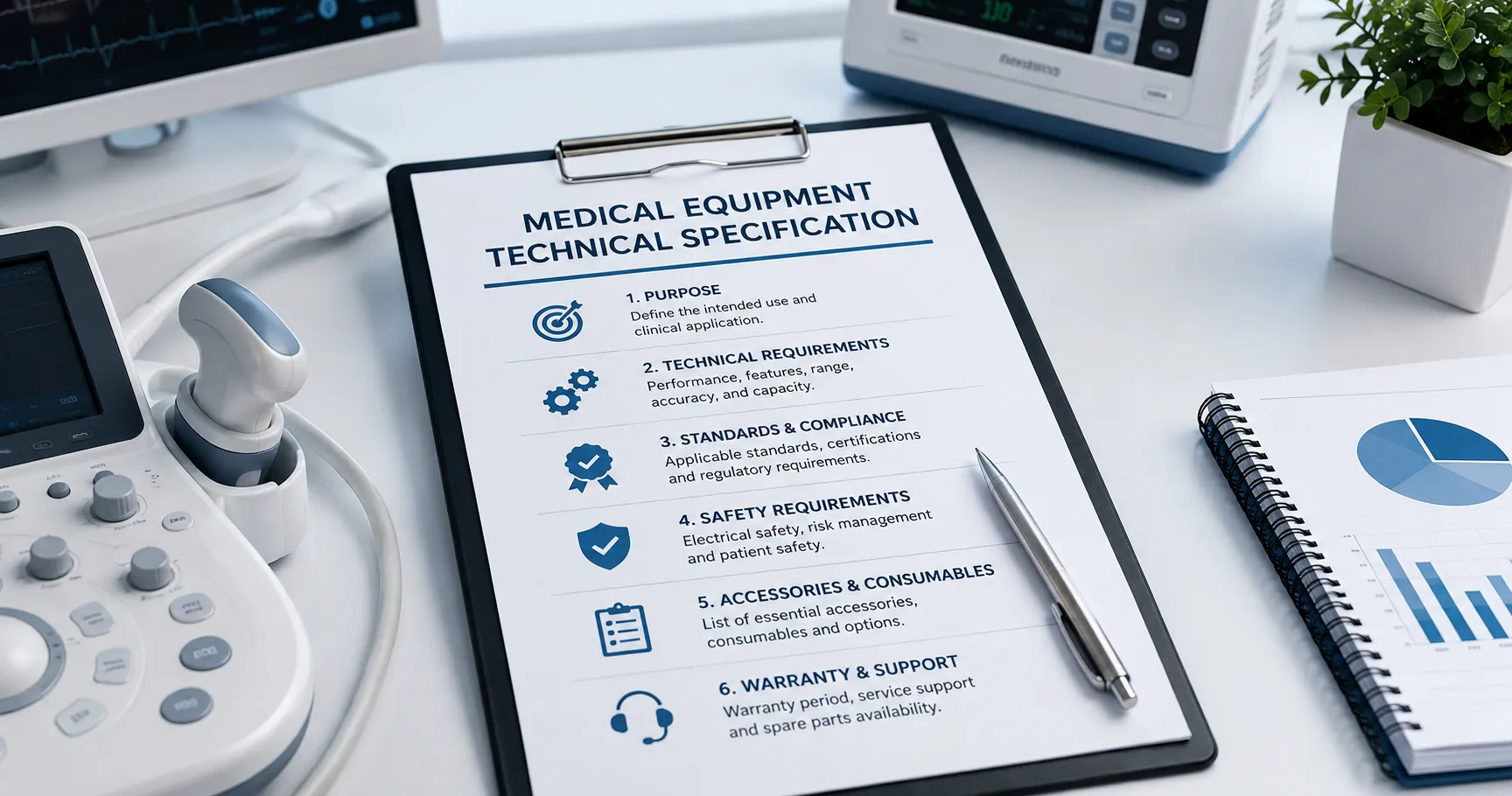
Intended Clinical Purpose — Explain what the equipment is expected to do in practice. The requirement might involve diagnosis, monitoring, treatment, patient support, emergency response, rehabilitation, sterilisation, or another healthcare function.
Clinical Users — Identify who will operate the equipment and who will be responsible for routine checks or cleaning. A device used by specialist clinicians may have different interface and training requirements from equipment operated by a wider multidisciplinary team.
Expected Workload — Define expected daily use, patient volume, operating hours, and peak demand. Facilities that plan only around average workload can discover that equipment becomes a bottleneck during busy periods or service interruptions.
Operational Risk — Identify what could happen if the equipment fails, produces unreliable results, or becomes unavailable. This helps procurement teams determine which requirements must be mandatory and which are simply desirable.
Experienced healthcare procurement teams generally find that the best technical specifications are built around actual workflow rather than product marketing language. The specification should make the clinical objective clear before selecting technical values.
Adapt the Specification to the Deployment Environment
Medical equipment may be used in a large teaching hospital, a district hospital, a community health centre, a mobile clinic, an emergency environment, or a point-of-care setting. The deployment environment can significantly affect the technical requirements.
Large Teaching Hospitals — High-volume facilities may require equipment capable of continuous or intensive use, integration with existing systems, and operation by multiple departments. Procurement teams should consider user turnover, training requirements, space, network infrastructure, and service continuity.
District and Community Facilities — Equipment in smaller facilities may need to operate with limited technical support and different infrastructure conditions. Simpler operation, durable construction, accessible maintenance, and dependable spare-parts availability may be more important than advanced functions that are rarely used.
Mobile Healthcare Services — Mobile and outreach environments require careful attention to portability, battery operation, transport protection, setup time, and environmental conditions. Equipment that performs well in a permanent clinical room may not be suitable for repeated transportation.
Point-of-Care Use — Equipment used near patients should support efficient workflows, simple cleaning, rapid operation, and appropriate connectivity where required. Facilities working with verified global medical equipment suppliers should also confirm shipping documentation, destination-market requirements, packaging, installation, and after-sales support.
A practical observation from equipment deployment is that infrastructure limitations are often discovered too late. Power quality, room size, temperature, humidity, network access, ventilation, and utility connections should be considered before finalising the specification.
Convert Requirements Into Measurable Technical Criteria
A specification is most useful when suppliers can clearly demonstrate compliance. Words such as “a" dva""e",”" “" i"h"qual" ty," " or"" easy" to"use” "may" sound attractive but are difficult to evaluate objectively.
Performance Range — Define measurable requirements relevant to the equipment's intended purpose. These may include accuracy, capacity, output, resolution, response time, flow rate, operating range, or battery endurance.
Safety Requirements — Identify the safety characteristics relevant to the equipment type. Depending on the device, this may include electrical safety, mechanical protection, alarm systems, infection-control considerations, radiation safety, software safeguards, or other risk controls.
Infrastructure Requirements — Specify power, frequency, voltage, grounding, environmental conditions, network connectivity, ventilation, gases, water, or other infrastructure requirements where applicable. A technically capable device cannot deliver its intended function if the facility cannot support its operating environment.
Accessories and Consumables — List the components required for the equipment to work as intended. This may include probes, sensors, cables, batteries, chargers, mounting systems, software, filters, or other accessories.
Technical values should always have an operational rationale. A requirement for battery duration, for example, may relate to patient transport or power instability. A requirement for measurement accuracy may relate to clinical decision-making. This approach helps distinguish meaningful requirements from specifications added without a clear purpose.
Evaluate the Complete Procurement Proposition
The purchase price is only one part of the equipment decision; the supplier's ability to provide documentation, training, warranty support, spare parts, and technical assistance may influence the equipment's value over many years.
Total Cost of Ownership — Consider installation, commissioning, training, consumables, maintenance, calibration, software, spare parts, energy use, and potential downtime. In regions where local technical support is limited, international service costs and delays may significantly affect long-term expenditure.
Technical Compliance Evidence — Require suppliers to show how their equipment meets each mandatory requirement. A compliance matrix can identify whether a requirement is fully met, partially met, unsupported, or subject to clarification.
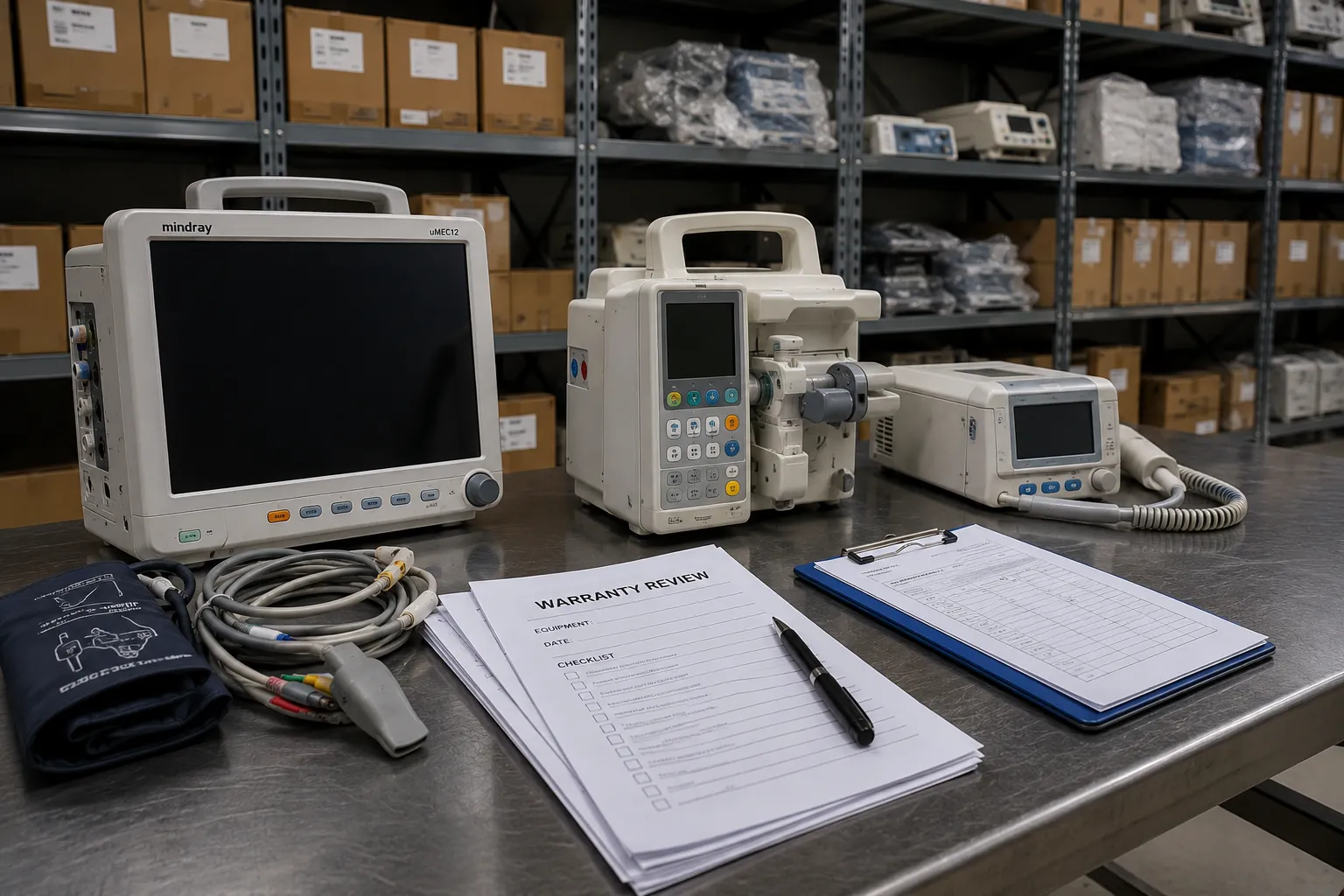
Suppliers and manufacturers advertising to global healthcare buyers should understand that procurement teams increasingly require evidence rather than general claims. Buyers should review manuals, conformity documents, service information, warranty terms, training commitments, and technical data alongside the quotation.
Training and Support — Define who will train clinical users and biomedical personnel, what materials will be provided, and how technical problems will be handled. International buyers should clarify remote support, response times, service locations, and spare-parts access before placing an order.
Compatibility and Future Use — Check whether the proposed equipment is compatible with existing systems, accessories, software, infrastructure, and workflows. Healthcare organisations managing several facilities may benefit from formal international supply chain partnerships that support consistent procurement, documentation, replacement planning, and technical coordination.
The final specification should be retained with the supplier response, evaluation records, acceptance criteria, and relevant supporting documentation.
Include Maintenance Requirements Before Purchase
Maintenance planning should form part of the original technical specification. A device that cannot be serviced efficiently may create avoidable downtime and higher lifecycle costs.
Preventive Maintenance — State expected maintenance intervals and identify whether servicing requires specialist tools, software, calibration equipment, or authorised technicians. The supplier should explain what service records will be provided.
Calibration and Verification — Where equipment measures, controls, or delivers clinically significant outputs, the specification should identify relevant calibration or performance verification requirements. The exact process depends on the equipment and applicable standards.
Spare Parts and Consumables — Identify regularly replaced items and expected availability. International buyers should consider import lead times for proprietary parts, filters, sensors, batteries, and other consumables.
Storage and Cleaning — Include relevant storage, environmental, cleaning, and handling requirements. In practice, inappropriate storage can shorten equipment life even when routine maintenance is performed correctly.
Maintenance costs can have a major effect on total cost of ownership, particularly in markets where authorised technical support is distant or spare parts require international shipment. The specification should therefore address service availability before the purchase is approved.
Consider International Sourcing From the Start
International procurement requires more than selecting a technically suitable product. Buyers must also consider destination-market requirements, shipping, documentation, lead times, and future availability.
Documentation Requirements — Identify the documents required for procurement, shipment, customs clearance, registration, installation, and acceptance. Requirements vary between countries and regions.
New and Refurbished Equipment — If refurbished equipment is acceptable, the specification should define the required condition, refurbishment quality, remaining service life, documentation, warranty, and inspection expectations. New equipment may offer longer expected service life, while suitable refurbished equipment may meet defined requirements at a different lifecycle cost.
Lead Times — Consider manufacturing, availability, export preparation, transport, customs, installation, commissioning, and training. Critical equipment may require contingency planning if delivery is delayed.
Future Availability — Ask whether consumables, spare parts, software support, and replacement units are likely to remain available. A technically suitable product can become difficult to manage if the manufacturer discontinues support soon after purchase.
International sourcing is most effective when the technical specification is clear enough for suppliers to respond with precise compliance information rather than broad product recommendations.
Final Thoughts
A medical equipment technical specification is more than a list of product features. It is a practical bridge between clinical requirements, engineering realities, procurement objectives, regulatory responsibilities, and long-term equipment management.
The strongest specifications define the intended use first, translate that need into measurable performance requirements, consider the deployment environment, establish safety and compliance expectations, and address maintenance and total cost of ownership before purchase. They also allow suppliers to demonstrate compliance clearly and objectively.
For healthcare facilities operating across different regions, the specification should remain technically precise while recognising variations in infrastructure, regulation, service availability, logistics, and clinical workflow. A carefully prepared document gives procurement teams a stronger basis for comparing equipment and helps ensure that the selected solution remains practical beyond the initial delivery.
Disclaimer
Medigear.uk is a global medical equipment supplier, exporter, and distributor. The content published on this site is intended for educational and product awareness purposes only. Nothing on this page constitutes medical advice, clinical guidance, or treatment recommendations. All healthcare procurement and clinical decisions should be made by qualified medical professionals and compliant procurement teams operating within the regulatory frameworks of their respective countries.