Medical equipment can remain unavailable for days or weeks when a small but essential component cannot be sourced quickly. Batteries, circuit boards, probes, cables, filters and sensors may have different suppliers, lead times, storage requirements and compatibility rules.
For hospital buyers and healthcare equipment managers, spare-parts availability should be assessed during equipment procurement rather than after a breakdown occurs. Buyers should confirm which parts fail most frequently, how long replacements take to arrive and whether manufacturer support will remain available throughout the expected equipment life.
Biomedical engineers, procurement teams, stores personnel, and suppliers should work from a single controlled parts record. Unverified components, incorrect part numbers,s or poorly stored stock can delay repairs and lead to unnecessary expenditure.
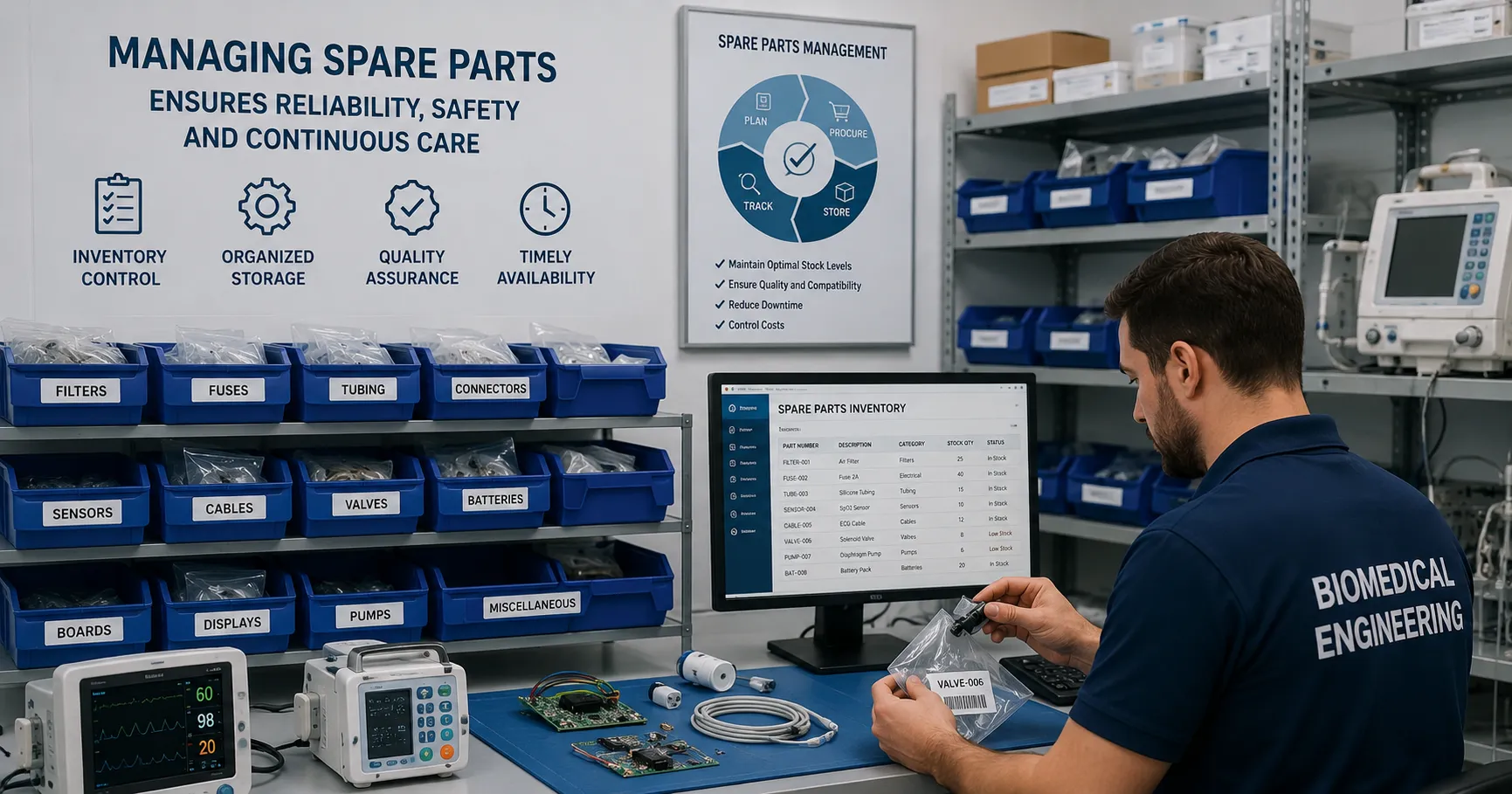
A structured spare-parts management process helps healthcare facilities prioritise critical components, maintain appropriate stock levels, verify compatibility, and prepare for product obsolescence.
Identify Critical Parts Before Equipment Failure
Hospitals should determine which components could create the greatest operational disruption if they become unavailable.
Clinical importance — Parts supporting equipment used in emergency care, critical care, surgery, diagnostics, or continuous monitoring may require priority planning.
Failure consequence — Assess whether a failed component would stop the complete device, reduce functionality or affect only a non-essential feature.
Failure frequency — Review maintenance records to identify batteries, cables, sensors, filters or boards that require repeated replacement.
Supplier lead time — Components sourced internationally may require manufacturing, export documentation, shipping and customs clearance.
Backup availability — Equipment with no practical substitute may justify holding more critical parts locally.
Repair complexity — A component may require specialist tools, software or manufacturer authorisation before installation.
Component cost — Expensive parts should be balanced against equipment value, expected failure rate and remaining support life.
Shelf life — Batteries, adhesives, sterile items and other dated products may expire before they are required.
In practice, biomedical engineering teams often find that inexpensive components create the longest downtime because they were not included in the original support plan.
A critical parts list should be reviewed whenever equipment usage, reliability, or supplier availability changes.
Adapt Spare-Parts Planning to the Healthcare Setting
Stock requirements vary according to facility size, equipment workload, location, and technical support access.
Large and teaching hospitals — High equipment volumes may justify central spare-parts stores, model standardisation and dedicated inventory personnel.
District and regional hospitals — Facilities located away from service centres may need stronger local stock because engineer and parts delivery can take longer.
When working with verified international medical equipment suppliers, hospitals should confirm whether replacement components are available for the exact model, configuration and destination.
Community clinics — Smaller facilities may carry only frequently used accessories and rely on supplier arrangements for specialist parts.
Laboratories and diagnostic centres — Reagent systems, pumps, valves, lamps and sampling components may require close coordination between technical and operational stock.
Critical care and surgical departments — Batteries, patient cables, sensors, and other essential accessories may require rapid replacement to maintain equipment availability.
Mobile and remote services — Transport conditions, limited storage and long delivery routes can affect which parts should be carried with the equipment.
Multi-facility healthcare groups — Centralised stock may reduce duplication, but distribution time between locations should be considered.
Experienced clinical engineering managers typically combine equipment criticality, consumption history and supplier lead time when setting stock priorities.
Build a Controlled Spare-Parts Register
Every replacement component should be linked to the equipment it supports.
Manufacturer name — Record the legal manufacturer rather than relying only on a distributor or reseller description.
Part number — Use the manufacturer’s exact reference number. Similar-looking components may have different performance or compatibility.
Equipment model — Identify every model and configuration with which the component can be used.
Serial-number range — Some replacement parts only support equipment manufactured within specific serial-number ranges.
Hardware and software compatibility — Connected devices may require components that match a specific board, firmware,e or software version.
Part description — Use a clear description that distinguishes the component from related items.
Supplier details — Record approved suppliers, contacts, ordering procedures and expected lead times.
Stock location — Identify the building, store, cabinet, shelf or controlled area where the part is held.
Quantity available — Record current stock, reserved stock and components awaiting inspection.
Expiry or review date — Batteries, sterile items and selected materials may require expiry monitoring or periodic condition checks.
Purchase and issue history — Track when parts were received, issued, returned or installed.
Associated asset record — When a component is used, record the equipment asset number, serial number and service report.
A controlled register reduces duplicate ordering and helps engineers confirm that the correct component is being installed.
Verify Suppliers and Commercial Conditions
Spare-parts purchasing should follow the same due-diligence standards used for complete medical equipment.
Supplier identity — Confirm the legal company name, business address, contact information and payment details.
Manufacturer relationship — Establish whether the supplier is authorised, appointed, independent or sourcing through another distributor.
Compatibility evidence — Request manufacturer references, technical documentation or written confirmation showing that the part supports the intended model.
Accuracy of product claims — Medical equipment companies advertising spare parts to healthcare buyers should ensure that public descriptions match the exact part numbers and compatibility information offered.
New or refurbished condition — The quotation should state whether the component is new, repaired, refurbished or removed from another device.
Warranty coverage — Confirm the warranty duration, activation point and coverage for replacement, labour and return freight.
Unit pricing — Buyers should check minimum order quantities, package quantities and volume-based pricing.
Commercial exclusions — Freight, insurance, customs, engineer attendance and installation may be excluded from the displayed part price.
Return conditions — Review whether incorrectly ordered, defective or incompatible parts can be returned.
Delivery commitment — Suppliers should distinguish stock availability from estimated manufacturer lead time.
Healthcare groups managing recurring replacement-parts requirements may benefit from structured international medical equipment supply partnerships. Each order should still undergo part-number, compatibility and commercial verification.
A low-priced component can become expensive when it cannot be returned, supported or installed on the intended equipment.
Control Stock, Storage and Obsolescence
Spare parts should remain identifiable, protected and available when needed.
Minimum stock level — Set the lowest acceptable quantity based on equipment importance, usage, and delivery lead time.
Reorder point — Trigger replenishment early enough to prevent stock from reaching zero during the supplier lead period.
Maximum stock level — Avoid excessive quantities that may expire, become obsolete or remain unused after equipment replacement.
Stock rotation — Use suitable first-expiry or first-in methods for dated and condition-sensitive components.
Storage environment — Follow the manufacturer's instructions for temperature, humidity, light exposure, and packaging.
Security control — High-value, restricted or easily misplaced components should be stored in controlled-access areas.
Condition inspection — Stored parts may require periodic checks for corrosion, battery swelling, damaged seals or packaging deterioration.
Issue control — Components should only be issued against an approved maintenance or repair request.
Returned parts — Unused or removed components should be labelled clearly to prevent accidental mixing with new stock.
Obsolescence alerts — Monitor manufacturer notices about discontinued equipment, software and component support.
End-of-life stock review — When equipment is replaced, review remaining components for transfer, controlled resale, return, recycling or disposal.
One aspect that surprises first-time buyers is how quickly spare stock loses value when equipment models are replaced without reviewing associated inventory.
Stock records should be reconciled regularly with physical quantities and active equipment models.
Plan International Sourcing and Lifecycle Support
International spare parts sourcing requires additional logistics, documentation, and lead-time controls.
Destination compatibility — Confirm that parts match the equipment version installed at the receiving facility.
Export and import documentation — Commercial invoices, packing lists, product descriptions and origin information should remain consistent.
Shipping method — Urgent components may require faster transport, while heavy or sensitive parts may need specialist packaging.
Cargo protection — Electronic boards, batteries, sensors and optical components may require antistatic, moisture or impact protection.
Customs classification — Incorrect product descriptions can delay clearance and increase delivery uncertainty.
International warranty handling — Clarify who pays return freight, diagnostic charges and replacement shipping when a part fails.
Local installation capability — Confirm whether hospital engineers can install the component or whether authorised technical attendance is required.
Remote technical support — Complex repairs may require secure diagnostics, software access or guided installation support.
Long-term availability — Buyers should ask how long the manufacturer or supplier expects to support the equipment model.
Replacement planning — Repeated shortages, discontinued components or rising repair costs may indicate that equipment replacement should be considered.
Healthcare teams seeking replacement components, supplier quotations, or international equipment support can contact the Medigear.uk team for spare parts sourcing assistance. Enquiries should include the manufacturer, model, serial number, required part number, quantity and destination.
Spare-parts planning should remain connected to equipment maintenance, budgeting and replacement decisions throughout the asset lifecycle.
Final thoughts
Medical equipment spare-parts management helps healthcare facilities reduce repair delays and protect equipment availability.
Hospitals should identify critical components, maintain accurate part records and verify compatibility before purchasing. Stock levels should reflect equipment risk, failure history, shelf life and supplier lead time.
Controlled storage, issue records and obsolescence monitoring help prevent parts from being damaged, misplaced or retained after the supported equipment has been replaced.
A structured spare-parts programme gives biomedical engineers and procurement teams clearer information for maintenance, budgeting and lifecycle planning.
Disclaimer
Medigear.uk is a global medical equipment supplier, exporter, and distributor. The content published on this site is intended for educational and product awareness purposes only. Nothing on this page constitutes medical advice, clinical guidance, or treatment recommendations. All healthcare procurement and clinical decisions should be made by qualified medical professionals and compliant procurement teams operating within the regulatory frameworks of their respective countries.