Medical equipment and supplier proposals can appear similar while offering different technical performance, accessories, service coverage and commercial terms. One quotation may include installation and training, while another covers only the base equipment. A direct comparison of headline prices can therefore produce a misleading result.
For healthcare teams comparing medical equipment and buyers, the process should begin with one controlled set of clinical and technical requirements. Every proposed product and supplier should be assessed against the same criteria before pricing influences the final decision.
Clinical users, biomedical engineers, infection-control representatives, facilities teams and commercial reviewers should contribute where relevant. Their combined input helps identify technical, operational and financial differences that may not be visible in a basic quotation.
This guide explains how healthcare teams can compare medical equipment, assess supplier capability and document a transparent purchasing decision.
Establish a Common Basis for Comparison
Fair comparison is only possible when every supplier receives the same requirement and responds in a consistent format.
Define the clinical purpose — State the examination, monitoring activity, procedure or treatment function the equipment must support. The manufacturer’s intended use should match the facility’s planned application.
In practice, healthcare teams often find that supplier proposals differ because the original requirement was too broad or unclear.
Set measurable performance requirements — Define capacity, measurement range, accuracy, throughput, battery duration or other relevant performance levels.
Separate mandatory and desirable criteria — Mandatory requirements determine whether equipment is acceptable. Desirable criteria can be scored according to their practical value.
Issue one controlled specification — Every supplier should receive the same approved document. Changes should be version-controlled and communicated equally.
Request item-level responses — Suppliers should confirm compliance, identify deviations and provide supporting evidence for each requirement.
Define evaluation responsibility — Clinical, technical and commercial reviewers should understand which parts of the proposal they are authorised to assess.
Set scoring rules before evaluation — Weightings and approval thresholds should be agreed before quotations are opened. This reduces the risk of criteria being changed to favour a particular offer.
A common evaluation structure helps healthcare teams compare evidence rather than sales presentations.
Adapt Comparisons to Different Healthcare Settings
The importance of each comparison criterion depends on where and how the equipment will be used.
Large hospitals and teaching facilities — Major hospitals may compare interoperability, capacity, software integration and multi-department standardisation. Suppliers may also need to demonstrate experience with complex installations.
District and regional hospitals — These facilities may place greater weight on parts availability, engineer response and remote technical support. When reviewing verified global medical equipment suppliers, buyers should confirm that stated service coverage applies to the facility’s exact location.
Experienced clinical supply managers typically request evidence from projects completed in similar operating environments.
Community clinics and outpatient centres — Smaller facilities may prioritise simple controls, compact equipment and predictable maintenance costs. Advanced features should only receive additional value when they support actual services.
Diagnostic and laboratory facilities — Equipment comparisons may include throughput, accuracy, reagent requirements, calibration, quality controls and information-system connectivity.
Surgical and critical care departments — Reliability, alarm performance, backup power and urgent service response may carry greater weight than optional functions.
Mobile and remote healthcare services — Portability, battery duration, protective packaging and environmental tolerance may become essential criteria.
Multi-facility healthcare groups — Standardisation can reduce training, maintenance and inventory complexity. Buyers should still verify suitability at each location.
Comparison criteria should reflect clinical risk, workload and available infrastructure rather than being applied equally to every healthcare setting.
Compare Equipment Performance and Configuration
Technical comparison should establish whether each product can meet the clinical requirement as a complete operating package.
Intended use and scope — Confirm that the manufacturer’s formal intended use supports the facility’s planned service and patient groups.
Performance capability — Compare measurement ranges, accuracy, capacity, throughput, operating limits and other clinically relevant functions.
Complete accessory package — Review probes, patient cables, sensors, batteries, trolleys, mounts and starter consumables. A low base-unit price may exclude essential accessories.
Physical suitability — Compare dimensions, weight, mobility and storage requirements. Equipment must fit available rooms and access routes.
Infrastructure compatibility — Check electrical supply, ventilation, water, drainage, medical gases and network requirements.
Cleaning requirements — Compare permitted cleaning products, reusable accessory procedures and fluid restrictions with facility policies.
Software and connectivity — Review interfaces, licences, data formats, cybersecurity controls, update responsibilities and compatibility with existing systems.
Compliance evidence — Equipment should meet applicable local regulatory standards, including CE, FDA, or their regional equivalents, where relevant. Documents should apply to the exact manufacturer and model.
User documentation — Manuals, installation guides, and technical information should be available in an appropriate language and in a controlled format.
Demonstration results — Complex equipment should be tested through realistic clinical workflows. Demonstration findings should be recorded against predefined criteria.
A technically compliant product should meet the facility’s actual requirements without relying on unconfirmed future upgrades.
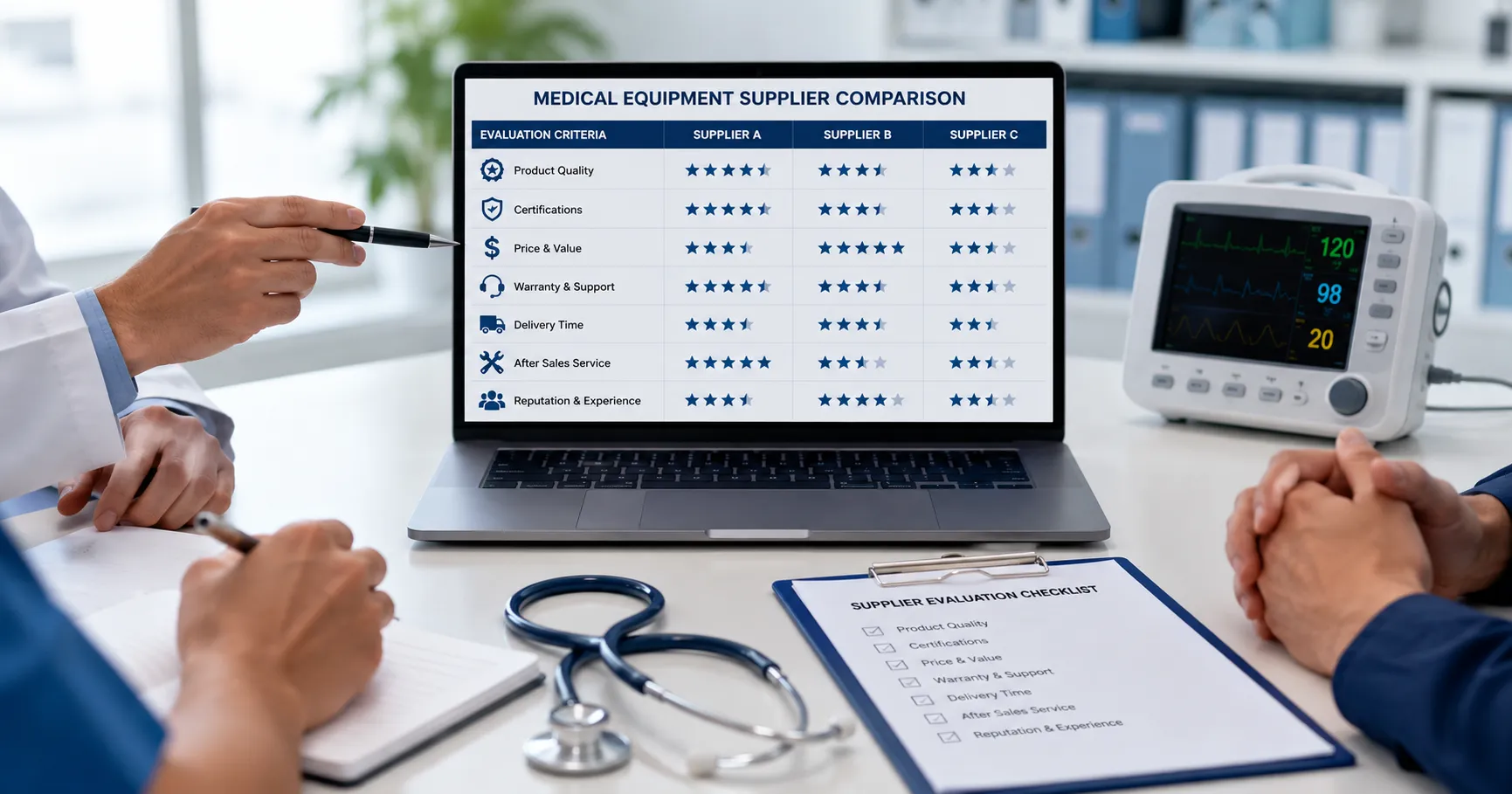
Compare Supplier Capability and Commercial Offers
Supplier comparison should assess whether the organisation can deliver and support the proposed equipment, not simply whether it can issue a competitive quotation.
Legal and commercial identity — Confirm the supplier’s registered business details, address, contact information and authority to supply the proposed product.
Relevant equipment experience — Review experience with the manufacturer, model or equipment category. General medical trading experience may not demonstrate technical capability.
Accuracy of public claims — Healthcare equipment vendors advertising across global markets should present accurate information about product performance, compliance and support. Buyers should compare published claims with formal evidence.
Manufacturer relationship — Determine whether the supplier is authorised, appointed or sourcing through another distribution channel. The relationship may affect warranty and technical support.
Itemised quotation — The proposal should separate equipment, accessories, software, freight, installation, training, maintenance and taxes where applicable.
Commercial exclusions — Buyers should identify whether unloading, customs, engineer travel, calibration, licences or consumables are excluded.
Delivery capability — Review stock status, manufacturing lead time, shipping arrangements and installation capacity.
References and performance history — Comparable customers can provide evidence about communication, delivery, documentation and after-sales service.
Healthcare organisations seeking repeat-supply arrangements may benefit from structured distribution and reseller partnerships. Each order should still use controlled specifications, transparent pricing and documented approval.
Compare Lifecycle Costs and After-Sales Support
Purchase price represents only one part of the total cost of owning medical equipment.
Consumable expenditure — Compare the expected use and price of filters, electrodes, reagents, sensors, cartridges and other recurring items.
Preventive maintenance — Review service frequency, calibration requirements, engineer charges and planned downtime.
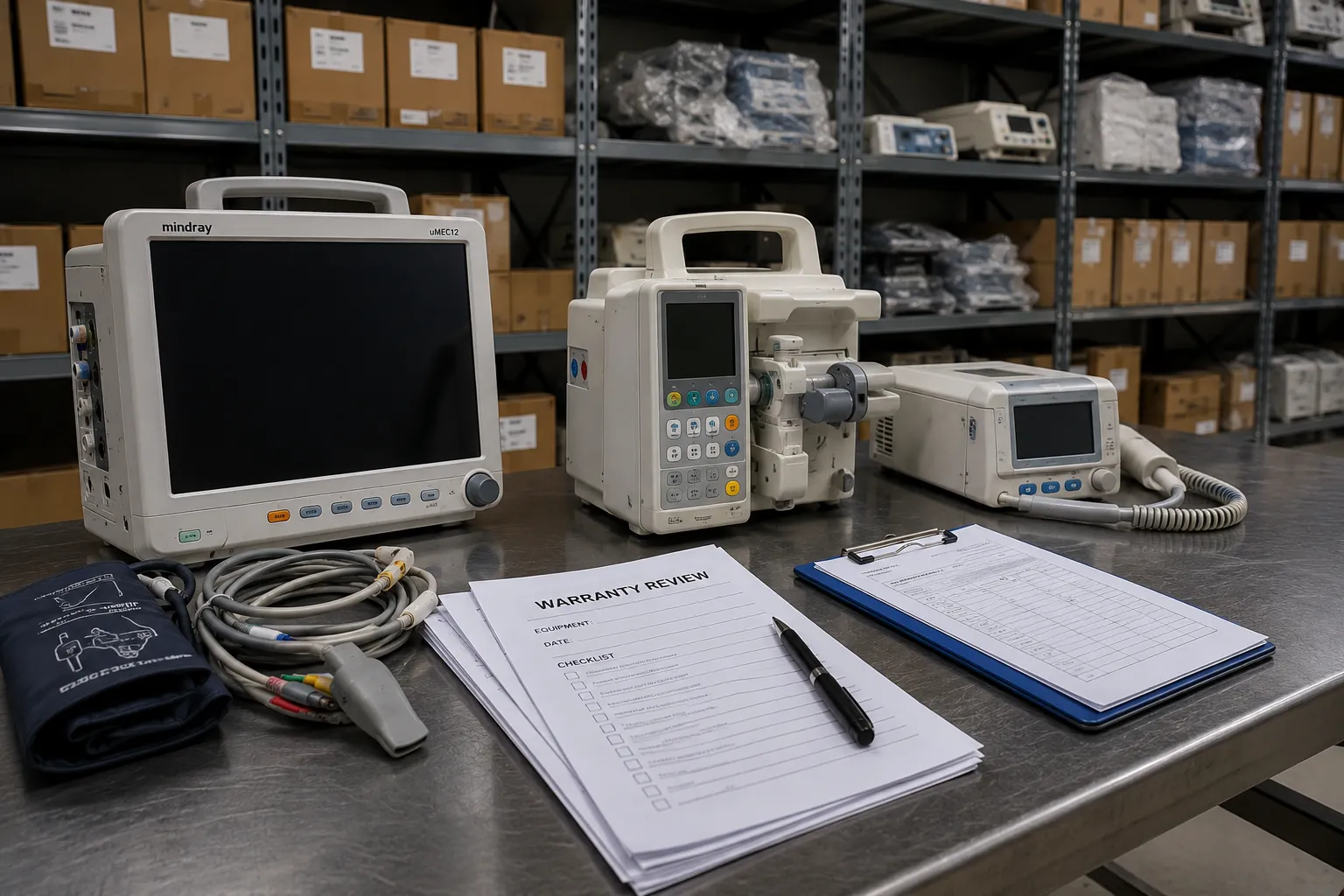
Warranty coverage — Compare warranty duration, starting date, parts, labour, software, freight and engineer travel. Exclusions should be clearly documented.
Corrective maintenance — Buyers should compare fault-reporting procedures, response times and repair responsibilities.
Spare parts availability — Suppliers should confirm the expected support periods and typical lead times for essential components.
Software and licence costs — Connected equipment may require subscriptions, interface licences, updates and cybersecurity support.
Training requirements — Compare included operator and biomedical engineering training. Refresher sessions and training materials may also add value.
Energy and infrastructure costs — High power consumption, cooling or utility requirements can affect long-term operating expenditure.
Expected service life — Compare equipment durability, manufacturer support plans and likely replacement timing.
Downtime risk — Lower-priced equipment can prove costly when repeated failures disrupt service or necessitate emergency alternatives.
A lifecycle comparison helps healthcare teams identify the offer that provides stronger operational value, not merely the lowest initial price.
Control International Sourcing and Final Approval
International supplier comparisons require additional checks because logistics, documentation and support may cross several markets.
Destination-market compliance — Confirm registration, import and conformity requirements before selecting a supplier.
Shipping responsibility — Compare freight, insurance, customs clearance, unloading and final-delivery responsibilities.
Documentation consistency — Manufacturer names, model numbers and product descriptions should match across quotations, invoices, manuals and compliance documents.
New and refurbished equipment — Refurbished products should include condition reports, testing evidence, software details, accessories, service history and warranty coverage.
Payment controls — Compare advance-payment requirements and whether later milestones are linked to shipment, delivery, installation or commissioning.
International warranty coverage — Confirm whether warranty, engineer service and parts delivery apply at the final destination.
Clarification management — All supplier questions and revised offers should be documented. The same material clarification should be shared fairly with competing suppliers.
Final evaluation record — Technical scores, commercial findings, risks, deviations and approval reasons should be retained in the purchasing file.
Specialist comparison assistance — Healthcare teams comparing equipment quotations or international supplier offers can contact Medigear.uk for procurement support. A useful enquiry should include the equipment category, clinical application, quantity, destination and preferred condition.
The final decision should be approved only after technical compliance, commercial value, and supplier capability have been reviewed together.
Final thoughts
Healthcare teams should compare medical equipment and suppliers using a single controlled, transparent evaluation process. Product specifications, supplier capability, costs and after-sales support should be reviewed separately before being combined into the final decision.
The lowest quotation should not automatically receive the highest ranking. Missing accessories, limited warranties, high consumable costs or weak service coverage can significantly affect long-term value.
Clinical users, biomedical engineers and commercial reviewers should contribute according to their responsibilities. Supplier deviations and evaluation decisions should be documented clearly.
A structured comparison helps healthcare facilities select equipment that meets clinical needs while remaining affordable, compliant and supportable throughout its service life.
Disclaimer
Medigear.uk is a global medical equipment supplier, exporter, and distributor. The content published on this site is intended for educational and product awareness purposes only. Nothing on this page constitutes medical advice, clinical guidance, or treatment recommendations. All healthcare procurement and clinical decisions should be made by qualified medical professionals and compliant procurement teams operating within the regulatory frameworks of their respective countries.