
Introduction
An operating theatre is where a hospital's surgery happens, so it has to be a controlled, sterile environment built around the surgeon, the anaesthetist and the patient. Setting one up means bringing together the operating table and lighting, anaesthesia and monitoring, energy devices and sterile instruments — all inside a room with special air handling, piped gases and reliable power.
This guide sets out the full operating theatre equipment list by area, the surrounding infrastructure and safety, the planning sequence, and the approval and compliance points — for a new theatre, a refurbishment, or added surgical capacity, wherever your hospital operates. It focuses on the equipment and environment decisions, and flags where clinical, biomedical and estates input is essential.
A theatre is only as good as the room around the equipment, so the build is shaped by air handling, sterility and the flow of people and instruments as much as by the devices themselves. Bringing in the operating table, the anaesthesia machine and the energy platforms is the visible part; commissioning the ventilation, the medical gases and the sterile-instrument supply is what actually lets a list run safely. Decisions taken early — where the anaesthetic room sits, how clean and dirty routes are kept apart, and how instruments are turned around between cases — shape how smoothly the theatre works for years afterwards.
In practice, the decisions that cause the most trouble later are the ones taken about the room rather than the devices: air handling that is undersized, gas outlets in the wrong place, or too little space around the table for the team and the imaging stack. Getting estates, clinical and biomedical input together early, before the fit-out is fixed, avoids expensive rework. Standardising instrument sets and energy platforms across theatres also makes training, servicing and sterile-supply planning far simpler.
The short version — what every operating theatre is built around
Strip it back, and an operating theatre needs three things — a table and lighting to work over the patient, anaesthesia and monitoring to keep them safe, and sterile instruments and a clean environment.
-
Table & lighting — an operating table and surgical lights to position and see the patient.
-
Anaesthesia & monitoring — an anaesthesia machine, airway equipment and patient monitoring.
-
Sterile field & energy — sterile instrument sets, electrosurgery, and a clean, controlled room.
Operating theatre equipment by area
-
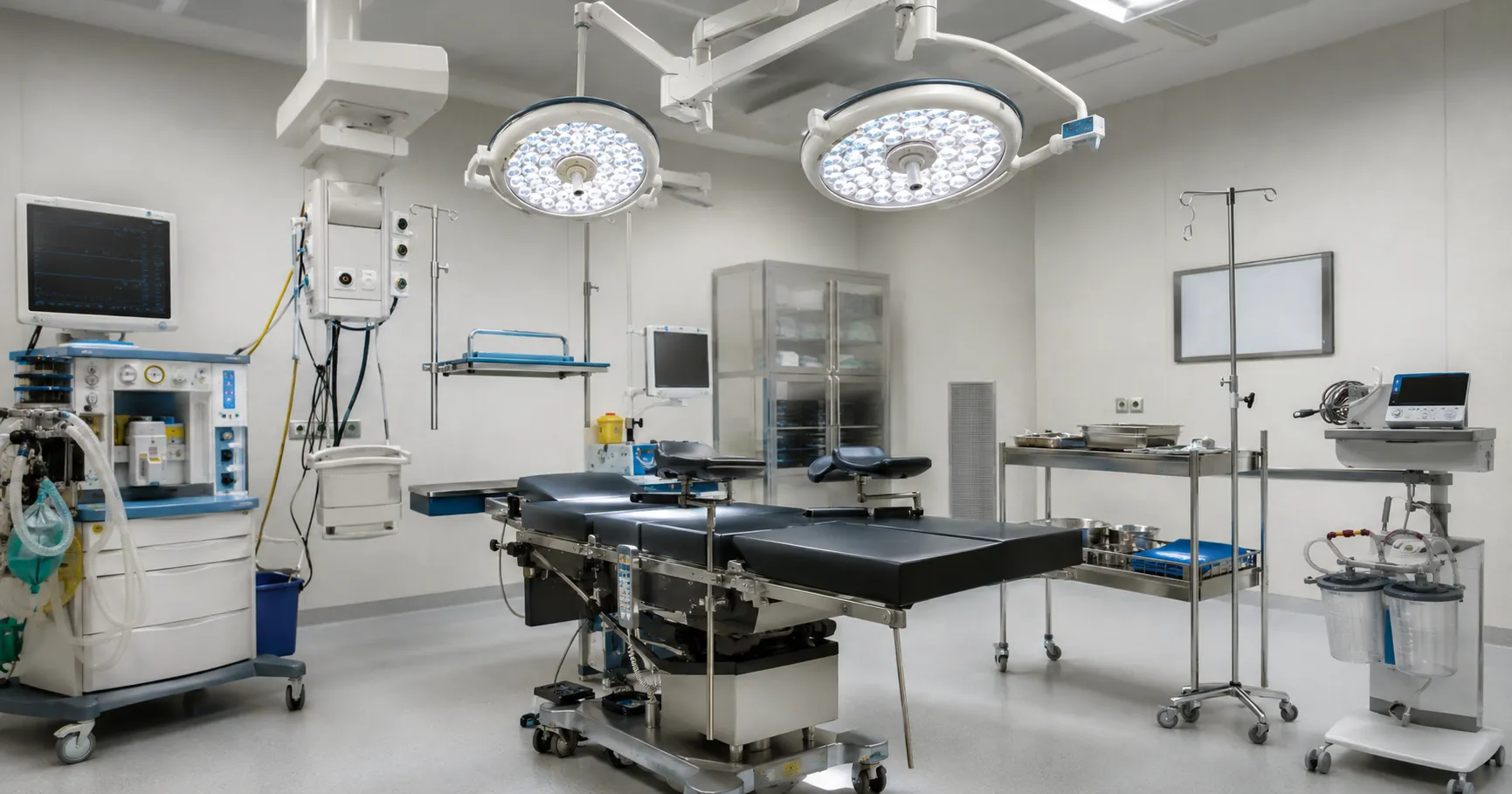
Operating table & positioning. A powered, radiolucent operating table with attachments and positioning aids for different specialities and patient positions, from supine to lateral and lithotomy, and heavier bariatric patients where needed.
-
Surgical lighting. Ceiling-mounted surgical lights, often with a camera, plus examination lighting, giving a shadow-free view of the operative field, however the surgeon and assistants are positioned.
-
Anaesthesia machine & airway. An anaesthesia workstation with ventilator and vaporisers, airway and intubation equipment, gas scavenging, and difficult-airway kit kept immediately to hand.
-
Patient monitoring. Multi-parameter monitors for ECG, oxygen saturation, invasive and non-invasive blood pressure, capnography and temperature throughout the procedure, with depth-of-anaesthesia monitoring where used.
-
Electrosurgery & energy. Electrosurgical (diathermy) units and, where needed, advanced energy and vessel-sealing devices, with smoke evacuation to protect the team from surgical plume.
-
Sterile instruments & sets. Speciality instrument sets, trolleys and drapes, supplied sterile from a sterile services (CSSD) department and tracked through decontamination between cases.
-
Imaging & endoscopy. Mobile C-arm imaging, and laparoscopic or endoscopic stacks with camera, light source and insufflator for minimally invasive work, with recording and screens where teaching, documentation or a shared view is needed.
-
Infrastructure. Theatre-grade air handling and ventilation, piped medical gases, scavenging, and reliable, backed-up power.
Operating theatre equipment checklist
|
Section |
Equipment |
Notes |
|
Table |
Operating table; positioning aids |
Radiolucent, powered |
|
Lighting |
Surgical lights; exam light |
Shadow-free, camera option |
|
Anaesthesia |
Anaesthesia machine; airway; scavenging |
With ventilator |
|
Monitoring |
Multi-parameter monitor |
ECG, SpO2, capnography |
|
Energy |
Electrosurgery; vessel sealing |
Plus smoke evacuation |
|
Sterile |
Instrument sets; trolleys; drapes |
From CSSD |
|
Imaging |
Mobile C-arm; laparoscopic stack |
As specialty requires |
|
Infrastructure |
Air handling; gases; backup power |
Theatre-grade HVAC |
Scale each area to your specialities and throughput — a general theatre and a hybrid or cardiac theatre differ widely in imaging, energy devices and air-handling requirements.
Planning a new theatre?
We'll help you equip it end-to-end. Tell us your specialities, case volumes, budget and market — we'll build the equipment list, balance new and refurbished units, and make sure everything's compliant and supported.
No pressure, no obligation. → Talk to the team
What else does setting up an operating theatre involve
-
Ventilation and air handling. Theatre-grade air handling — filtered air, controlled pressure and air changes — is central to keeping the field sterile and is planned with the room, not added later.
-
Sterile services. A theatre depends on a sterile services department (CSSD) to decontaminate and sterilise instruments; setting up theatres means planning that capacity alongside.
-
Scrub, prep and layout. Dedicated scrub areas, an anaesthetic room where used, and separated clean and dirty flows shape both safety and how smoothly a list runs from one case to the next.
-
Medical gases and scavenging. Piped oxygen, air and vacuum, plus anaesthetic-gas scavenging to protect staff, are core infrastructure planned into the theatre from the outset.
-
Consumables and service. Anaesthesia machines, energy devices and monitors depend on a steady consumable supply and service contracts — factor these into the running model, not just the purchase.
Setting up an operating theatre, step by step
-
Define your specialities, case mix and list volumes — which operations, how many, what complexity.
-
Confirm infrastructure — air handling, medical gases, power and the scrub and clean/dirty layout — and start works early.
-
Build the equipment list by area, sized to your throughput, with the imaging and energy devices your specialities need.
-
Decide new versus refurbished per item and plan sterile-instrument, consumable and service contracts alongside.
-
Install, commission and test everything, verify the air handling, and train the theatre team before go-live.
Air-handling validation and commissioning take time — build them into the schedule so the theatre can open safely, not just with equipment in place.
Budget and procurement
Theatres are equipment- and consumable-intensive, so the purchase price is only part of the story; anaesthesia machines, energy devices and monitors all carry running and service costs. A common approach is to buy new for high-throughput core units and certified refurbished for ancillary equipment. Because these are regulated devices, check the device risk class and the certification for your market. Match the imaging, energy and air-handling specification to the operations you actually perform, so a general theatre is not overbuilt and a hybrid or cardiac theatre is not left short of what it needs.
Approval and accreditation by region
|
Region |
Regulator |
Device requirement |
|
United Kingdom |
UKCA mark (CE accepted to 2028–2030) |
|
|
European Union |
CE marking under the MDR |
|
|
United States |
FDA clearance or approval |
|
|
Gulf (GCC) |
SFDA & GCC bodies |
National registration / GCC conformity |
|
South Africa |
Medical device licensing |
Surgical and anaesthetic devices are regulated, so confirm each is approved for your market. Anaesthetic and surgical devices are used on anaesthetised patients, so approval, servicing and medical-gas safety are central to running a theatre. For quality standards and clinical guidance, the World Health Organisation and NICE are useful references. If you're equipping an operating theatre, our buyer hub sets out how to purchase with confidence.
More from Business
-
Buyers — source a full operating theatre equipment package for your hospital.
-
Suppliers — list your equipment and reach buyers worldwide.
-
Advertise — promote your products and services to a clinical audience.
-
Business overview — explore everything MediGear offers healthcare organisations.
Disclaimer
This article is for general information only and does not constitute clinical, medical, procurement, engineering or regulatory advice. Theatre design, equipment, air handling, medical gases and safety requirements vary by country, speciality and facility, and change over time. The checklist is a general planning aid, not a specification — always work with qualified clinical, biomedical, facilities and procurement professionals, and confirm that every device is approved for your market (for example, UKCA, CE, FDA, SFDA/GCC or SAHPRA). medigear.uk accepts no liability for actions taken based on this content.
Equip your theatre end-to-end.
From operating tables and surgical lights to anaesthesia machines, monitors and energy devices, we help hospitals across the UK, Europe, the US, the Gulf and South Africa build operating theatres — compliant, supported and on budget.
Frequently Asked Questions
An operating theatre needs an operating table and positioning aids, surgical lights, an anaesthesia machine with airway equipment, multi-parameter patient monitoring, electrosurgery and energy devices, sterile instrument sets, and often mobile imaging or a laparoscopic stack — all inside a room with theatre-grade air handling and piped medical gases. The exact kit depends on the specialties served.
The main areas are the operating table and positioning, surgical lighting, the anaesthesia machine and airway, patient monitoring, electrosurgery and energy devices, sterile instruments and sets, imaging and endoscopy, and the underlying infrastructure of air handling, gases and backup power. These areas are planned together, because a theatre only works when the room, the gases and the equipment are designed as one.
Costs depend heavily on the specialties, the imaging and energy devices required, and the air-handling works, so there is no single figure. Because theatres are consumable- and service-intensive, weigh the purchase price against running and service costs over the life of each device rather than the upfront price alone.
Yes, for many items. High-use core devices are often bought new, while certified refurbished units can be sensible for tables, lights and ancillary equipment. Every device must be approved for your market and fully supported with service and consumables, whether new or refurbished.
It varies with scale and whether air-handling and gas works are needed, but planning, equipping, commissioning and validating a theatre typically takes several months. Air-handling validation and staff training are the parts most often underestimated, so build them into the schedule from the start.
A theatre needs theatre-grade air handling with filtered air and controlled pressure, piped medical gases and anaesthetic-gas scavenging, reliable and backed-up power, and dedicated scrub and clean/dirty layouts. This infrastructure is planned with the room from the outset, not added afterwards, because retrofitting air handling or gases into an unsuitable room is slow and costly.