
Introduction
An oncology unit delivers cancer treatment, most often chemotherapy and supportive care, so its equipment is built around safe, comfortable infusion and the careful handling of powerful, hazardous drugs. Setting one up means fitting out a chemotherapy day unit with treatment chairs and infusion pumps, safe-handling and emergency provision, and the monitoring and support patients need, closely linked to a pharmacy that prepares the drugs.
This guide sets out the full oncology unit equipment list by area, the surrounding infrastructure and safety, the planning sequence, and the approval and compliance points — for a new unit, an expansion, or added chemotherapy capacity, wherever your hospital operates. It focuses on the equipment and safe-handling decisions, and flags where clinical, pharmacy and safety input is essential. It covers medical oncology; radiotherapy is a separate, specialist facility.
What shapes an oncology unit most is that its treatments are both long and hazardous. Chemotherapy is given over hours, often repeatedly over months, so the unit is built for comfort and close observation, with treatment chairs, infusion pumps and monitoring for patients who may spend a whole day receiving care. At the same time, the drugs are cytotoxic, hazardous to staff as well as therapeutic to patients, so safe handling, spill management and the link to an aseptic pharmacy that prepares doses are central. The unit sits between a comfortable day facility and a controlled, safety-critical environment.
In practice, the decisions that matter most are about safe handling, the pharmacy link and patient comfort rather than any single device. Because cytotoxic drugs are prepared in a pharmacy clean room and given on the unit, the two are planned together so doses arrive safely and on time. Emergency provision for reactions and extravasation has to be immediately available wherever treatment is given. Standardising infusion pumps and monitoring simplifies training and safety, while comfortable, well-observed treatment spaces recognise that patients often spend long, repeated sessions receiving care.
The short version — what every oncology unit is built around
Strip it back, and an oncology unit needs three things — comfortable, well-monitored infusion, safe handling of hazardous drugs, and emergency provision for reactions.
-
Infusion & comfort — treatment chairs and infusion pumps for long chemotherapy sessions.
-
Safe handling — cytotoxic safe-handling, spill management and a link to aseptic pharmacy preparation.
-
Monitoring & emergency — observation and immediate provision for reactions and extravasation.
Oncology unit equipment by area
-
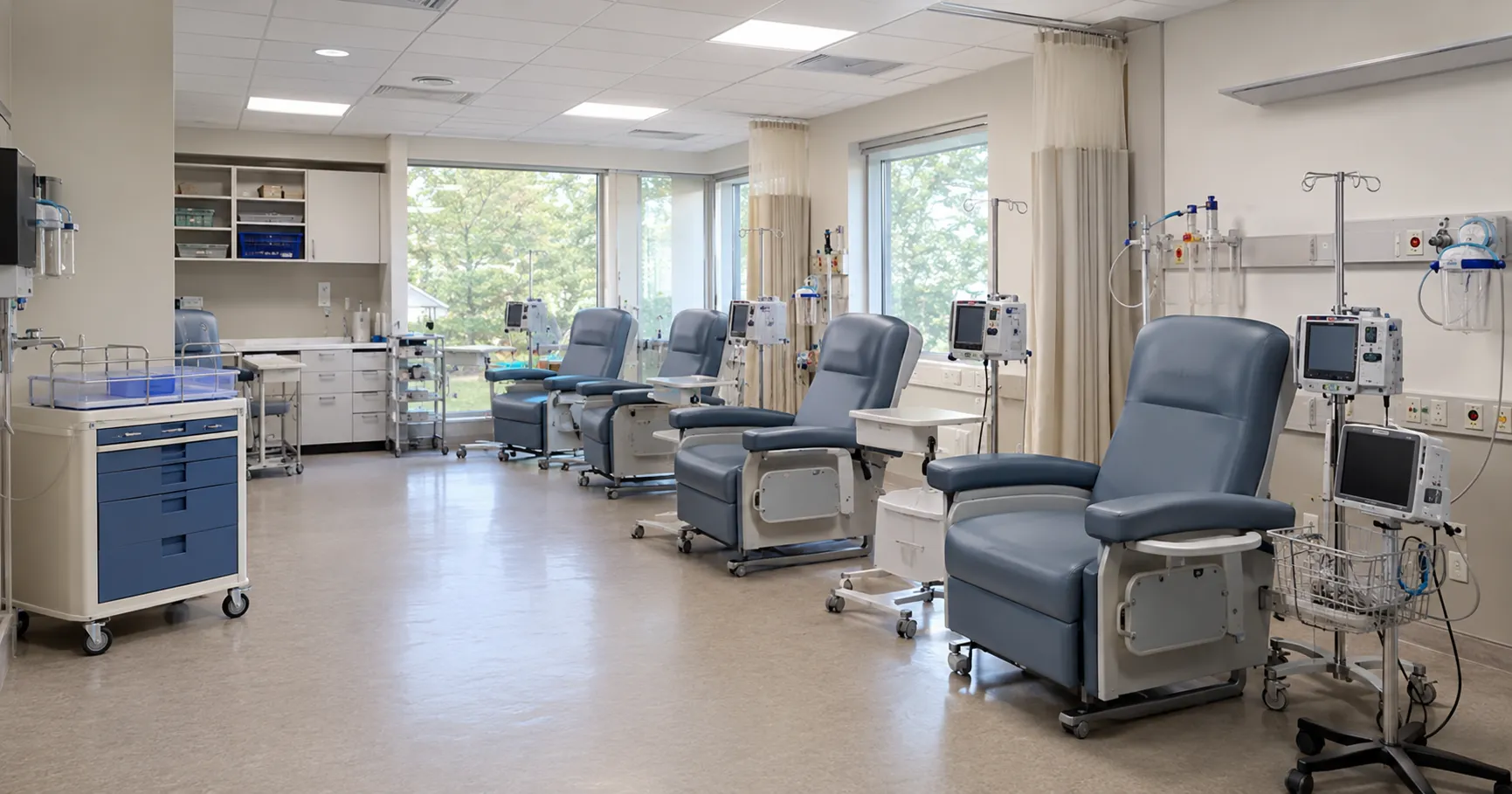
Chemotherapy chairs & day unit. Comfortable, adjustable treatment chairs and a day-unit layout for patients receiving infusions that may last several hours at a time, often on repeated visits.
-
Infusion pumps. Volumetric and syringe infusion pumps to deliver chemotherapy and supportive fluids accurately and at controlled rates.
-
Cytotoxic safe handling. Spill kits, personal protective equipment, closed-system transfer devices and safe-disposal provision, since chemotherapy drugs are hazardous to staff as well as therapeutic to patients.
-
Monitoring & observation. Patient monitoring and observation for people who may react to treatment or become unwell during long sessions.
-
Treatment & consulting. Consulting and examination rooms and treatment equipment for assessment, review and minor procedures alongside infusions.
-
Emergency provision. Equipment for managing anaphylaxis, extravasation and other reactions, immediately available wherever chemotherapy is given.
-
Pharmacy link. Close working with an aseptic pharmacy that prepares cytotoxic doses safely, so drugs arrive ready, correct and on time for each patient's regimen.
-
Infrastructure. Reliable power, safe storage and disposal for hazardous drugs and waste, and a calm, comfortable treatment environment.
Oncology unit equipment checklist
|
Section |
Equipment |
Notes |
|
Chairs/day unit |
Chemotherapy chairs; day-unit layout |
Long, comfortable sessions |
|
Infusion |
Volumetric + syringe pumps |
Controlled delivery |
|
Safe handling |
Spill kits; PPE; closed systems |
Hazardous drugs |
|
Monitoring |
Patient monitors; observation |
Reactions, wellbeing |
|
Treatment |
Consulting/exam; treatment kit |
Assess and review |
|
Emergency |
Anaphylaxis; extravasation provision |
Immediately available |
|
Pharmacy link |
Aseptic cytotoxic preparation |
Correct, on time |
|
Infrastructure |
Power; hazardous storage/disposal |
Calm environment |
Scale each area to your patient numbers and regimens — a small day unit and a large cancer centre giving complex regimens differ widely in chairs, pumps and pharmacy support.
Planning a new oncology unit?
We'll help you equip it end-to-end. Tell us your patient numbers, regimens, budget and market — we'll build the equipment list, balance new and refurbished units, and make sure everything's compliant and supported.
No pressure, no obligation. → Talk to the team
What else does setting up an oncology unit involve
-
Safe handling of hazardous drugs. Chemotherapy drugs are hazardous to staff, so safe handling, closed-system devices, spill management and safe disposal are central to the unit's design and equipping from the outset, not optional add-ons.
-
The pharmacy link. Cytotoxic doses are prepared in an aseptic pharmacy and given on the unit, so the two are planned together, and space and timing are arranged, so drugs arrive correct, safe and on time for each patient.
-
Patient comfort and observation. Patients may spend long sessions receiving treatment, so comfortable chairs and close observation shape the unit as much as the infusion equipment itself.
-
Emergency readiness. Reactions and extravasation can happen during treatment, so emergency equipment and provision are immediately available wherever chemotherapy is given.
-
Consumables, staffing and service. Infusion, safe-handling and treatment consumables, trained oncology nurses, and service and safe-handling contracts all shape the running model over time, not just the purchase of the equipment.
Setting up an oncology unit, step by step
-
Define your patient numbers and regimens — routine day-unit chemotherapy or complex regimens — and expected volumes.
-
Confirm infrastructure and the pharmacy link — safe handling, storage and disposal, aseptic preparation and space — and start works early.
-
Build the equipment list by area, sized to your patients, with safe-handling and emergency provision throughout.
-
Decide new versus refurbished per item and plan consumables, safe-handling and service contracts alongside.
-
Install, commission and test everything, set up safe handling and emergency provision, and train the team before go-live.
Safe-handling setup and the pharmacy link take time — build them into the schedule so the unit can open safely, not just with equipment in place.
Budget and procurement
Oncology is consumable- and service-intensive, so the purchase price is only part of the story; chairs, infusion pumps, safe-handling provision and treatment consumables all carry running and service costs. A common approach is to buy new for high-throughput core units and certified refurbished for ancillary equipment. Because these are regulated devices, check the device risk class and the certification for your market. Match chair and pump numbers and pharmacy support to your patient throughput and regimens, so treatment capacity is never limited by chairs, pumps or drug preparation.
Approval and accreditation by region
|
Region |
Regulator |
Device requirement |
|
United Kingdom |
UKCA mark (CE accepted to 2028–2030) |
|
|
European Union |
CE marking under the MDR |
|
|
United States |
FDA clearance or approval |
|
|
Gulf (GCC) |
SFDA & GCC bodies |
National registration / GCC conformity |
|
South Africa |
Medical device licensing |
Oncology equipment and cytotoxic handling are regulated, so confirm each device is approved and each process is safe for your market. Cytotoxic preparation and safe handling are governed by specific safety standards on top of device approval, so plan for both. For quality standards and clinical guidance, the World Health Organisation and NICE are useful references. If you're equipping an oncology unit, our buyer hub sets out how to purchase with confidence.
More from Business
-
Buyers — source a full oncology unit equipment package for your hospital.
-
Suppliers — list your equipment and reach buyers worldwide.
-
Advertise — promote your products and services to a clinical audience.
-
Business overview — explore everything MediGear offers healthcare organisations.
Disclaimer
This article is for general information only and does not constitute clinical, medical, procurement, engineering or regulatory advice. Oncology design, equipment, safe handling, pharmacy links and safety requirements vary by country, service and facility, and change over time. The checklist is a general planning aid, not a specification — always work with qualified clinical, biomedical, facilities and procurement professionals, and confirm that every device is approved for your market (for example, UKCA, CE, FDA, SFDA/GCC or SAHPRA). medigear.uk accepts no liability for actions taken based on this content.
Equip your oncology unit end-to-end.
From chemotherapy chairs and infusion pumps to safe-handling and monitoring equipment, we help hospitals across the UK, Europe, the US, the Gulf and South Africa build oncology units — compliant, supported and on budget.
Frequently Asked Questions
A medical oncology unit needs comfortable chemotherapy treatment chairs and a day-unit layout, volumetric and syringe infusion pumps, cytotoxic safe-handling provision such as spill kits, personal protective equipment and closed-system devices, patient monitoring, emergency provision for reactions and extravasation, and a close link to an aseptic pharmacy that prepares the drugs. Safe handling is as central as the infusion itself.
The main areas are chemotherapy chairs and the day unit, infusion pumps, cytotoxic safe handling, monitoring and observation, treatment and consulting, emergency provision, the pharmacy link, and the underlying safe storage, disposal and environment. These are planned together, because chemotherapy is both a long treatment and a hazardous one.
Costs depend on patient numbers, the regimens given and the pharmacy support required, so there is no single figure. Because oncology is consumable- and service-intensive, weigh the purchase price against running and service costs over the life of each device rather than the upfront price alone.
Yes, for many items. Certified refurbished treatment chairs and infusion pumps can be sensible, provided they are fully supported and reliable. Every device must be approved for your market and fully supported with service and consumables, and safe-handling provision must meet the standards that apply, whether new or refurbished.
It varies with the scale and whether aseptic pharmacy works are involved, but planning, equipping, commissioning and training typically take several months. Safe-handling setup, the pharmacy link and staff training are the parts most often underestimated, so build them into the schedule from the start.
An oncology unit needs reliable power, safe storage and disposal for hazardous drugs and waste, a close link to an aseptic pharmacy for cytotoxic preparation, and a comfortable, well-observed treatment environment. This infrastructure and safe handling matter as much as the infusion equipment, because chemotherapy is hazardous as well as therapeutic.