
Introduction
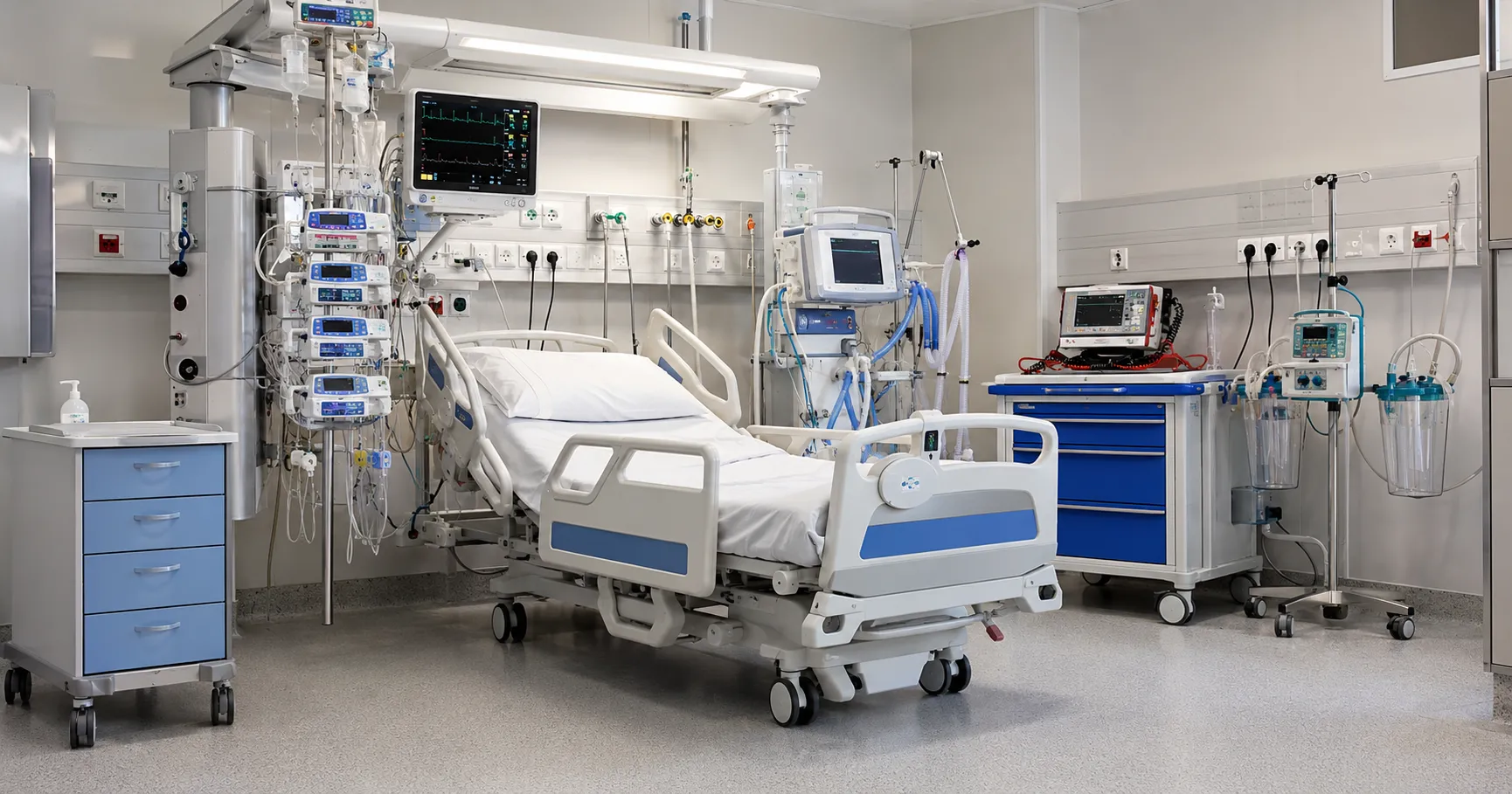
An intensive care unit exists to support patients whose organs are failing, so its equipment has to keep breathing, circulation and vital functions going without interruption. Setting one up means bringing together life support, continuous monitoring and organ support around every bed — all on infrastructure that cannot fail, with medical gases, uninterruptible power and a network tying it together.
This guide sets out the full ICU equipment list by area, the surrounding infrastructure and safety, the planning sequence, and the approval and compliance points — for a new unit, an expansion, or added critical-care capacity, wherever your hospital operates. It focuses on the equipment and infrastructure decisions, and points to where clinical, biomedical and estates input is essential.
Because an ICU never closes, resilience runs through every choice. Equipment is bought in enough quantity to cover breakdowns, servicing and cleaning, spares and loan arrangements are planned, and every device has to work with the others gathered around a single bed. That makes an ICU less a shopping list than a system: the monitor, the ventilator and the infusion pumps are chosen so they talk to each other and to the hospital record, alarms are managed so staff hear what matters, and the whole assembly is designed to keep running when part of it fails or is taken out of service.
In practice, the hardest part is rarely choosing a ventilator or a monitor; it is making sure the whole set works together and keeps working. Standardising on a small number of device types across the unit simplifies training, servicing and the stock of consumables, and reduces the chance of error when staff move between beds. Planning spare capacity, loan arrangements and a clear maintenance schedule from the outset is what keeps every bed genuinely available rather than merely equipped.
The short version — what every ICU is built around
Strip it back, and an ICU needs three things — equipment that supports failing organs, monitoring that never looks away, and infrastructure robust enough to run continuously.
-
Life support — ventilators and airway equipment to support or replace breathing.
-
Monitoring — multi-parameter monitors watching heart, oxygen, pressure and more, continuously.
-
Organ support & infrastructure — infusion pumps, renal support, and fail-safe power and gases.
ICU equipment by area
-
Ventilation & airway. Invasive and non-invasive ventilators, humidifiers, and airway equipment, with high-flow oxygen and suction at every bed, plus transport ventilators for moving unstable patients to imaging or theatre.
-
Patient monitoring. Multi-parameter monitors for ECG, oxygen saturation, invasive and non-invasive blood pressure, capnography and temperature, feeding a central station so a small team can watch several patients at once.
-
Infusion & drug delivery. Volumetric and syringe pumps in quantity, since critically ill patients often run many precise infusions at once, from sedation and inotropes to nutrition and fluids.
-
Haemodynamic support. Defibrillators, external pacing, and cardiac-output monitoring for unstable patients, with resuscitation trolleys stocked and checked so a deteriorating patient can be treated within seconds.
-
Renal support. Continuous renal replacement therapy (CRRT) machines for acute kidney injury, with consumables and water where haemodialysis is used.
-
Beds & patient handling. ICU beds with pressure-relieving mattresses, weighing and tilt, plus hoists and lateral-transfer aids, because ICU patients are often sedated, ventilated and unable to move themselves.
-
Point-of-care & imaging. Blood-gas analysers, glucose and lactate testing, portable ultrasound and access to mobile X-ray, so unstable patients are investigated without leaving the unit.
-
Infrastructure. Piped medical gases, uninterruptible and backup power, alarm integration and a network linking monitors to the hospital record.
ICU equipment checklist
|
Section |
Equipment |
Notes |
|
Ventilation |
Ventilators; humidifiers; suction; high-flow oxygen |
One per bed, plus spares |
|
Monitoring |
Multi-parameter monitors; central station |
Continuous, networked |
|
Infusion |
Volumetric + syringe pumps |
Several per bed |
|
Resuscitation |
Defibrillator; crash trolley; pacing |
Immediately available |
|
Renal |
CRRT / dialysis machine |
For acute kidney injury |
|
Beds |
ICU beds; pressure mattresses; hoists |
Weighing, tilt |
|
Point-of-care |
Blood-gas analyser; ultrasound |
Bedside testing |
|
Infrastructure |
Medical gases; UPS/backup power; network |
Fail-safe, monitored |
Scale each area to your bed numbers and case mix — a district general ICU and a tertiary unit with cardiac or neuro cases differ widely in monitoring depth and organ-support capacity.
Planning a new ICU?
We'll help you equip it end-to-end. Tell us your bed count, case mix, budget and market — we'll build the equipment list, balance new and refurbished units, and make sure everything's compliant and supported.
No pressure, no obligation. → Talk to the team
What else does setting up an intensive care unit (ICU) involve
-
Medical gases and power. Piped oxygen, air and vacuum at every bed, with uninterruptible and backup power, are the non-negotiable foundation — nothing else matters if they fail.
-
Infection prevention. Isolation capacity, hand-hygiene provision, and easily cleaned surfaces and equipment protect a vulnerable, invasively managed patient group.
-
Alarms and integration. Monitors, ventilators and pumps generate constant alarms; plan how they are managed and integrated so staff are alerted without being overwhelmed.
-
Staffing and training. An ICU runs on a high nurse-to-patient ratio and skilled medical cover; equipment choices should match the team's training and competence.
-
Consumables and service. Ventilators, monitors and pumps depend on a steady consumable supply and service contracts with calibration — build these into the running model, not just the purchase.
Setting up an intensive care unit (ICU), step by step
-
Define the bed count, level of care and case mix — which patients, how many beds, what complexity.
-
Confirm infrastructure — medical gases, power resilience, isolation and bed-space layout — and start works early.
-
Build the equipment list by area, sized to your beds, with the right monitoring depth and organ support.
-
Decide new versus refurbished per item and plan consumable and service contracts alongside.
-
Install, commission and test everything, integrate monitoring and alarms, and train the team before go-live.
Commissioning and staff training take time — build them into the schedule so the unit can open safely, not just with equipment in place.
Budget and procurement
ICUs are equipment- and consumable-intensive, so the purchase price is only part of the story; monitors, ventilators and pumps all carry running and service costs. A common approach is to buy new for high-throughput core units and certified refurbished for ancillary equipment. Because these are regulated devices, check the device risk class and the certification for your market. Match the depth of monitoring and organ support to the level of care each bed provides, so a high-dependency bed and a fully ventilated bed are each equipped for what they actually do rather than to a single standard.
Approval and accreditation by region
|
Region |
Regulator |
Device requirement |
|
United Kingdom |
UKCA mark (CE accepted to 2028–2030) |
|
|
European Union |
CE marking under the MDR |
|
|
United States |
FDA clearance or approval |
|
|
Gulf (GCC) |
SFDA & GCC bodies |
National registration / GCC conformity |
|
South Africa |
Medical device licensing |
Critical-care devices are regulated, so confirm each is approved for your market. Critical-care equipment is often used continuously and invasively, so approval, servicing and a dependable consumable supply all matter to keep a bed open safely. For quality standards and clinical guidance, the World Health Organisation and NICE are useful references. If you're equipping an intensive care unit (ICU), our buyer hub sets out how to purchase with confidence.
More from Business
-
Buyers — source a full ICU equipment package for your hospital.
-
Suppliers — list your equipment and reach buyers worldwide.
-
Advertise — promote your products and services to a clinical audience.
-
Business overview — explore everything MediGear offers healthcare organisations.
Disclaimer
This article is for general information only and does not constitute clinical, medical, procurement, engineering or regulatory advice. Critical-care design, equipment, infrastructure, staffing and safety requirements vary by country, level of care and facility, and change over time. The checklist is a general planning aid, not a specification — always work with qualified clinical, biomedical, facilities and procurement professionals, and confirm that every device is approved for your market (for example, UKCA, CE, FDA, SFDA/GCC or SAHPRA). medigear.uk accepts no liability for actions taken based on this content.
Equip your ICU end-to-end.
From ventilators and patient monitors to infusion pumps, renal support and ICU beds, we help hospitals across the UK, Europe, the US, the Gulf and South Africa build intensive care units — compliant, supported and on budget.
Frequently Asked Questions
An ICU needs ventilators and airway equipment, multi-parameter patient monitors, plenty of infusion and syringe pumps, defibrillators and resuscitation trolleys, renal support such as CRRT, ICU beds with pressure-relieving mattresses, and point-of-care testing such as blood-gas analysers — all on resilient medical gases and power. Quantities scale with the number of beds and the level of care.
The main areas are ventilation and airway support, continuous patient monitoring, infusion and drug delivery, haemodynamic and resuscitation support, renal support, beds and patient handling, point-of-care testing, and the underlying infrastructure of medical gases, backup power and networking. Planning these areas together, on resilient infrastructure, is what produces a unit that works as a whole rather than a collection of devices.
Costs depend on the number of beds, the level of care and how much monitoring and organ support each bed needs, so there is no single figure. Because ICUs are consumable- and service-intensive, weigh the purchase price against running and service costs over the life of each device rather than the upfront price alone.
Yes, for many items. High-use core devices such as ventilators and monitors are often bought new, while certified refurbished units can be sensible for beds, pumps and ancillary equipment. Every device must be approved for your market and fully supported with service and consumables, whether new or refurbished.
It varies with the scale and whether infrastructure works are needed, but planning, equipping, commissioning and training typically take several months. Medical-gas and power works, plus staff training and commissioning, are the parts most often underestimated, so build them into the schedule from the start.
An ICU needs piped medical gases (oxygen, air and vacuum) at every bed, uninterruptible and backup power, isolation capacity for infection control, integrated alarm management, and a network linking monitors and devices to the hospital record. This infrastructure is as important as the clinical equipment itself.