
Introduction
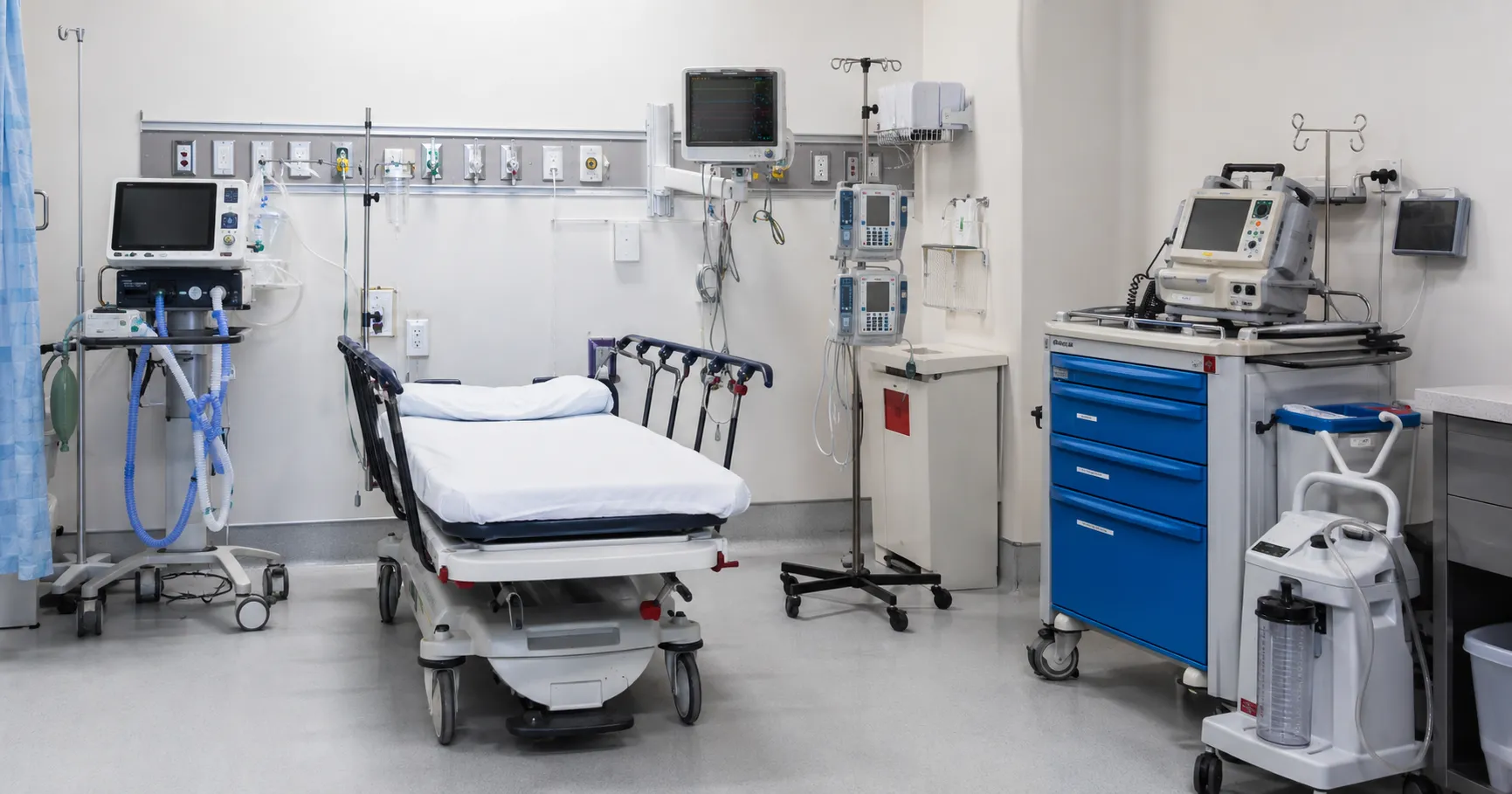
An emergency department has to be ready for anything, instantly. Resuscitation, airway, monitoring and rapid imaging decide outcomes in the first minutes, so an ED that's well-equipped, fast and well-organised is the foundation of emergency care.
This guide sets out the full emergency department equipment list by area, the resuscitation and monitoring kit, the planning sequence, and the compliance points — for a new build, an expansion, or an upgrade, wherever you operate.
The short version — what every emergency department is built around
Strip it back, and an ED needs three things — a resuscitation kit to save lives fast, monitoring to watch every patient, and the airway and imaging to stabilise and diagnose.
-
Resuscitation — defibrillators, crash carts and emergency trolleys ready at a moment's notice.
-
Monitoring & airway — multi-parameter monitors, oximeters, ventilators and suction to stabilise patients.
-
Trauma & imaging — trolleys, immobilisation, mobile X-ray and point-of-care ultrasound for rapid assessment.
Emergency department equipment by area
-
Resuscitation. Defibrillators (manual and AED), fully stocked crash carts and resuscitation trolleys for cardiac and trauma emergencies.
-
Airway & breathing. Laryngoscopes, intubation kit, bag-valve masks, transport and ED ventilators, and portable suction units.
-
Monitoring. Multi-parameter monitors, pulse oximeters and ECG machines at every resus and majors bay.
-
Trauma & immobilisation. Trolleys and stretchers, spinal boards, scoop stretchers, cervical collars and splints for trauma handling.
-
Circulation & infusion. Infusion and syringe pumps, rapid fluid infusers and fluid warmers for resuscitation.
-
Point of care. Blood-gas analysers, glucometers and point-of-care ultrasound (POCUS) for rapid bedside decisions.
-
Imaging. Mobile X-ray and portable ultrasound, with quick access to CT for major trauma.
-
Procedures & oxygen. Minor-procedure and suturing sets, plaster (POP) facilities, nebulisers and piped oxygen at every bay.
Emergency department equipment checklist
|
Section |
Equipment |
Notes |
|
Resuscitation |
Defibrillators; crash carts; resus trolleys |
Resus bays |
|
Airway |
Laryngoscopes; ventilators; BVM; suction |
Intubation kit |
|
Monitoring |
Multi-parameter monitors; oximeters; ECG |
Every bay |
|
Trauma |
Trolleys; spinal boards; collars; splints |
Immobilisation |
|
Infusion |
Infusion/syringe pumps; rapid infuser; warmer |
Resuscitation |
|
Point of care |
Blood-gas analyser; glucometer; POCUS |
Bedside |
|
Imaging |
Mobile X-ray; portable ultrasound |
CT nearby |
|
Procedures |
Minor-ops/suture sets; POP; nebulisers; O2 |
At each bay |
Scale each area to your attendance and case mix — a district A&E and a major trauma centre differ widely in resuscitation bays, imaging and intensive-care links.
Building or expanding an emergency department?
We'll help you equip it end-to-end. Tell us your attendance, your number of bays, your budget and your market — we'll build the equipment list, balance new and refurbished units, and make sure everything's compliant and supported.
No pressure, no obligation. → Talk to the team
What else does setting up an emergency department involve
-
Layout & flow. Triage, resus, majors, minors and a clear patient pathway shape both speed and safety — design the flow before the equipment.
-
Medical gases & power. Oxygen, air, vacuum and backup power at every bay are essential — plan the services to your bay count.
-
Stock & readiness. Crash carts, airway trolleys and consumables must be checked, sealed and ready — build daily checks into the model.
-
Imaging & lab links. Fast access to X-ray, CT and the lab is part of the ED design — plan the links and turnaround times early.
-
Infection control & decontamination. Isolation space, decontamination facilities and cleanable surfaces let the ED handle infectious and contaminated patients safely.
Setting up an emergency department, step by step
-
Define your role and attendance — minor injuries, district A&E or major trauma — and the case mix.
-
Confirm the layout, medical gases, power and imaging links — and start works early.
-
Build the equipment list by area, sized to your bays, with resuscitation and monitoring to match.
-
Decide new vs refurbished per item and plan consumables, gases and service contracts alongside.
-
Install and commission equipment, stock the crash carts, connect imaging, and prepare to open.
Commissioning and readiness checks take time — build them into the schedule so the department opens fully ready, not just equipped.
Budget and procurement
An ED mixes big-ticket monitoring and imaging with a constant flow of consumables, so the purchase price is only part of the story. A common approach is to buy new for defibrillators and ventilators and certified refurbished for monitors, trolleys and ancillary kit. Because emergency devices are regulated, check the device risk class and the certification for your market, and align the ED with your plans for intensive care, radiology and the operating theatre.
Approval and compliance by region
|
Region |
Regulator |
Device requirement |
|
United Kingdom |
UKCA mark (CE accepted to 2028–2030) |
|
|
European Union |
CE marking under the EU MDR |
|
|
United States |
FDA clearance or approval |
|
|
Gulf (GCC) |
SFDA & GCC bodies |
National registration / GCC conformity |
|
South Africa |
Medical device licensing |
Emergency equipment follows the same medical-device rules as the rest of healthcare. For quality standards and clinical guidance, the World Health Organisation and NICE are useful references. If you're equipping a department, our buyer hub sets out how to purchase with confidence.
More from Business
-
Buyers — source a full emergency department equipment package for your hospital.
-
Suppliers — list your emergency and resuscitation equipment and reach buyers worldwide.
-
Advertise — promote your products and services to a clinical audience.
-
Business overview — explore everything MediGear offers healthcare organisations.
Disclaimer
This article is for general information only and does not constitute clinical, emergency, medical, procurement, engineering or regulatory advice. Emergency department design, equipment, medical-gas, infection-control and compliance requirements vary by country and facility, and change over time. The checklist is a general planning aid, not a specification — always work with qualified emergency, biomedical and procurement professionals, and confirm that every device is approved for your market (for example, UKCA, CE/MDR, FDA, SFDA/GCC or SAHPRA). medigear.uk accepts no liability for actions taken based on this content.
Equip your emergency department end-to-end.
From defibrillators, crash carts and ventilators to monitors, trolleys, mobile X-ray and ultrasound, we help hospitals across the UK, Europe, the US, the Gulf and South Africa build emergency departments — compliant, supported and on budget.
Frequently Asked Questions
An emergency department needs resuscitation equipment such as defibrillators and crash carts, airway and breathing kit including laryngoscopes, ventilators and suction, and monitoring with multi-parameter monitors, pulse oximeters and ECG machines. Add trauma equipment — trolleys, spinal boards, collars and splints — infusion pumps, point-of-care testing, mobile X-ray and ultrasound. The mix depends on the department's role.
A typical ED has triage, a resuscitation area for the sickest patients, majors for serious cases, minors for minor injuries, and a paediatric area. Many also have observation, isolation and decontamination space. The layout is built around a clear patient pathway from arrival to admission or discharge.
Emergency devices must be approved for the market (such as UKCA, CE or FDA), and departments follow resuscitation, infection-control and patient-safety standards. Equipment such as defibrillators, monitors and ventilators must be maintained and checked, and crash carts kept stocked, sealed and ready, with daily readiness checks.
Yes — certified refurbished monitors, trolleys and ultrasound are widely used and can reduce setup costs, while defibrillators and ventilators are often bought new given their critical role. Confirm certified refurbishment, a warranty, calibration and service support, and check the device is approved for your market.
It varies with scale. Equipping a serviced area can take weeks once equipment is procured, while a new build with medical gases, power, imaging and a designed patient pathway takes many months. Commissioning, stocking and readiness checks should be built into the timeline.
Beyond the equipment, an ED needs a clear layout and patient flow, medical gases and backup power at every bay, fast links to imaging and the laboratory, isolation and decontamination space, and stocked, checked crash carts. The design prioritises speed, safety and the ability to handle anything that arrives.