
Introduction
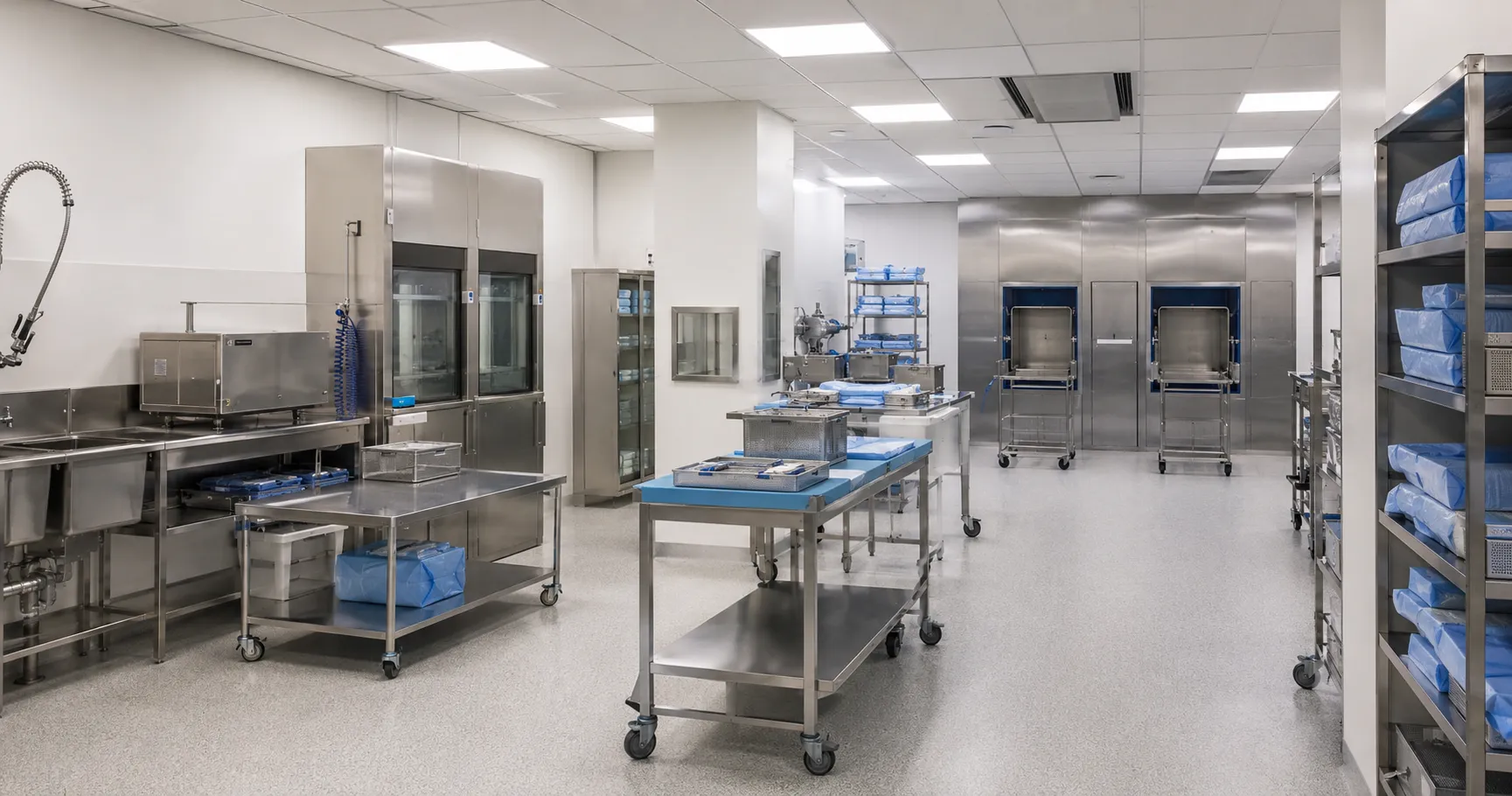
A sterilisation unit, or CSSD, is the engine room of infection control. Every reusable instrument in the hospital is cleaned, packed, sterilised, and tracked here, so a unit that's well-equipped, validated and tightly zoned protects every patient in the building.
This guide sets out the full CSSD equipment list by stage, the washing, sterilisation and tracking systems, the planning sequence, and the compliance points — for a new unit, an expansion, or an upgrade, wherever you operate.
The short version — what every sterilisation unit is built around
Strip it back, and a CSSD needs three things — thorough cleaning to remove all soil, validated sterilisation to make instruments safe, and a one-way flow with tracking to keep dirty and sterile apart.
-
Cleaning & disinfection — ultrasonic cleaners and washer-disinfectors that remove all soil before sterilisation.
-
Sterilisation — steam autoclaves, with low-temperature methods for heat-sensitive items.
-
Packing, tracking & flow — sealing machines, indicators and tracking software across a strict dirty-to-sterile flow.
Sterilisation unit equipment by stage
-
Cleaning. Ultrasonic cleaners and automated washer-disinfectors to remove soil from instruments before sterilisation.
-
Endoscope reprocessing. Automated endoscope reprocessors (AERs) and drying cabinets for flexible scopes, where handled.
-
Steam sterilisation. Pre-vacuum and gravity steam autoclaves — the workhorses for the majority of reusable instruments.
-
Low-temperature sterilisation. Hydrogen-peroxide gas plasma or ethylene-oxide systems for heat- and moisture-sensitive devices.
-
Packing & sealing. Heat-sealing machines, pouches, wraps and rigid containers to package instruments before sterilisation.
-
Water & steam quality. Reverse-osmosis or deionised water treatment and a steam generator to protect instruments and autoclaves.
-
Monitoring & validation. Biological and chemical indicators, Bowie-Dick tests and data loggers to prove every cycle worked.
-
Tracking & storage. Instrument-tracking software, loading trolleys, baskets and sterile-storage shelving for full traceability.
Sterilisation unit equipment checklist
|
Section |
Equipment |
Notes |
|
Cleaning |
Ultrasonic cleaners; washer-disinfectors |
Dirty zone |
|
Endoscopes |
AER; drying cabinets |
Where handled |
|
Steam |
Pre-vacuum/gravity autoclaves |
Validated cycles |
|
Low-temp |
Gas plasma or ETO steriliser |
Heat-sensitive |
|
Packing |
Heat sealers; pouches; wraps; containers |
Clean zone |
|
Water/steam |
RO/DI water; steam generator |
Quality control |
|
Monitoring |
Biological/chemical indicators; Bowie-Dick |
Every load |
|
Tracking |
Tracking software; trolleys; shelving |
Full traceability |
Scale each stage to your hospital's instrument load — a small unit serving a few theatres and a central CSSD serving a whole hospital differ widely in washer and autoclave capacity, automation and tracking.
Building or upgrading a sterilisation unit?
We'll help you equip it end-to-end. Tell us the theatres and departments you serve, your instrument volumes, your budget and your market — we'll build the equipment list, balance new and refurbished units, and make sure everything's compliant and supported.
No pressure, no obligation. → Talk to the team
What else does setting up a sterilisation unit involve
-
One-way flow & zoning. A strict dirty-to-clean-to-sterile flow, with physical separation and pass-through equipment, is the heart of CSSD design.
-
Validation & cycle control. Every steriliser must be validated and routinely tested with biological, chemical and Bowie-Dick checks — build this into operations.
-
Water, steam & ventilation. Treated water, clean steam, controlled humidity and the right airflow protect instruments and keep the unit working.
-
Traceability. Instrument-tracking software links each set to its cycle, load and patient — essential for recall and audit, so plan it early.
-
Storage & transport. Sterile storage and clean transport to theatres and wards keep instruments sterile right up to the point of use.
Setting up a sterilisation unit, step by step
-
Define the departments and theatres you serve and your instrument throughput and turnaround times.
-
Confirm the layout — dirty, clean and sterile zones — plus water, steam, drainage and ventilation, and start works early.
-
Build the equipment list by stage, sized to your load, with washers and autoclaves to match.
-
Decide new vs refurbished per item and plan water treatment, validation and tracking alongside.
-
Install, validate and commission washers and sterilisers, set up tracking, and prepare to go live.
Validation and commissioning take time — build them into the schedule so the unit opens fully validated and traceable, not just equipped.
Budget and procurement
A CSSD is capital- and utility-intensive, so the purchase price is only part of the story. A common approach is to buy new for washer-disinfectors and autoclaves and certified refurbished for trolleys, sealers and ancillary kit. Because sterilisers are regulated devices, check the device risk class and the certification for your market, and align CSSD capacity with the operating theatre and laboratory it serves.
Approval and compliance by region
|
Region |
Regulator |
Device requirement |
|
United Kingdom |
UKCA mark (CE accepted to 2028–2030) |
|
|
European Union |
CE marking under the EU MDR |
|
|
United States |
FDA clearance or approval |
|
|
Gulf (GCC) |
SFDA & GCC bodies |
National registration / GCC conformity |
|
South Africa |
Medical device licensing |
Sterilisation equipment follows the same medical-device rules as the rest of healthcare, alongside decontamination standards such as ISO 17665 for steam sterilisation. For quality standards and clinical guidance, the World Health Organisation and NICE are useful references. If you're equipping a unit, our buyer hub sets out how to purchase with confidence.
More from Business
-
Buyers — source a full sterilisation unit equipment package for your hospital.
-
Suppliers — list your CSSD and sterilisation equipment and reach buyers worldwide.
-
Advertise — promote your products and services to a clinical audience.
-
Business overview — explore everything MediGear offers healthcare organisations.
Disclaimer
This article is for general information only and does not constitute clinical, decontamination, medical, procurement, engineering or regulatory advice. Sterilisation unit design, equipment, validation, water and steam quality and compliance requirements vary by country and facility, and change over time. The checklist is a general planning aid, not a specification — always work with qualified decontamination, biomedical and procurement professionals, and confirm that every device is approved for your market (for example, UKCA, CE/MDR, FDA, SFDA/GCC or SAHPRA). medigear.uk accepts no liability for actions taken based on this content.
Equip your sterilization unit end-to-end.
From ultrasonic cleaners and washer-disinfectors to steam autoclaves, low-temperature sterilizers, sealing and tracking, we help hospitals across the UK, Europe, the US, the Gulf and South Africa build CSSDs — compliant, supported and on budget.
Frequently Asked Questions
A sterilization unit, or CSSD, needs cleaning equipment such as ultrasonic cleaners and washer-disinfectors, steam autoclaves for most instruments, and low-temperature sterilizers for heat-sensitive items. Add sealing machines and packaging, water treatment and a steam generator, biological and chemical indicators for validation, and instrument-tracking software with trolleys and sterile storage. The mix depends on the load.
A CSSD is built around a one-way flow with three zones — a dirty area for receiving and cleaning, a clean area for inspection, packing and sterilizer loading, and a sterile area for storage and dispatch. Physical separation and pass-through washers and sterilizers keep dirty and sterile instruments apart.
Sterilizers are medical devices and must be approved for the market (such as UKCA, CE or FDA), and the unit follows decontamination standards such as ISO 17665 for steam sterilization. Every sterilizer must be validated and routinely tested with biological, chemical and Bowie-Dick checks, with full records for traceability.
Yes — certified refurbished autoclaves and washer-disinfectors are used in many units and can reduce costs, provided they are properly refurbished, validated and supported. Confirm certified refurbishment, a warranty, installation and service support, and check the device is approved for your market and validated after installation.
It varies with scale. Equipping a serviced space can take weeks once equipment is procured, while a new CSSD with zoned dirty, clean and sterile areas, water treatment, steam and ventilation takes several months. Validation and commissioning of washers and sterilizers should be built into the timeline.
Beyond the machines, a CSSD needs a strict one-way flow with separated dirty, clean and sterile zones, treated water and clean steam, controlled humidity and ventilation, instrument-tracking software for traceability, and sterile storage with clean transport to theatres. The layout and validation are as important as the equipment.