
Introduction
A rehabilitation centre helps people rebuild strength, movement and independence after injury, illness or surgery, so its equipment spans assessment, therapy and the practice of everyday activities. Setting one up means fitting out a therapy gym, gait and mobility areas, and occupational-therapy and daily-living spaces, so a multidisciplinary team can move each person from assessment towards getting back to normal life.
This guide sets out the full rehabilitation centre equipment list by area, the surrounding space and safety, the planning sequence, and the approval and compliance points — for a new centre, an expansion, or added rehabilitation capacity, wherever you operate. It focuses on the equipment and space decisions, and flags where clinical, accessibility and safety input is essential.
Rehabilitation is broader than any single therapy, because recovery is measured in function and independence rather than in a treatment delivered. A centre usually brings several disciplines together — physiotherapy, occupational therapy and often speech and language therapy — around goals like walking again, dressing independently or returning to work, which is why its equipment ranges from a therapy gym to a practice kitchen. The space itself does much of the work: accessible, safe and generous enough for people to move, try, fail and try again, often over weeks, is as important as any single machine.
In practice, the decisions that matter most are about space, accessibility and the range of activities rather than any single device. Rehabilitation needs room for gait and balance work, exercise and functional practice, all accessible to people with limited mobility, so the layout and flooring shape what can be delivered. Standardising and choosing durable equipment matters, since it is used hard over years. Planning occupational-therapy and daily-living facilities alongside the gym, and provision for mobility aids and wheelchairs, is what lets a centre rebuild real independence rather than just strength.
The short version — what every rehabilitation centre is built around
Strip it back, and a rehabilitation centre needs three things — a way to assess function, equipment to rebuild strength, movement and balance, and facilities to practise the activities of daily living.
-
Assessment — tools to measure function, movement and progress towards goals.
-
Therapy & movement — a gym, gait and balance equipment to rebuild strength and mobility.
-
Daily living & independence — occupational therapy and daily-living facilities and mobility aids.
Rehabilitation centre equipment by area
-
Assessment & measurement. Assessment tools, plinths and measurement equipment to evaluate movement, strength and function and to track progress towards each person's own rehabilitation goals over time.
-
Therapy gym & exercise. A gym with resistance and cardiovascular equipment, free weights and mats for guided strengthening and conditioning across a wide range of abilities and stages of recovery.
-
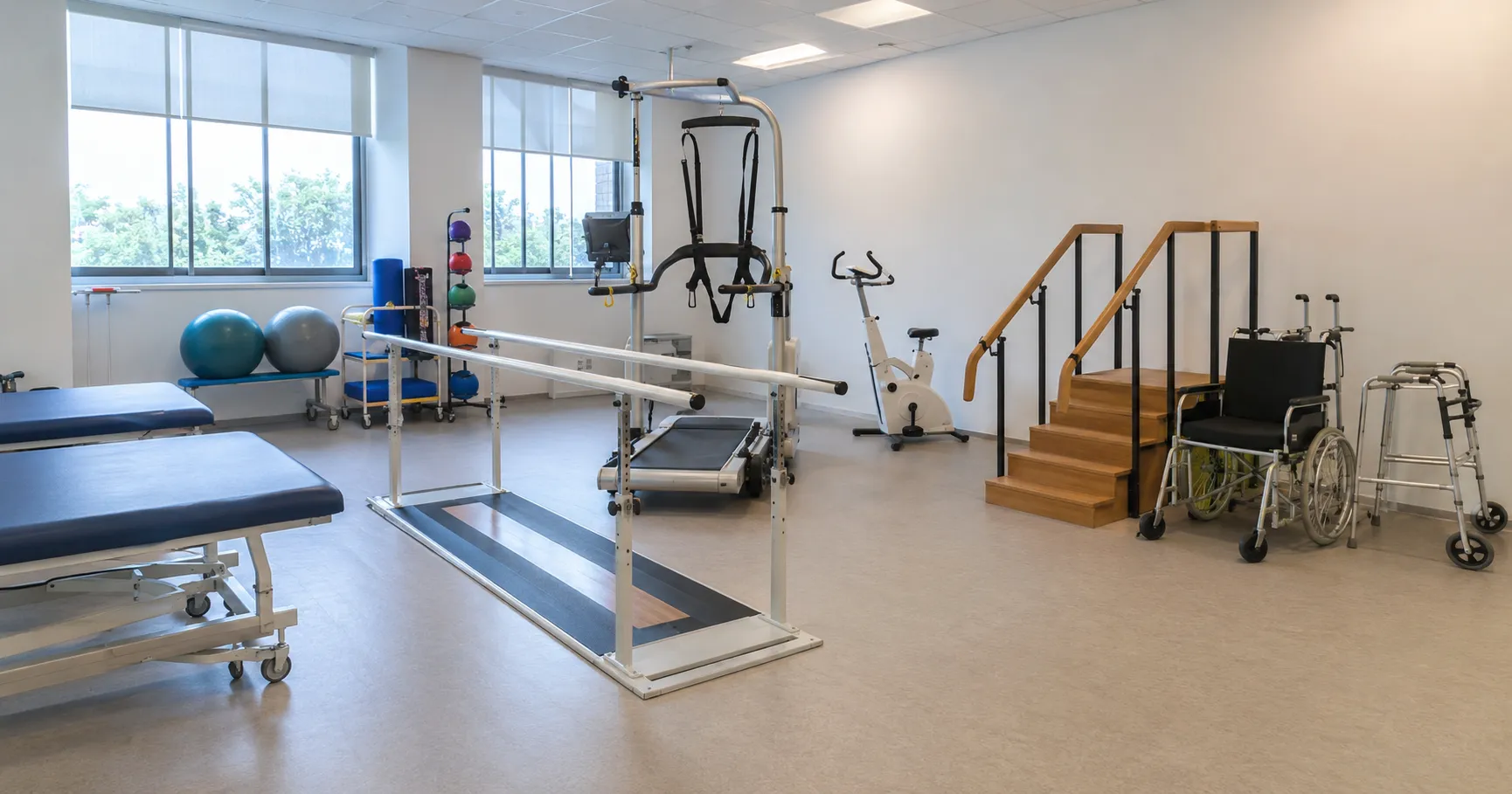
Gait, balance & mobility. Parallel bars, treadmills, steps and balance equipment for retraining walking, balance and functional movement after injury, surgery, stroke or illness.
-
Occupational therapy & daily living. A practice kitchen, daily-living aids and functional-task equipment for relearning dressing, cooking and the everyday activities that independence depends on.
-
Electrotherapy & modalities. Therapeutic ultrasound, electrical stimulation and other modalities, where used, to support pain relief, muscle activation and recovery.
-
Mobility aids & wheelchairs. Wheelchairs, walking aids and provision for fitting and practising with mobility equipment as people regain their independence and confidence.
-
Hydrotherapy. A hydrotherapy pool where offered, for supported, low-impact exercise that eases movement for people who find land-based work painful or difficult.
-
Space & accessibility. Accessible, non-slip flooring, generous circulation, and safe, adaptable spaces where people can practise, fail and try again safely.
Rehabilitation centre equipment checklist
|
Section |
Equipment |
Notes |
|
Assessment |
Plinths; measurement tools |
Track progress to goals |
|
Gym |
Resistance; cardio; weights; mats |
Strength and conditioning |
|
Gait/balance |
Parallel bars; treadmill; steps |
Walking and balance |
|
Daily living |
Practice kitchen; ADL aids |
Everyday activities |
|
Electrotherapy |
Ultrasound; stimulation |
Where used |
|
Mobility |
Wheelchairs; walking aids |
Fitting and practice |
|
Hydrotherapy |
Hydrotherapy pool |
If offered |
|
Space |
Accessible flooring; circulation |
Practise safely |
Scale each area to your caseload and specialities — a general rehabilitation centre and one focused on neurological or spinal rehabilitation differ widely in specialist gait, mobility, and daily-living equipment and space.
Planning a new rehab centre?
We'll help you equip it end-to-end. Tell us your specialities, caseload, budget and market — we'll build the equipment list, balance new and refurbished units, and make sure everything's compliant and supported.
No pressure, no obligation. → Talk to the team
What else does setting up a rehabilitation centre involve
-
Space and accessibility. Rehabilitation needs room to move and full accessibility, so generous, safe, non-slip spaces shape what a centre can deliver as much as the equipment does, and are hard and costly to add later.
-
A multidisciplinary approach. Rehabilitation usually brings physiotherapy, occupational therapy and often speech and language therapy together, so the equipment spans a gym, a practice kitchen and specialist aids, rather than serving one discipline alone.
-
Daily living and independence. Recovery is measured in independence, so occupational therapy and daily-living facilities are planned alongside the gym from the start, not treated as an afterthought.
-
Durability and safety. Rehabilitation equipment is used hard over years, so durability, easy cleaning and regular safety checks matter as much as the initial choice of equipment when planning a centre.
-
Consumables, staffing and service. Supports, consumables and mobility aids, a trained multidisciplinary team, and service and safety contracts all shape the running model over the years, not just the purchase of the equipment.
Setting up a rehabilitation centre, step by step
-
Define your specialities and caseload — general, neurological, spinal, musculoskeletal — and expected numbers.
-
Confirm the space and accessibility — gym, gait area, daily-living facilities, flooring and access — and start works early.
-
Build the equipment list by area, sized to your caseload, with the specialist gait, mobility and daily-living equipment you need.
-
Decide new versus refurbished per item and plan consumable, mobility-aid and service contracts alongside.
-
Install and commission everything, arrange safety checks, and prepare the multidisciplinary team before opening.
Space fit-out and accessibility works take time — build them into the schedule so the centre can open safely, not just with equipment in place.
Budget and procurement
Rehabilitation centres carry a mix of durable equipment and everyday consumables, so the purchase price is only part of the story; gym, gait, hydrotherapy and mobility equipment all carry running and service costs. A common approach is to buy new for high-throughput core units and certified refurbished for ancillary equipment. Because these are regulated devices, check the device risk class and the certification for your market. Match specialist gait, mobility and daily-living equipment to your specialities, so a neurological rehabilitation centre and a general one are each equipped for the people they actually treat.
Approval and accreditation by region
|
Region |
Regulator |
Device requirement |
|
United Kingdom |
UKCA mark (CE accepted to 2028–2030) |
|
|
European Union |
CE marking under the MDR |
|
|
United States |
FDA clearance or approval |
|
|
Gulf (GCC) |
SFDA & GCC bodies |
National registration / GCC conformity |
|
South Africa |
Medical device licensing |
Rehabilitation and electrotherapy devices are regulated, so confirm each is approved for your market. Rehabilitation equipment is used by people with limited mobility, so suitability, accessibility and safety matter alongside device approval. For quality standards and clinical guidance, the World Health Organisation and NICE are useful references. If you're equipping a rehabilitation centre, our buyer hub sets out how to purchase with confidence.
More from Business
-
Buyers — source a full rehabilitation centre equipment package for your service.
-
Suppliers — list your equipment and reach buyers worldwide.
-
Advertise — promote your products and services to a clinical audience.
-
Business overview — explore everything MediGear offers healthcare organisations.
Disclaimer
This article is for general information only and does not constitute clinical, medical, procurement, engineering or regulatory advice. Rehabilitation centre design, equipment, accessibility and safety requirements vary by country, speciality and facility, and change over time. The checklist is a general planning aid, not a specification — always work with qualified clinical, biomedical, facilities and procurement professionals, and confirm that every device is approved for your market (for example, UKCA, CE, FDA, SFDA/GCC or SAHPRA). medigear.uk accepts no liability for actions taken based on this content.
Equip your rehabilitation centre end-to-end.
From assessment and gym equipment to gait, balance, daily-living and mobility aids, we help centres across the UK, Europe, the US, the Gulf and South Africa build rehabilitation centres — compliant, supported and on budget.
Frequently Asked Questions
A rehabilitation centre needs assessment and measurement tools, a therapy gym with resistance and cardiovascular equipment, gait and balance equipment such as parallel bars and treadmills, occupational-therapy and daily-living facilities such as a practice kitchen, electrotherapy where used, mobility aids and wheelchairs, and often hydrotherapy — all in accessible, safe spaces. The mix depends on the specialties served.
The main areas are assessment and measurement, the therapy gym, gait, balance and mobility, occupational therapy and daily living, electrotherapy and modalities, mobility aids and wheelchairs, hydrotherapy where offered, and the underlying accessible space. These are planned together, because rehabilitation is multidisciplinary and measured in function and independence.
Costs depend on the specialties, the caseload and whether specialist neurological, spinal or hydrotherapy facilities are provided, so there is no single figure. Weigh the purchase price of durable equipment against running and service costs over its life rather than the upfront price alone.
Yes, for many items. Treadmills, gym and gait equipment can often be certified refurbished, while some electrotherapy is bought new. Every device must be approved for your market and fully supported with service, safety checks and consumables, whether new or refurbished.
It varies with the size and whether hydrotherapy and accessibility works are needed, but planning, fitting out and equipping a centre typically takes several months, and longer where a pool is built. Space fit-out, accessible flooring and safety checks are the parts most often underestimated.
A rehabilitation centre needs accessible, non-slip flooring, generous circulation and safe, adaptable spaces for gym, gait and daily-living practice, reliable power for equipment, and easy cleaning. This accessible space shapes the centre as much as the clinical equipment, because rehabilitation is about moving, practising and rebuilding independence.