
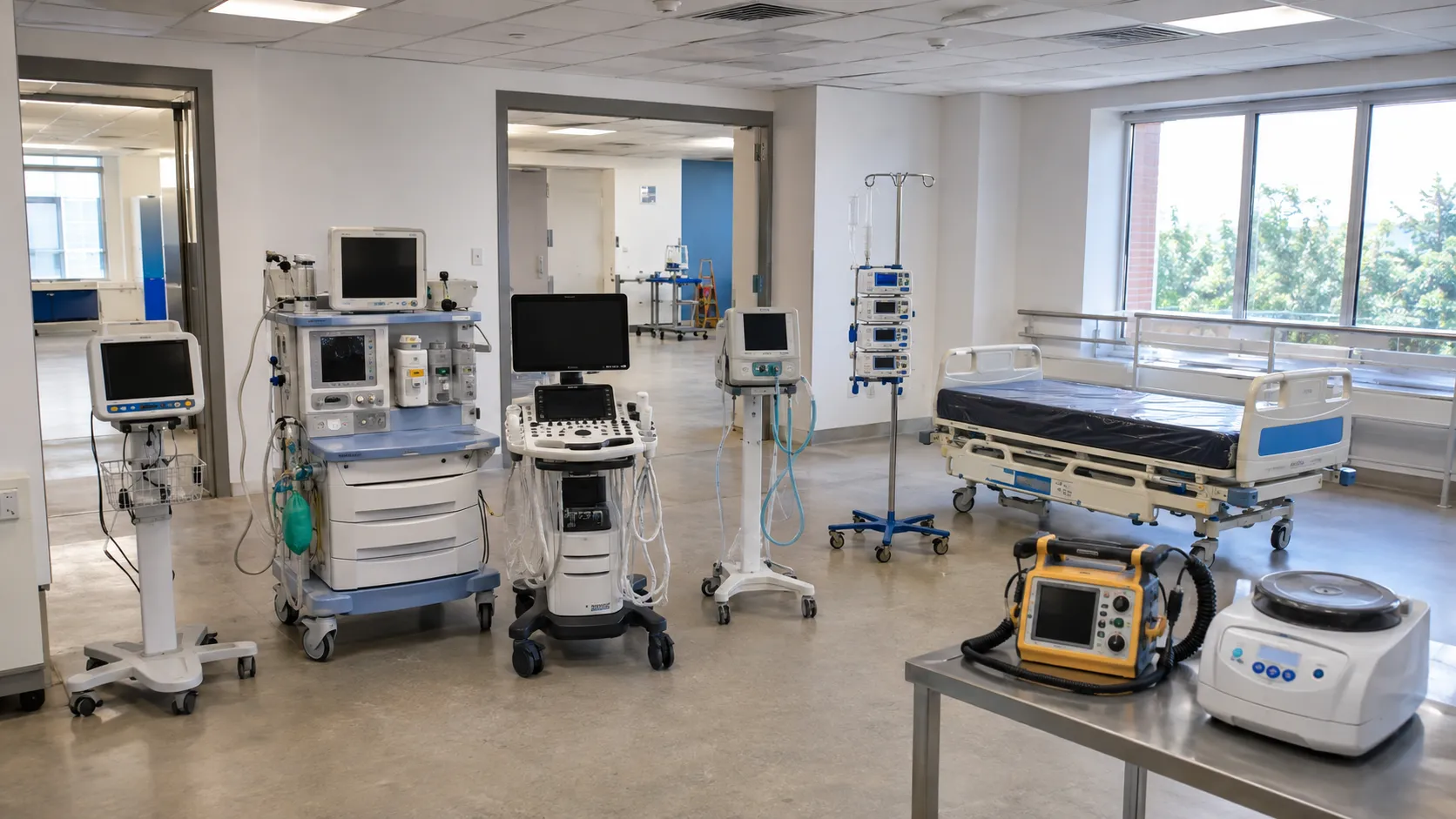
Introduction
A multi-speciality hospital treats many conditions under one roof. It brings cardiology, orthopaedics, neurology and more together. So equipping one means planning across many specialities, not one. Each speciality has its own needs. They also lean on shared services such as imaging, the laboratory and theatres. Setting one up means building an equipment plan speciality by speciality, joined by strong shared services.
This guide covers the full multi-speciality hospital equipment list by area. It then walks through the infrastructure, the planning sequence, and the approval and compliance points. Use it for a new hospital, an expansion, or added specialities. It focuses on the equipment and integration decisions. Where clinical, biomedical and estates input is essential, it says so.
What defines a multi-speciality hospital is breadth. It has to serve many specialities well, and let them work together. Each speciality brings its own equipment. Cardiology needs cath and monitoring. Orthopaedics needs imaging and theatre kit. Neurology needs its own tools. But the shared services carry a heavy load. Imaging, the laboratory, theatres and critical care support every speciality at once. So the hospital is planned as specialities plus shared services, sized so the shared parts never become the bottleneck.
In practice, the decisions that matter most are about breadth, shared capacity and integration. Plan each speciality against its own service, using the relevant setup guide. Then size the shared services to serve them all together, not one at a time. Imaging and the lab in particular must keep up with combined demand. Standardise equipment across specialities where you can, so training and service stay simple. Plan the specialities and the shared services as one system, and the hospital works as a whole. Strong parts still need strong links.
The short version — what every multi-speciality hospital is built around
Strip it back, and a multi-speciality hospital needs three things. Equipment for each speciality. Shared services that serve them all. And integration that ties the whole hospital together.
-
Specialities — equipment for each clinical speciality the hospital offers.
-
Shared services — imaging, laboratory, theatres and critical care that serve every speciality.
-
Integration — systems and records that tie the specialities together.
Multi-speciality hospital equipment by area
-
Speciality clinics & wards. Consulting, examination and ward equipment for each speciality. Cardiology, orthopaedics, neurology and others each have their own needs. One size does not fit all.
-
Operating theatres. Theatres are equipped for the surgical specialities offered. Tables, lights, anaesthesia and energy devices, with proper air handling. Theatres are shared across specialities.
-
Diagnostic imaging. X-ray, ultrasound, CT and, where offered, MRI. Imaging supports every speciality, so it must keep up with combined demand. Under-sizing it slows the whole hospital.
-
Laboratory. Analysers across haematology, chemistry and microbiology. Like imaging, the lab serves the whole hospital at once. Its capacity is planned accordingly.
-
Critical care. An ICU and high dependency unit for the sickest patients. Every speciality may need critical-care support. So it is shared, not siloed. It backs up theatres and wards.
-
Speciality-specific equipment. The particular kit each speciality needs, such as a cath lab, endoscopy or dialysis. These are planned per speciality. Each uses its own setup guide.
-
Shared services. Sterile services and pharmacy that supply the whole hospital. Both are sized to serve every speciality. They are easy to under-size.
-
Infrastructure. Piped gases, resilient power, IT and records that connect many specialities into one hospital.
Multi-speciality hospital equipment checklist
|
Section |
Equipment |
Notes |
|
Specialties |
Clinic + ward kit per speciality |
Own needs each |
|
Theatres |
Tables; lights; anaesthesia |
Air handling |
|
Imaging |
X-ray; ultrasound; CT/MRI |
Serves all |
|
Laboratory |
Analysers; broad range |
Whole hospital |
|
Critical care |
ICU + HDU |
Sickest patients |
|
Specialty kit |
Cath lab; endoscopy; dialysis |
Per specialty |
|
Shared services |
Sterile services; pharmacy |
Serve everyone |
|
Infrastructure |
Gases; power; IT; records |
Connect specialties |
Scale each area to your specialities and size. A mid-size hospital with a few specialities and a large tertiary centre differ widely across every department and shared service. Breadth is the defining challenge.
Planning a multi-speciality hospital?
We'll help you equip it end-to-end. Tell us your specialities, size, budget and market. We'll build the speciality-by-speciality equipment plan, balance new and refurbished units, and make sure everything is compliant and supported.
No pressure, no obligation. → Talk to the team
What else does setting up a multi-speciality hospital involve
-
Shared services carry the load. Imaging, the lab and theatres serve every speciality at once. So they must be sized to combined demand, or they become the bottleneck. The weakest shared service limits them all.
-
Plan speciality by speciality. Each speciality has its own detailed needs. So plan each against its own guide, then join them up so nothing is missed or duplicated.
-
Integration ties it together. Many specialities must share records, imaging and results. So integration shapes the plan as much as any single item of equipment. Shared results save repeat tests.
-
Standardise where you can. Common equipment across specialities keeps training and service simple. So standardise shared kit, while respecting each speciality's real needs.
-
Consumables, staffing and service. Consumables across every speciality, staff to run them, and hospital-wide service contracts all shape the running model. The purchase is only the start.
Setting up a multi-speciality hospital, step by step
-
Define your specialities and size. Decide which specialities, how many theatres, beds and clinics.
-
Confirm shared services and infrastructure. Size imaging, the lab, theatres, gases, power and IT. Start works early.
-
Build the equipment plan speciality by speciality, using each setup guide, with shared services sized to serve all.
-
Decide new versus refurbished per item. Standardise where sensible, and plan consumables and service alongside.
-
Install and commission area by area. Integrate systems, train teams, and open each part when ready.
A hospital-wide build is phased and takes time. Build commissioning and training into the schedule, so each area opens safely rather than only fitted out.
Budget and procurement
A multi-speciality hospital is capital- and service-intensive across every speciality. So the purchase price is only part of the story. Theatres, imaging and critical care carry high ongoing costs. A common approach is to buy new for high-throughput core units and certified refurbished for ancillary equipment. Because these are regulated devices, check the device risk class and the certification for your market. Match each speciality's equipment to its service, and size the shared services to serve all. That way the hospital works as a whole rather than as strong parts with weak links. The links matter as much as the parts.
Approval and accreditation by region
|
Region |
Regulator |
Device requirement |
|
United Kingdom |
UKCA mark (CE accepted to 2028–2030) |
|
|
European Union |
CE marking under the MDR |
|
|
United States |
FDA clearance or approval |
|
|
Gulf (GCC) |
SFDA & GCC bodies |
National registration / GCC conformity |
|
South Africa |
Medical device licensing |
All the medical devices across the hospital are regulated, so confirm each is approved for your market. A multi-speciality hospital may also need accreditation and licensing as a facility, so plan for both alongside device approval. For quality standards and clinical guidance, the World Health Organisation and NICE are useful references. If you're equipping a multi-speciality hospital, our buyer hub sets out how to purchase with confidence.
More from Business
-
Buyers — source a full, speciality-by-speciality equipment package for your multi-speciality hospital.
-
Suppliers — list your equipment and reach buyers worldwide.
-
Advertise — promote your products and services to a clinical audience.
-
Business overview — explore everything MediGear offers healthcare organisations.
Disclaimer
This article is for general information only. It is not clinical, medical, procurement, engineering or regulatory advice. Hospital design, equipment, shared services, accreditation and safety requirements vary by country, speciality mix and facility, and change over time. The checklist is a planning aid, not a specification. Always work with qualified clinical, biomedical, facilities and procurement professionals. And confirm every device is approved for your market — for example, UKCA, CE, FDA, SFDA/GCC or SAHPRA. Requirements change, so check the current position before you buy. medigear.UK accepts no liability for actions taken on this content.
Equip your multi-specialty hospital end-to-end.
From specialty clinics and theatres to imaging, laboratory, critical care and shared services, we help hospitals across the UK, Europe, the US, the Gulf and South Africa build multi-specialty hospitals — compliant, supported and on budget.
Frequently Asked Questions
A multi-specialty hospital needs equipment for each specialty it offers, such as cardiology, orthopaedics and neurology, plus strong shared services. That means operating theatres, diagnostic imaging, a laboratory, critical care, and specialty-specific kit like a cath lab or endoscopy. It is planned specialty by specialty, joined by shared services sized to serve them all.
The main areas are the specialty clinics and wards, operating theatres, diagnostic imaging, the laboratory, critical care, specialty-specific equipment, shared services such as sterile supply and pharmacy, and the infrastructure. These are planned together, because the shared services support every specialty at once.
Costs depend heavily on the specialties and shared services, since imaging, theatres and critical care are far more capital-intensive than clinics, so there is no single figure. Weigh the purchase price against service and running costs across every specialty, and phase the build.
Yes, across many areas. Certified refurbished imaging, theatre and ward equipment can be sensible where it is fully supported, balanced with new for high-use core systems. Every device must be approved for your market and fully supported, whether new or refurbished.
It varies greatly with the size and specialties, but planning, building and equipping specialty by specialty typically takes many months to years, phased and commissioned in turn. Shared services, imaging capacity and integration are the parts most often underestimated, so build them into the schedule from the start.
A multi-specialty hospital needs piped medical gases, resilient power, IT and records, and shared sterile services and pharmacy, all sized to serve many specialties. The shared services and integration matter as much as each specialty's equipment, because the specialties must work together as one hospital.