
Introduction
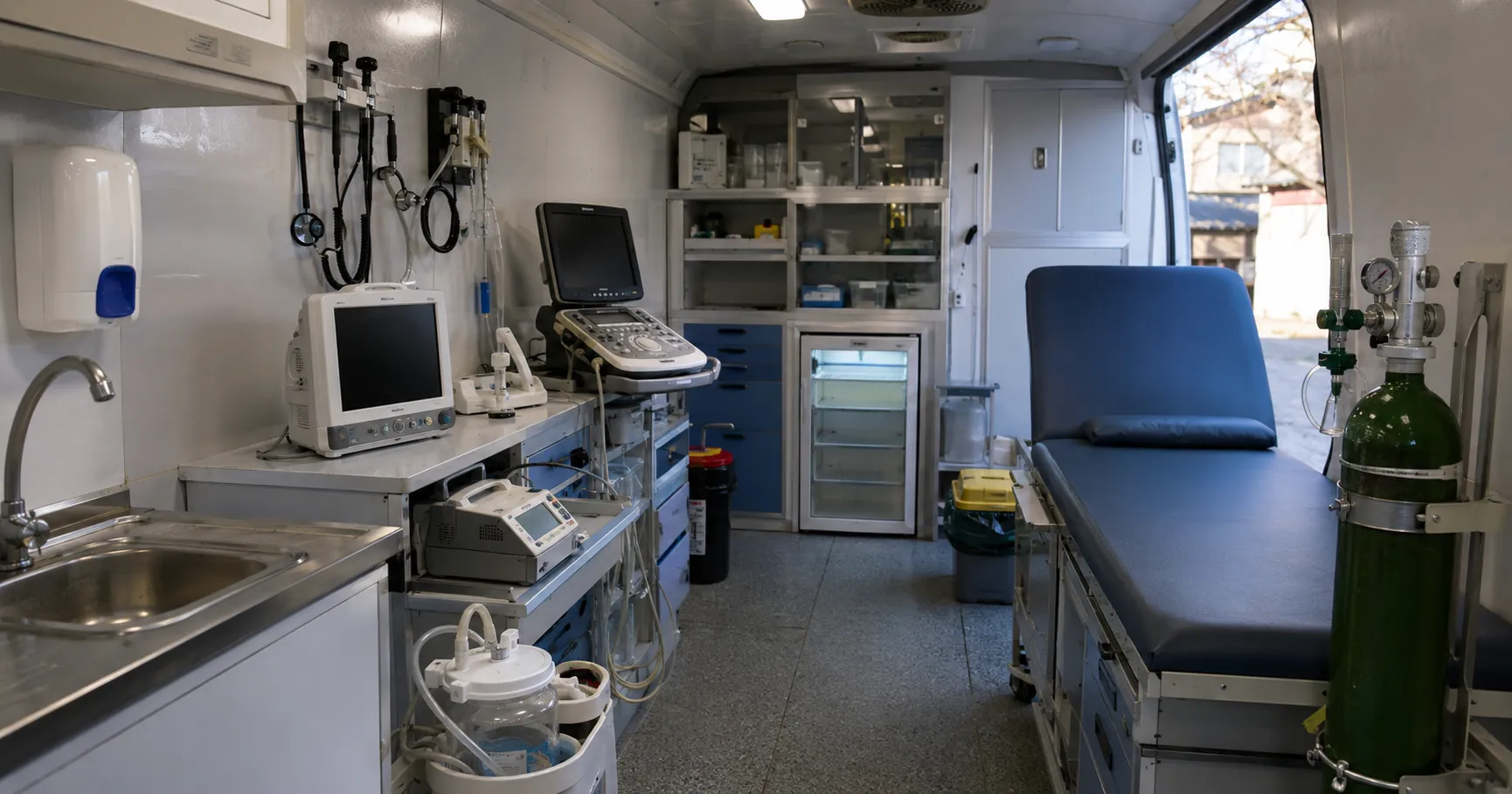
A mobile medical clinic takes healthcare to people who cannot easily reach a hospital, so its equipment has to be portable, rugged and able to work away from mains services. Setting one up means fitting out a vehicle or transportable unit with portable diagnostics, examination and treatment equipment, and its own power, cold chain and connectivity, so a small team can deliver real care wherever they park.
This guide sets out the full mobile clinic equipment list by area, the surrounding infrastructure and safety, the planning sequence, and the approval and compliance points — for a new mobile service, an extra vehicle, or a refit, wherever you operate. It focuses on the equipment and self-sufficiency decisions, and flags where clinical, vehicle and safety input is essential.
What sets a mobile clinic apart is that it must be self-sufficient. There is no wall socket, piped oxygen or hospital network to fall back on, so power, climate control, water, cold chain and connectivity all travel with the unit and shape every equipment choice. Everything has to be compact, secure for transport, and able to withstand movement, vibration and a range of conditions. The result is a careful trade-off: enough capability to be genuinely useful at each stop, within the space, weight and power a vehicle can carry.
In practice, the decisions that matter most are about power, portability and the cold chain rather than the clinical devices alone. A generator or battery system that is undersized limits everything it feeds, and a cold chain that fails wastes vaccines and medicines, so these are planned as critical systems from the outset. Equipment is chosen to be portable, durable and simple to run by a small team, and secured so it survives the journey. Connectivity for records and telemedicine links extends what a mobile clinic can do, letting it draw on specialists far away.
The short version — what every mobile clinic is built around
Strip it back, and a mobile clinic needs three things — portable equipment to diagnose and treat, its own power and cold chain, and the connectivity to work away from a hospital.
-
Portable clinical equipment — compact diagnostics, examination and treatment kit for a small team.
-
Self-sufficiency — on-board power, climate control and a reliable cold chain.
-
Connectivity — records and telemedicine links to work beyond the hospital.
Mobile clinic equipment by area
-
Portable diagnostics. Portable ultrasound, ECG, and point-of-care testing for glucose, haemoglobin and rapid tests, chosen to be compact, rugged and battery-capable.
-
Examination & treatment. A portable examination couch, examination lighting, basic treatment and wound-care equipment, and vital-signs monitoring for a range of patients.
-
Screening & vaccination. Equipment for the screening and vaccination programmes a mobile service often runs, from measurement tools to a reliable vaccine cold chain.
-
Power & climate. A generator or battery system with backup, and heating or cooling, so equipment and staff can work in a range of conditions away from mains power.
-
Cold chain. Portable medical refrigeration with temperature monitoring for vaccines and medicines, since a broken cold chain wastes them and puts patients at risk.
-
Connectivity & records. Mobile connectivity, electronic records and a telemedicine link, so the clinic can document care and reach specialists remotely.
-
Infection control & sterilisation. Portable hand hygiene, clean and dirty separation, waste handling and, where needed, compact sterilisation for a safe, self-contained unit.
-
Vehicle fit-out & storage. Secure, transport-safe storage and mounting, so equipment survives movement and is quickly ready to use at each stop.
Mobile clinic equipment checklist
|
Section |
Equipment |
Notes |
|
Diagnostics |
Portable ultrasound; ECG; point-of-care |
Compact, battery-capable |
|
Examination |
Portable couch; lighting; vital signs |
Range of patients |
|
Screening |
Screening + vaccination kit |
With cold chain |
|
Power |
Generator/battery; backup; climate |
Away from mains |
|
Cold chain |
Portable fridge; monitoring |
Vaccines, medicines |
|
Connectivity |
Mobile network; records; telemedicine |
Reach specialists |
|
Infection control |
Hand hygiene; waste; sterilisation |
Self-contained |
|
Fit-out |
Secure, transport-safe storage |
Survives movement |
Scale each area to your service and terrain — a city outreach van and a rural or remote unit crossing long distances differ widely in power, cold chain and self-sufficiency needs.
Planning a new mobile clinic?
We'll help you equip it end-to-end. Tell us your service, terrain, budget and market — we'll build the portable equipment list, balance new and refurbished units, and make sure everything's compliant and supported.
No pressure, no obligation. → Talk to the team
What else does setting up a mobile medical clinic involve
-
Power and self-sufficiency. A mobile clinic has no mains to rely on, so on-board power, backup and climate control are core systems that shape every equipment choice, not add-ons.
-
The cold chain on the move. Keeping vaccines and medicines cold while travelling is a real challenge, so portable refrigeration with monitoring and backup is planned as a critical system from the outset.
-
Portability and durability. Everything must be compact, secure for transport and able to withstand movement and varied conditions, so durability and safe mounting matter as much as clinical capability.
-
Connectivity and telemedicine. Connectivity lets a mobile clinic keep records and reach specialists remotely, extending what a small team can safely do, so it is planned in rather than assumed.
-
Consumables, staffing and service. Portable-equipment consumables, a small trained team, and service and calibration that reach the vehicle all shape the running model, not just the purchase.
Setting up a mobile medical clinic, step by step
-
Define your service, terrain and stops — outreach, screening, primary care — and how far the unit travels.
-
Confirm self-sufficiency — power, backup, climate, cold chain and connectivity — and the vehicle or unit, and start work early.
-
Build the portable equipment list by area, sized to your service and to what the vehicle can carry and power.
-
Decide new versus refurbished per item and plan consumable and service contracts that reach the vehicle.
-
Fit out, install and test everything, secure it for transport, and train the team before the first clinic.
Vehicle fit-out, power and cold-chain setup take time — build them into the schedule so the clinic can run safely, not just be loaded with equipment.
Budget and procurement
Mobile clinics are equipment- and logistics-intensive, so the purchase price is only part of the story; portable equipment, power, the cold chain and vehicle upkeep all carry running and service costs. A common approach is to buy new for high-throughput core units and certified refurbished for ancillary equipment. Because these are regulated devices, check the device risk class and the certification for your market. Match capability to what the vehicle can carry, power and keep cold, so a mobile clinic is genuinely useful at each stop without being overloaded beyond what it can support.
Approval and accreditation by region
|
Region |
Regulator |
Device requirement |
|
United Kingdom |
UKCA mark (CE accepted to 2028–2030) |
|
|
European Union |
CE marking under the MDR |
|
|
United States |
FDA clearance or approval |
|
|
Gulf (GCC) |
SFDA & GCC bodies |
National registration / GCC conformity |
|
South Africa |
Medical device licensing |
Portable medical devices are regulated, so confirm each is approved for your market. Mobile services also depend on a reliable cold chain and safe power, so these matter alongside device approval. For quality standards and clinical guidance, the World Health Organisation and NICE are useful references. If you're equipping a mobile medical clinic, our buyer hub sets out how to purchase with confidence.
More from Business
-
Buyers — source a full mobile medical clinic equipment package for your service.
-
Suppliers — list your equipment and reach buyers worldwide.
-
Advertise — promote your products and services to a clinical audience.
-
Business overview — explore everything MediGear offers healthcare organisations.
Disclaimer
This article is for general information only. It is not clinical, medical, procurement, engineering or regulatory advice. Mobile clinic design, equipment, power, cold-chain, vehicle and safety requirements vary by country, terrain and facility, and change over time. The checklist is a planning aid, not a specification. Always work with qualified clinical, biomedical, facilities and procurement professionals. And confirm every device is approved for your market — for example, UKCA, CE, FDA, SFDA/GCC or SAHPRA. Requirements change, so check the current position before you buy. medigear.uk accepts no liability for actions taken on this content.
Equip your mobile clinic end-to-end.
From portable diagnostics and examination equipment to on-board power, cold chain and connectivity, we help services across the UK, Europe, the US, the Gulf and South Africa build mobile medical clinics — compliant, supported and on budget.
Frequently Asked Questions
A mobile medical clinic needs portable diagnostics such as ultrasound, ECG and point-of-care testing, a portable examination couch and treatment equipment, screening and vaccination kit with a cold chain, on-board power and climate control, portable refrigeration, connectivity for records and telemedicine, and infection-control provision — all compact, rugged and secured for transport. Capability is scaled to what the vehicle can carry and power.
The main areas are portable diagnostics, examination and treatment, screening and vaccination, power and climate, the cold chain, connectivity and records, infection control and sterilisation, and the vehicle fit-out and storage. These are planned together, because a mobile clinic must be self-sufficient away from mains services.
Costs depend on the service, the vehicle and how self-sufficient the unit must be, so there is no single figure. Because mobile clinics are equipment- and logistics-intensive, weigh the purchase price against running, power, cold-chain and vehicle costs over their life rather than the upfront price alone.
Yes, for many items. Certified refurbished portable diagnostics and examination equipment can be sensible, provided they are rugged and fully supported. Every device must be approved for your market, able to run on the unit's power, and secured safely for transport, whether new or refurbished.
It varies with the vehicle and the service, but planning, fitting out, installing and testing typically take a few months. The vehicle fit-out, power system and cold chain are the parts most often underestimated, so build them into the schedule from the start rather than treating them as the easy part.
A mobile clinic needs its own power with backup, climate control, a portable cold chain with monitoring, connectivity for records and telemedicine, and secure, transport-safe storage. This self-sufficiency is as important as the clinical equipment, because a mobile clinic works away from the mains services a fixed site takes for granted.