
Introduction
A hospital blood bank stores and issues blood and blood products, and makes sure every unit is safe and correctly matched to the patient, so its equipment is built around controlled storage, testing and rigorous traceability. Setting one up means fitting out blood storage, grouping and cross-matching, and sample handling, all monitored closely and recorded so each unit can be tracked from arrival to transfusion.
This guide sets out the full blood bank equipment list by area, the surrounding infrastructure and safety, the planning sequence, and the approval and compliance points — for a new service, an upgrade, or added transfusion capacity, wherever your hospital operates. It focuses on the equipment and traceability decisions, and flags where laboratory, quality and engineering input is essential.
A blood bank is defined by two things: an unbroken cold chain and complete traceability. Blood and its components must be held at precise, monitored temperatures — red cells, plasma and platelets each differently — because a lapse can make a unit unusable or unsafe. Just as important is the record: every unit is grouped, screened and cross-matched, and tracked from arrival to transfusion or return, so that the right blood reaches the right patient and any problem can be traced back. The equipment exists to protect both the product and that chain of evidence.
In practice, the decisions that matter most are about temperature control, monitoring and traceability rather than any single machine. Storage that drifts out of range or alarms that fail can waste scarce, life-saving stock, so monitoring, alarms and backup power are treated as critical from the outset. A tracking and blood-bank information system links each unit to its tests and its patient, supporting safe issue, recall and audit. Standardising storage and sample handling, and validating the cold chain and testing, keep a service safe and dependable rather than merely equipped.
The short version — what every blood bank is built around
Strip it back, and a blood bank needs three things — temperature-controlled storage for each blood component, testing to group and match blood safely, and traceability that follows every unit to the patient.
-
Storage — blood-bank refrigerators, plasma freezers and platelet agitators at precise temperatures.
-
Testing — grouping, cross-matching and infectious-marker screening to issue blood safely.
-
Traceability — monitoring, alarms and a tracking system following every unit to the patient.
Blood bank equipment by area
-
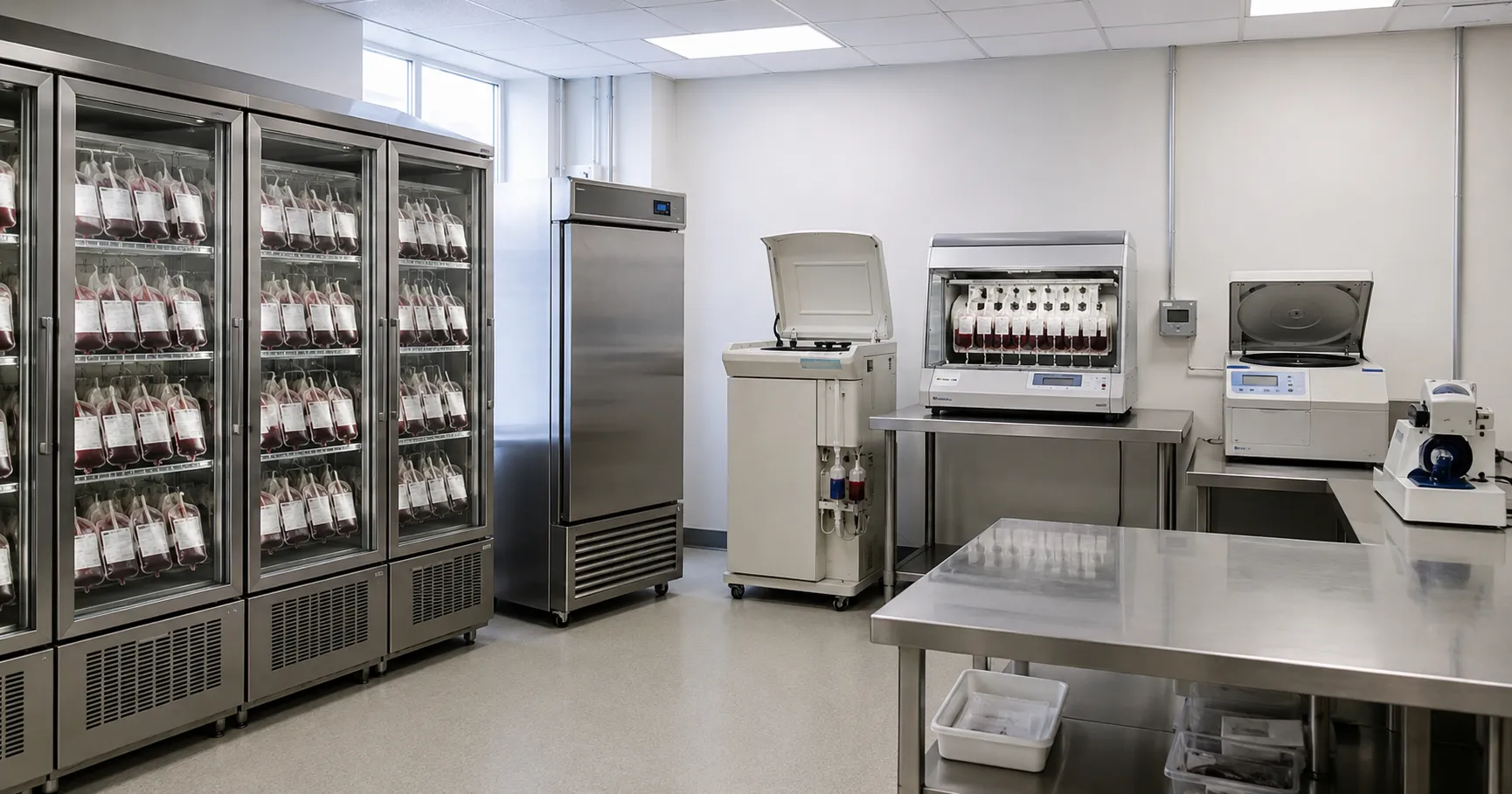
Blood storage. Blood-bank refrigerators for red cells, plasma freezers, and platelet incubators with agitators — each component held at its own precise, monitored temperature, since red cells, plasma and platelets differ.
-
Grouping & cross-match. Equipment for blood grouping and cross-matching, whether manual or automated, to ensure blood is compatible before it is issued to a patient.
-
Screening. Testing for infectious markers and antibodies as required, so that blood and recipients are screened to keep transfusion safe.
-
Plasma thawing. Controlled plasma thawers for preparing frozen plasma safely and quickly when it is needed for a patient.
-
Sample handling. Centrifuges, pipettes and sample-preparation equipment for processing patient and unit samples accurately.
-
Cold-chain monitoring. Continuous temperature monitoring and alarms on every storage unit, with backup power, since blood is wasted or unsafe if the cold chain breaks.
-
Traceability & software. A blood-bank information and tracking system linking each unit to its tests and its patient, for safe issue, recall and audit.
-
Infrastructure. Reliable and backed-up power for storage, secure space, and integration with the laboratory and hospital record system.
Blood bank equipment checklist
|
Section |
Equipment |
Notes |
|
Storage |
Blood fridges; plasma freezers; platelet agitators |
Component-specific temps |
|
Grouping/match |
Grouping + cross-match (manual/automated) |
Compatibility before issue |
|
Screening |
Infectious markers; antibodies |
Safe transfusion |
|
Plasma |
Plasma thawer |
Controlled thawing |
|
Sample handling |
Centrifuges; pipettes |
Accurate processing |
|
Cold chain |
Temperature monitoring; alarms; backup |
Unbroken, or wasted |
|
Traceability |
Blood-bank information/tracking system |
Unit to patient |
|
Infrastructure |
Backup power; security; integration |
Protect stock and record |
Scale each area to your transfusion demand and services — a small hospital blood bank and one supporting major surgery, trauma and obstetrics differ widely in storage and testing capacity.
Planning a new blood bank?
We'll help you equip it end-to-end. Tell us your transfusion demand, services, budget and market — we'll build the equipment list, balance new and refurbished units, and make sure everything's compliant and supported.
No pressure, no obligation. → Talk to the team
What else does setting up a hospital blood bank involve
-
The cold chain. Each blood component must stay within a precise temperature range, so specialised storage, continuous monitoring, alarms and backup power are the foundation of the service and are planned as critical.
-
Traceability and records. Every unit must be traceable from arrival to transfusion or return, so a blood-bank information system and labelling are core to safe issue, recall and audit, not an add-on.
-
Testing and quality. Grouping, cross-matching and screening must be reliable and controlled, so testing equipment, quality control and validated processes shape how the service is equipped and run.
-
Backup power. Blood is wasted or made unsafe if storage fails, so resilient, backed-up power and alarm response are core infrastructure planned from the outset.
-
Consumables, staffing and service. Reagents, tubes and sample consumables, trained transfusion scientists, and service and calibration contracts all shape the running model, not just the purchase of the equipment.
Setting up a hospital blood bank, step by step
-
Define your transfusion demand and services — routine, surgery, trauma, obstetrics — and expected volumes.
-
Confirm infrastructure — backed-up power, secure space, laboratory integration and monitoring — and start works early.
-
Build the equipment list by area, sized to your demand, with the storage and testing capacity to match.
-
Decide new versus refurbished per item and plan reagent, consumable and service contracts alongside.
-
Install, commission and validate everything, prove the cold chain and testing, and set up traceability before go-live.
Cold-chain validation and traceability setup take time — build them into the schedule so the service can go live safely, not just with equipment in place.
Budget and procurement
A blood bank is equipment- and consumable-intensive, so the purchase price is only part of the story; specialised storage, testing systems, reagents and monitoring all carry running and service costs. A common approach is to buy new for high-throughput core units and certified refurbished for ancillary equipment. Because these are regulated devices, check the device risk class and the certification for your market. Size storage and testing capacity to your busiest demand, so scarce blood stock is never lost to a shortage of monitored storage or slowed by limited testing.
Approval and accreditation by region
|
Region |
Regulator |
Device requirement |
|
United Kingdom |
UKCA mark (CE accepted to 2028–2030) |
|
|
European Union |
CE marking under the MDR |
|
|
United States |
FDA clearance or approval |
|
|
Gulf (GCC) |
SFDA & GCC bodies |
National registration / GCC conformity |
|
South Africa |
Medical device licensing |
Blood-bank equipment and transfusion practice are regulated, so confirm each device is approved and each process validated for your market. Blood safety and traceability are governed by specific transfusion standards on top of device approval, so plan for both. For quality standards and clinical guidance, the World Health Organisation and NICE are useful references. If you're equipping a hospital blood bank, our buyer hub sets out how to purchase with confidence.
More from Business
-
Buyers — source a full blood bank equipment package for your hospital.
-
Suppliers — list your equipment and reach buyers worldwide.
-
Advertise — promote your products and services to a clinical audience.
-
Business overview — explore everything MediGear offers healthcare organisations.
Disclaimer
This article is for general information only and does not constitute clinical, medical, procurement, engineering or regulatory advice. Blood bank design, equipment, cold-chain, testing, traceability and safety requirements vary by country, standard and facility, and change over time. The checklist is a general planning aid, not a specification — always work with qualified clinical, biomedical, facilities and procurement professionals, and confirm that every device is approved for your market (for example, UKCA, CE, FDA, SFDA/GCC or SAHPRA). medigear.uk accepts no liability for actions taken based on this content.
Frequently Asked Questions
A hospital blood bank needs component-specific storage — blood-bank refrigerators, plasma freezers and platelet agitators — grouping and cross-matching equipment, infectious-marker screening, plasma thawers, sample-handling equipment such as centrifuges, continuous temperature monitoring with alarms, and a tracking system for traceability. Capacity scales with transfusion demand and the services supported.
The main areas are blood storage, grouping and cross-matching, screening, plasma thawing, sample handling, cold-chain monitoring, traceability and software, and the underlying backed-up power and integration. These are planned together, because an unbroken cold chain and complete traceability matter as much as the testing itself.
Costs depend on transfusion demand and whether the service supports major surgery, trauma and obstetrics, so there is no single figure. Because a blood bank is consumable- and service-intensive, weigh the purchase price against running and service costs over the life of each device rather than the upfront price alone.
Yes, for many items. Certified refurbished blood-bank refrigerators, freezers and centrifuges can be sensible, provided they hold precise temperatures and are fully supported and monitored. Every device must be approved for your market and able to be validated to the right standards, whether new or refurbished.
It varies with the demand and building works, but planning, installing, commissioning and validating a service typically takes several months. Cold-chain validation, alarm and backup-power setup, and traceability configuration are the parts most often underestimated, so build them into the schedule from the start.
A blood bank needs component-specific, temperature-monitored storage, resilient and backed-up power, continuous monitoring with alarms, secure space, and integration with the laboratory and hospital record. This infrastructure is as critical as the equipment, because blood is wasted or made unsafe if the cold chain or the record fails.
Equip your blood bank end-to-end.
From blood-bank refrigerators and plasma freezers to grouping, cross-match and cold-chain monitoring, we help hospitals across the UK, Europe, the US, the Gulf and South Africa build blood banks — compliant, supported and on budget.