
Introduction
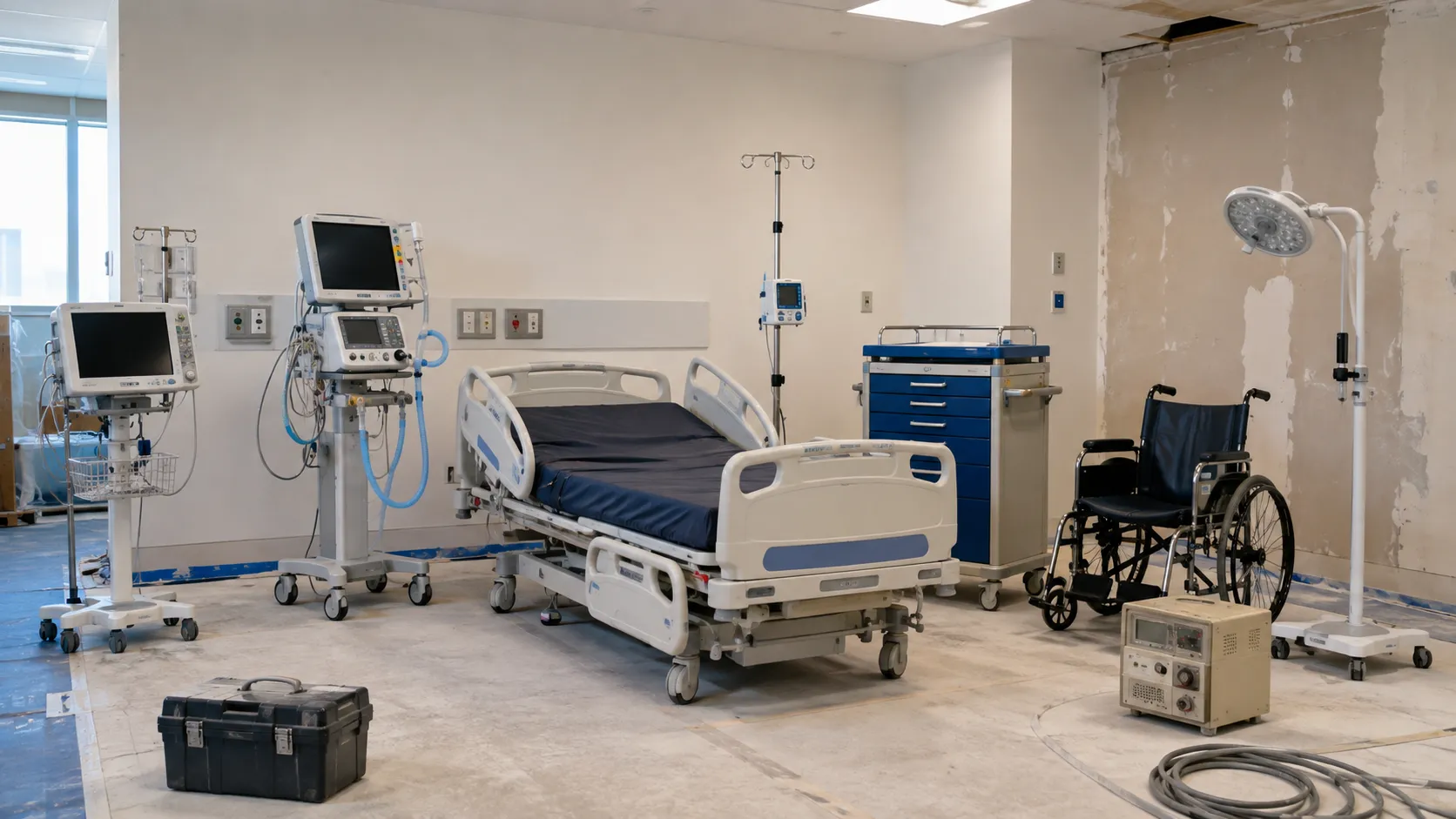
A hospital refurbishment upgrades an existing space rather than adding a new one. So equipment planning is mostly about what to keep, what to replace and what to move. The footprint often stays the same. The aim is a modernised, safer facility with minimal disruption. Setting it up means assessing the current equipment, replacing what is worn or outdated, and phasing the work so services keep running.
This guide covers hospital refurbishment equipment planning, area by area. It then walks through the infrastructure, the planning sequence, and the approval and compliance points. Use it for a ward refresh, a department upgrade, or a whole-floor refurbishment. It focuses on the keep-or-replace, reuse and phasing decisions. Where clinical, project and estates input is essential, it says so.
A refurbishment differs from an expansion in one key way. You are usually not adding capacity, but renewing what is already there. So the first job is an honest assessment. Which equipment is still safe, supported and worth keeping? Which is worn, outdated or unsupported, and needs replacing? Some kit can be reused or relocated. Some has reached the end of its life. The refurbishment is a chance to modernise and to standardise, while keeping the disruption to patients low. Good planning gets the balance right between renewing and reusing.
In practice, the decisions that matter most are about assessment, reuse and phasing. Start by auditing the current equipment against its age, condition and support. That tells you what to keep and what to replace. Reuse what is still good, because replacing everything wastes money. Then plan the phasing and any decant with care, so patients stay safe while the work goes on. Standardise replacements with the rest of the hospital where you can. Plan the keep, replace and move decisions together, and the refurbishment renews the space without waste. Balance is the whole art.
The short version — what every hospital refurbishment is built around
Strip it back, and a refurbishment needs three things. An honest audit of what to keep or replace. Replacement equipment for what is worn or outdated. And phasing that keeps services running.
-
Condition assessment — an honest audit of what to keep, replace or move.
-
Replacement & reuse — new equipment for what is worn, and reuse of what is still good.
-
Phasing & continuity — a plan that keeps services running during the work.
Hospital refurbishment equipment, area by area
-
Condition assessment. An audit of current equipment by age, condition and support. It decides what to keep, replace or retire, so nothing is renewed without reason. Evidence beats guesswork here.
-
Replacement equipment. New equipment for anything worn, outdated or no longer supported. A refurbishment is the natural moment to modernise ageing kit. Waiting often costs more later.
-
Reuse & relocation. Equipment that is still good, kept and relocated within the refurbished space. Reusing sound kit saves money and waste. Not everything needs replacing.
-
Decant & continuity. Temporary arrangements and any decant, so the service keeps running during the work. Patients must stay safe throughout. Plan the moves in detail.
-
Infrastructure refresh. Renewed power, medical gases, IT and finishes where the refurbishment reaches them. Older infrastructure is often the real reason to refurbish. Fix the bones, not just the surface.
-
Modernisation & upgrades. Upgrades that improve safety, efficiency or patient experience. A refurbishment is a chance to raise standards, not just replace like for like. Aim higher where you can.
-
Procurement. A procurement plan that balances replacement and reuse, standardises with the hospital, and sequences delivery to the phasing.
-
Infrastructure. The building services and connections that tie the refurbished area back into the wider hospital.
Hospital refurbishment equipment checklist
|
Section |
Equipment |
Notes |
|
Assessment |
Audit by age/condition/support |
Keep, replace or retire |
|
Replacement |
New kit for worn/outdated items |
Moment to modernise |
|
Reuse |
Keep and relocate good kit |
Save money and waste |
|
Decant |
Temporary arrangements |
Keep service running |
|
Infrastructure refresh |
Power; gases; IT; finishes |
Often the real reason |
|
Modernisation |
Safety and efficiency upgrades |
Raise standards |
|
Procurement |
Replace vs reuse; standardise |
Sequence to phasing |
|
Infrastructure |
Building services; connections |
Tie back to hospital |
Scale each area to the refurbishment. A single ward refresh and a whole-department upgrade differ widely in replacement, decant and infrastructure needs.
Planning a refurbishment?
We'll help you plan it end-to-end. Tell us your refurbishment, services, budget and market. We'll build the keep-and-replace equipment plan, balance new and refurbished units, and make sure everything is compliant and supported.
No pressure, no obligation. → Talk to the team
What else does setting up a hospital refurbishment involve
-
Audit before you order. An honest audit of the current equipment comes first. So the keep-or-replace decision, not a blank shopping list, drives the whole plan. Data drives the spend.
-
Reuse what is still good. Replacing everything wastes money. So keep and relocate sound equipment, and spend the budget on what is genuinely worn or outdated. Reuse is not second best.
-
Keep services running. A refurbishment happens in a live hospital. So decanting and phasing are planned carefully, because patients cannot be put at risk during the work. Safety leads the schedule.
-
Refresh the infrastructure. Ageing power, gases and IT are often the real reason to refurbish. So plan the infrastructure refresh, not just the visible equipment.
-
Consumables, staffing and service. Consumables for the renewed area, staff through the transition, and service contracts across old and new all shape the running model. The purchase is only the start.
Setting up a hospital refurbishment, step by step
-
Audit the current equipment by age, condition and support. Decide what to keep, replace or retire.
-
Confirm the infrastructure refresh. Check power, gases, IT and finishes, and start works early.
-
Build the equipment plan area by area, replacing what is worn and reusing what is still good.
-
Standardise replacements with the hospital. Sequence delivery to the phasing and decant.
-
Install, commission and hand over each area in turn. Keep the service running throughout.
Decanting, phasing and commissioning take time. Build them into the plan, so the service keeps running and each area reopens safely.
Budget and procurement
A refurbishment mixes replacement and reuse, and it touches a live hospital. So the purchase price is only part of the story. Replacement equipment, infrastructure and phasing all carry costs. A common approach is to buy new for high-throughput core units and certified refurbished for ancillary equipment. Because these are regulated devices, check the device risk class and the certification for your market. Match replacement to what is genuinely worn, and reuse the rest. That way, a ward refresh and a full department upgrade each spend where it counts.
Approval and accreditation by region
|
Region |
Regulator |
Device requirement |
|
United Kingdom |
UKCA mark (CE accepted to 2028–2030) |
|
|
European Union |
CE marking under the MDR |
|
|
United States |
FDA clearance or approval |
|
|
Gulf (GCC) |
SFDA & GCC bodies |
National registration / GCC conformity |
|
South Africa |
Medical device licensing |
Any replacement medical devices are regulated, so confirm each is approved for your market. A refurbishment may also need updated safety sign-off for the renewed areas, so plan for this alongside device approval. For quality standards and clinical guidance, the World Health Organisation and NICE are useful references. If you're equipping a hospital refurbishment, our buyer hub sets out how to purchase with confidence.
More from Business
-
Buyers — source a full equipment plan for your hospital refurbishment.
-
Suppliers — list your equipment and reach buyers worldwide.
-
Advertise — promote your products and services to a clinical audience.
-
Business overview — explore everything MediGear offers healthcare organisations.
Disclaimer
This article is for general information only. It is not clinical, medical, procurement, engineering or regulatory advice. Hospital refurbishment planning, equipment, infrastructure, phasing and safety requirements vary by country, project and facility, and change over time. The checklist is a planning aid, not a specification. Always work with qualified clinical, biomedical, facilities and procurement professionals. And confirm every device is approved for your market — for example, UKCA, CE, FDA, SFDA/GCC or SAHPRA. Requirements change, so check the current position before you buy. medigear.UK accepts no liability for actions taken on this content.
Plan your hospital refurbishment end-to-end.
From condition assessment and replacement to reuse and phasing, we help hospitals across the UK, Europe, the US, the Gulf and South Africa plan refurbishments — compliant, supported and on budget.
Frequently Asked Questions
Start with an honest audit of the current equipment by age, condition and support. That decides what to keep, replace or retire. Reuse what is still good, replace what is worn or outdated, and refresh the infrastructure where needed. Then phase the work so the service keeps running. A refurbishment is mostly about keep-or-replace decisions, not a blank shopping list.
The main areas are the condition assessment, replacement equipment, reuse and relocation, decant and continuity, infrastructure refresh, modernisation and upgrades, procurement, and the building services that tie the area back into the hospital. These are planned together, because a refurbishment renews a live space with minimal disruption.
Costs depend on how much is replaced versus reused, the infrastructure refresh, and the phasing, so there is no single figure. Reusing sound equipment saves money. Weigh the purchase price against infrastructure and phasing costs over the project rather than the upfront price alone.
Yes, that is central to a refurbishment. Equipment that is still safe, supported and worth keeping is reused or relocated, while worn or outdated kit is replaced. Certified refurbished units can also fill gaps. Every device, kept or new, must be safe and approved for your market.
It varies with the scale, but planning, auditing, procuring and phasing a refurbishment typically takes several months, done area by area to keep the hospital running. Decant, the infrastructure refresh and phasing are the parts most often underestimated, so build them into the schedule.
A refurbishment often renews power, medical gases, IT and finishes, since ageing infrastructure is frequently the real reason to refurbish. It also needs a decant and phasing plan that keeps current care safe. This infrastructure refresh matters as much as the visible equipment, because it is what makes the space modern and reliable.