Endotoxin testing measures bacterial endotoxin - lipopolysaccharide (LPS) from the outer membrane of Gram-negative bacteria - because it is a potent pyrogen that triggers fever and, at higher doses, dangerous inflammatory reactions. The Bacterial Endotoxin Test (BET) reports endotoxin in endotoxin units per millilitre (EU/mL) for fluids, or EU per device for reprocessed items. It answers a question sterilisation alone cannot: whether something is pyrogen-safe, not just sterile.
That gap matters to anyone reprocessing devices or handling water and injectables. Endotoxin is heat-stable, so it survives the very autoclave cycle that kills the bacteria that produced it.
Why pyrogen risk survives sterilisation
Killing bacteria and removing their toxins are two different jobs. Standard steam sterilisation reliably destroys viable organisms, but LPS is a robust molecule that withstands autoclaving; a sterile item can still be pyrogenic if it was contaminated before the cycle. Removing endotoxin needs either dry-heat depyrogenation, typically around 250°C for 30 minutes on glassware, or thorough cleaning and rinsing with endotoxin-controlled water. This is why final-rinse water for endoscope reprocessing, dialysis fluid, and any parenteral pathway is monitored for endotoxin, not just sterility.
How endotoxin is detected
LAL assays
The classic method uses Limulus Amebocyte Lysate (LAL), derived from horseshoe crab blood, which clots or changes colour in the presence of endotoxin. Three formats are common. Gel-clot is a semi-quantitative endpoint test - the sample either forms a gel at a given sensitivity or it does not. Kinetic turbidimetric assays measure the rate at which the sample becomes cloudy. Kinetic chromogenic assays measure the rate of colour development from a synthetic substrate and read it against an endotoxin standard curve, giving a precise EU/mL result across a wide range.
Recombinant and animal-free options
Recombinant Factor C (rFC) assays use a synthetically produced enzyme instead of crab lysate, detect endotoxin by fluorescence - the same read-out used by many immunoassay analyser platforms - and are now recognised in the European Pharmacopoeia, reducing reliance on a wild-sourced reagent. Where non-endotoxin pyrogens are a concern, the Monocyte Activation Test (MAT) detects a broader range of fever-inducing substances, and the historic in-vivo rabbit pyrogen test is being phased out in its favour.
How a kinetic assay runs
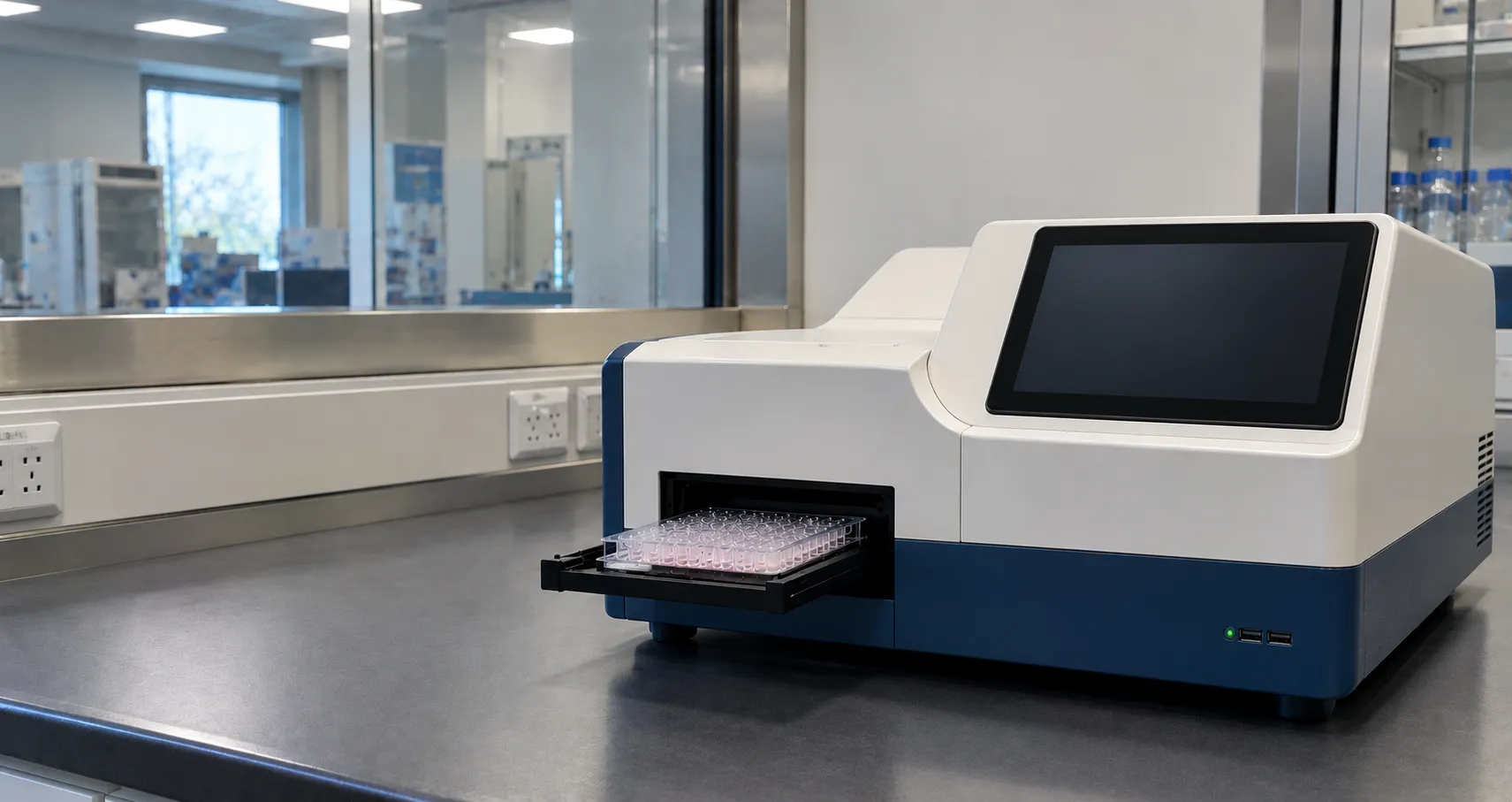
In a kinetic chromogenic test, sample and LAL reagent are dispensed with a micropipette into a microplate or tube and incubated at 37°C while a microplate reader tracks optical density. The time taken to reach a set threshold is inversely related to endotoxin concentration and is compared against a calibration curve prepared from a reference standard endotoxin, often spanning something like 0.005 to 5 EU/mL depending on the reagent. A key control is the maximum valid dilution (MVD), the greatest dilution at which the sample can still be tested against its endotoxin limit, and spiked positive product controls confirm the sample does not inhibit or enhance the reaction. The kinetic formats are favoured where many samples must be run against a precise limit, because a single microplate can carry the standard curve, controls and dozens of samples in one incubated read.
Inhibition, enhancement and controls
A raw sample rarely behaves perfectly in the assay, so validated controls are built in. Some sample matrices inhibit the reaction and mask endotoxin; others enhance it and overstate it. To detect this, laboratories run a positive product control - the sample spiked with a known amount of endotoxin - and confirm recovery falls within an acceptable window, typically 50-200 percent. If it does not, the sample is diluted further, up to the maximum valid dilution, or otherwise treated to overcome interference. A negative control of endotoxin-free water confirms the reagents and labware are clean, and a standard curve made from reference standard endotoxin anchors every run. These controls are what separate a defensible EU/mL result from a number that cannot be trusted.
Depyrogenation versus sterilisation
It is worth being precise about the two processes a buyer will hear conflated. Sterilisation kills or removes viable organisms; depyrogenation removes or inactivates pyrogens, including endotoxin. Dry-heat depyrogenation, commonly a validated cycle around 250°C for 30 minutes, achieves a large log reduction in endotoxin on glass and metal and is used for the very labware the test relies on. Solutions and heat-sensitive items cannot be dry-heated, so endotoxin is controlled upstream by water quality, ultrafiltration and clean process design instead. Understanding that a validated sterilisation cycle does not equal a validated depyrogenation cycle prevents a dangerous assumption in reprocessing and compounding.
Standards and limits
The method is defined in the European Pharmacopoeia general chapter 2.6.14 and the equivalent USP chapter, with rFC covered in Ph. Eur. 2.6.32. Endotoxin limits are set by application: for haemodialysis, the ISO 23500 series sets limits such as under 0.25 EU/mL for dialysis fluid, with ultrapure water tighter still. For medical devices, an endotoxin limit per device is calculated from the maximum dose and a threshold pyrogenic value. The MHRA oversees device safety expectations in the UK, and endotoxin control forms part of that assurance for reprocessed and single-use items alike.
Where endotoxin limits bite hardest
Endotoxin control tightens sharply in fluid-contact and water applications. Haemodialysis is the clearest example: standard dialysis fluid carries an endotoxin limit under 0.25 EU/mL, while ultrapure dialysis water for online preparation is held far lower, so dialysis units test water at defined points in the loop on a routine schedule. Pharmaceutical water grades follow the same logic, with water for injection and the products made from it held to stringent limits per the pharmacopoeia. Reprocessed reusable devices with narrow lumens, where biofilm can persist if cleaning is incomplete, are assessed against an endotoxin limit calculated per device. In each case,e the limit, not just a pass or fail, drives the maximum valid dilution and the assay range you need to buy, which is why the application must be defined before the reagent is chosen.
Before you buy endotoxin testing supplies
-
Match the assay format - gel-clot, kinetic turbidimetric or chromogenic, or rFC - to the precision and throughput you need.
-
Confirm the reader is an incubating tube or microplate photometer suited to your chosen format.
-
Source LAL or rFC reagent lots with a certificate of analysis stating labelled sensitivity and endotoxin standard.
-
Budget for depyrogenated, endotoxin-free labware and LAL reagent water to avoid false positives.
-
Verify the assay range covers your endotoxin limit at the maximum valid dilution.
-
Check reagent cold-chain storage and shelf life, which drive stock control and cost.
-
Consider an animal-free rFC option where sustainability and supply security matter.
Where endotoxin testing fits in decontamination
Beyond pharmaceutical manufacturing, endotoxin control is directly relevant to healthcare decontamination. Final-rinse water in endoscope reprocessing, water systems feeding dialysis, and pharmacy aseptic compounding all rely on endotoxin monitoring, alongside the microbial checks done with water testing kits, to keep the fluid pathway pyrogen-safe. Reusable devices with lumens that are cleaned and reprocessed can accumulate endotoxin if biofilm is not removed, so cleaning validation and water quality sit alongside sterilisation, not after it. Treating endotoxin as a separate control point from microbial kill is what closes the loop. To build a reliable supply of assay reagents and endotoxin-free consumables, MediGear buyer accounts can consolidate laboratory ordering, and our team can advise on format selection.
The verdict
Endotoxin testing measures a risk that sterilisation leaves behind. Choose the assay format that matches your precision and volume, control your water and glassware to endotoxin-free standards, and interpret results against the correct EU/mL limit for the application. Get those three right and BET becomes a dependable guard against pyrogen risk. Source endotoxin assay reagents and consumables through MediGear.
Disclaimer
This article is for informational purposes only. It is published by MediGear (medigear.uk) for general information and procurement guidance, and is not clinical, diagnostic, treatment, technical, engineering, legal or regulatory advice, nor a product endorsement, guarantee or substitute for professional assessment. MediGear does not provide medical consultations. Buyers should consult their clinical, biomedical, estates and regulatory contacts, and the manufacturer's documentation, and independently verify all specifications, certifications, compatibility and suitability before purchase. Specifications, certifications and availability are correct at the time of publication and may change without notice. MediGear is a medical-equipment distributor and does not sell medicines or pharmaceutical products.