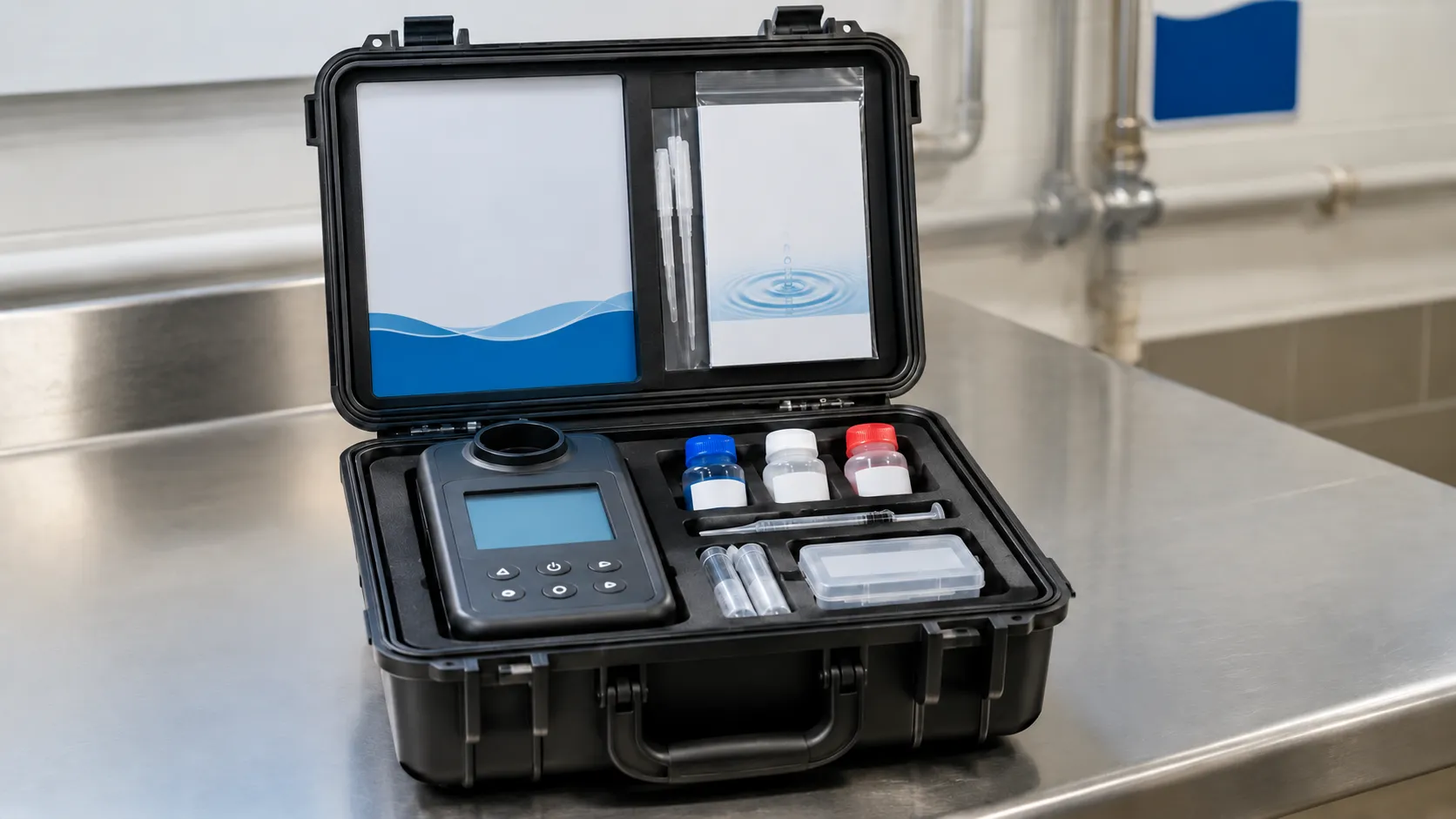
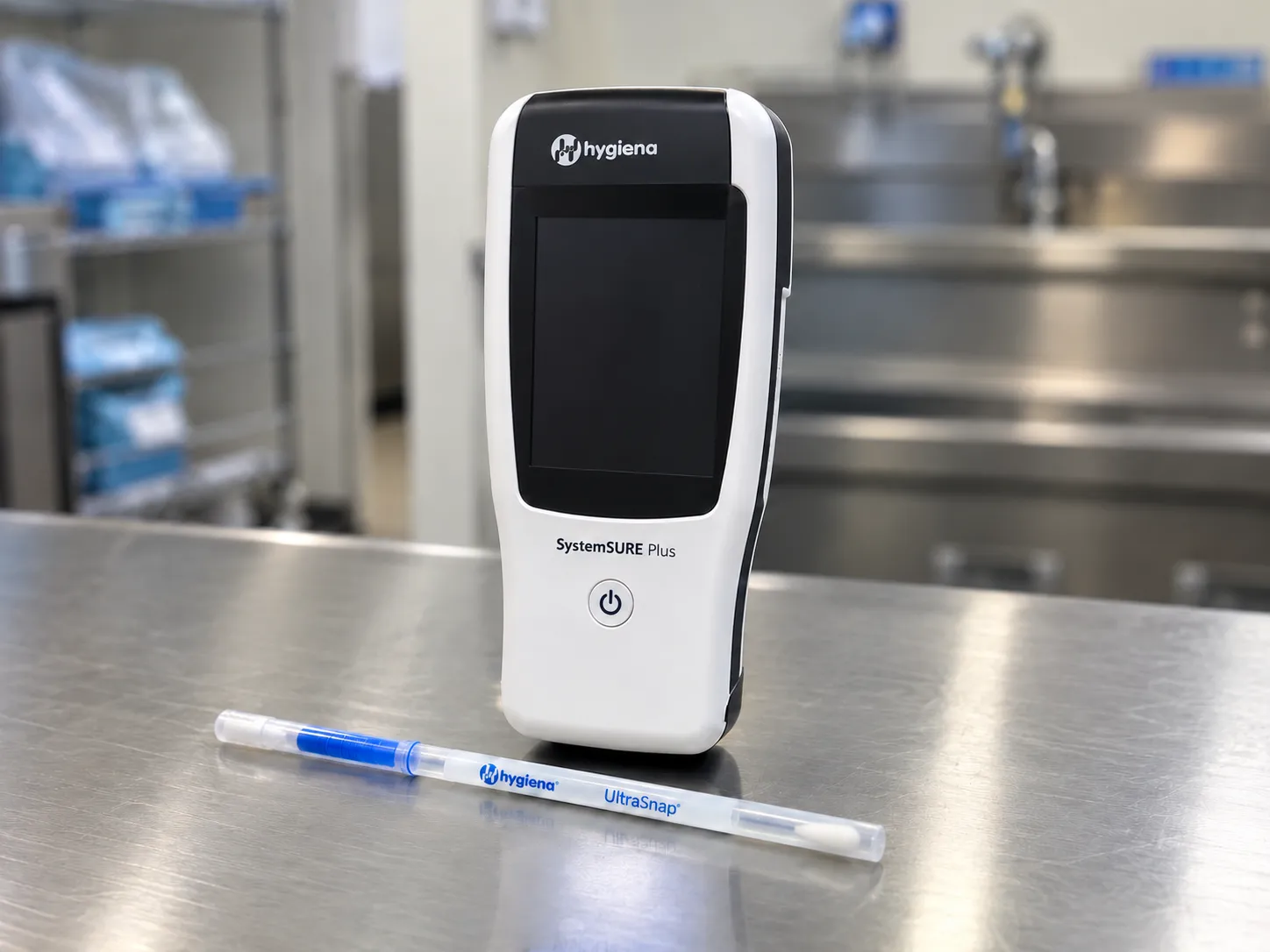
ATP bioluminescence testing checks how clean a surface or rinse is in seconds by detecting adenosine triphosphate (ATP), the energy molecule found in all living and recently living cells. A swab collects residue, a reagent releases the ATP, and the enzyme luciferase converts it to light that a handheld luminometer reads as Relative Light Units (RLU). More organic residue means more light. Crucially, it is a measure of cleanliness, not a microbial count.
For procurement, that distinction is the whole story. ATP gives an instant pass/fail for a cleaning process; it does not tell you which organisms are present or how many are viable.
How the chemistry works
The reaction is the same one that makes fireflies glow. Luciferase, in the presence of ATP and oxygen, oxidises luciferin and emits photons. Light output is proportional to the amount of ATP in the sample, so the luminometer converts photon counts to an RLU value. Because the reaction runs the moment reagent meets sample, a result appears in roughly 15-30 seconds. The swab device carries a premoistened tip, extractant, and reagent in one sealed unit that is snapped and read.
How clean is clean?
Cleanliness is judged against an RLU threshold: below it is a pass, above it a fail, often with a caution band in between. There is no single universal number - each swab system has its own RLU scale, so a benchmark from one manufacturer cannot be read across to another. Thresholds are set for the application, tighter for a reprocessed surgical instrument channel than for a general ward surface. Sites usually validate their own limits by sampling after a known-good clean and after a known-poor one, then setting the cut-off between them. The value of ATP is the immediate feedback loop it gives cleaning teams.
ATP versus culture-based checks
ATP and microbiological culture answer different questions and complement each other. Culture, using surface sampling swabs or contact plates, counts viable colony-forming units but takes 24-72 hours. ATP is instant but non-specific: it responds to food, blood, biofilm,m and cleaning-product organics as well as microbes, and it does not distinguish live from dead cells. Use ATP for real-time verification that a surface or endoscope channel has been cleaned before disinfection; use culture for infection surveillance and identification. A rising RLU trend flags a cleaning failure long before a culture plate would. In practice,ce many decontamination and infection-control teams run the two in parallel: ATP as the fast in-process gate that must be passed before an item or surface moves on, and periodic culture as the slower assurance that the process is genuinely controlling microbial load.
Common applications
Rapid cleaning audits under healthcare cleanliness frameworks, verification of manual pre-cleaning on endoscopes and reusable instruments, checks on final rinse water, hand-hygiene coaching, ing and food-hygiene monitoring all use ATP. In decontamination, protein and ATP residue checks act as surrogates that a soil load has been removed before the item enters a washer-disinfector.
Limitations buyers should understand
ATP is powerful but has hard edges. Strong oxidising sanitisers such as bleach can quench the reaction and depress readings, so timing of the swab relative to disinfection matters. Because RLU is relative, you monitor trends and pass/fail rather than an absolute concentration, and you cannot benchmark one brand against another. It is not a substitute for the microbiological performance testing required by standards such as the ISO 15883 series for washer-disinfectors; it is a fast, complementary process check. Nor is it a diagnostic test: detecting a specific pathogen calls for a different method such as rapid antigen testing. Understanding this keeps the tool credible with clinical and infection-control colleagues.
ATP versus protein residue tests
ATP is not the only rapid cleanliness method, and buyers often weigh it against protein residue tests. Protein swabs use a colour-change chemistry, such as a ninhydrin or OPA reaction, that turns from one colour to another when protein above a threshold is present, giving a visual semi-quantitative result without a reader. They are cheap and simple but coarse. ATP gives a numeric RLU value, better sensitivity, and data you can log and trend, at the cost of a luminometer and cold-stored reagents. Because ATP detects any cellular residue while protein tests target protein specifically, some decontamination units run protein checks aligned to washer-disinfector soil expectations and ATP for broader cleaning audits. Knowing which residue you care about steers the choice.
Reading, trending and validating limits
The number on the screen is only useful inside a system. Modern luminometers store each reading against a named test point, so results build into a trend rather than a stream of one-off numbers. Sites set their own pass, caution, and fail thresholds by sampling repeatedly after a validated good clean to establish a baseline, then after a deliberately poor clean, and placing the cut-off between the two distributions. Fail results feed straight back to the cleaning team for a re-clean and re-test, closing the loop within minutes. Over weeks, the data shows which surfaces, shifts,s or methods consistently underperform, which is where ATP earns its keep as a management tool rather than a single spot check. Exporting results to cleaning-audit software supports reporting against healthcare cleanliness expectations.
Uses beyond surfaces
The same luminometer supports several workflows, which improves its value case. Water-specific ATP tests check final rinse water and dental unit waterlines for organic load. Endoscope reprocessing units swab the working channel or test the channel rinse to confirm manual pre-cleaning removed soil before an endoscope reprocessor runs, since residual organic matter can shield micro-organisms from disinfection. Hand-hygiene programmes use ATP to demonstrate to staff, in real time, how much residue a rushed hand-wash leaves behind, which is a powerful training aid. Because one meter and one swab range can cover surfaces, water and channels, a single system standardised across departments keeps both cost and RLU interpretation consistent, provided each application has its own validated threshold rather than a shared figure.
Choosing a luminometer and swabs
-
Confirm the RLU dynamic range and sensitivity suit your tightest application, from instruments to surfaces.
-
Check swab shelf life and whether reagents need refrigerated storage, which affects logistics and cost.
-
Look for onboard data logging, pass/fail thresholds by testpoint,nt and export to cleaning-audit software.
-
Assess throughput and battery life for the volume of tests each shift will run.
-
Verify calibration checks and any positive/negative control devices the manufacturer supplies.
-
Make sure the swab extractant tolerates residues from your specific detergents and disinfectants.
-
Standardise on one system per site so RLU results stay comparable across departments.
Beyond the device price
The luminometer is a modest one-off; the swabs are the recurring cost and the driver of total spend. Each test consumes a single-use swab with a defined shelf life, so usage volume and reorder cadence shape the budget more than the meter does. Factor in reagent cold-chain storage, calibration, staff training, and the software you use to log and trend results. Because swab systems are proprietary, choosing a supplier is a long-term commitment - switching later means re-validating every threshold. Setting up managed consumable supply through MediGear buyer accounts keeps swab stock rotating and in date, and our team can help match a system to your workflow. National cleaning expectations are set out by the NHS.
The buyer's takeaway
ATP bioluminescence is the fastest honest answer to how clean is clean, provided you treat RLU as a cleaning indicator rather than a bacterial count and pair it with culture for surveillance. Pick a system whose sensitivity, data handling, and swab logistics fit your service, validate your own thresholds, and it becomes a reliable everyday check. Explore rapid hygiene monitoring options with MediGear.
Disclaimer
This article is for informational purposes only. It is published by MediGear (medigear.uk) for general information and procurement guidance, and is not clinical, diagnostic, treatment, technical, engineering, legal or regulatory advice, nor a product endorsement, guarantee or substitute for professional assessment. MediGear does not provide medical consultations. Buyers should consult their clinical, biomedical, estates and regulatory contacts, and the manufacturer's documentation, and independently verify all specifications, certifications, compatibility and suitability before purchase. Specifications, certifications and availability are correct at the time of publication and may change without notice. MediGear is a medical-equipment distributor and does not sell medicines or pharmaceutical products.