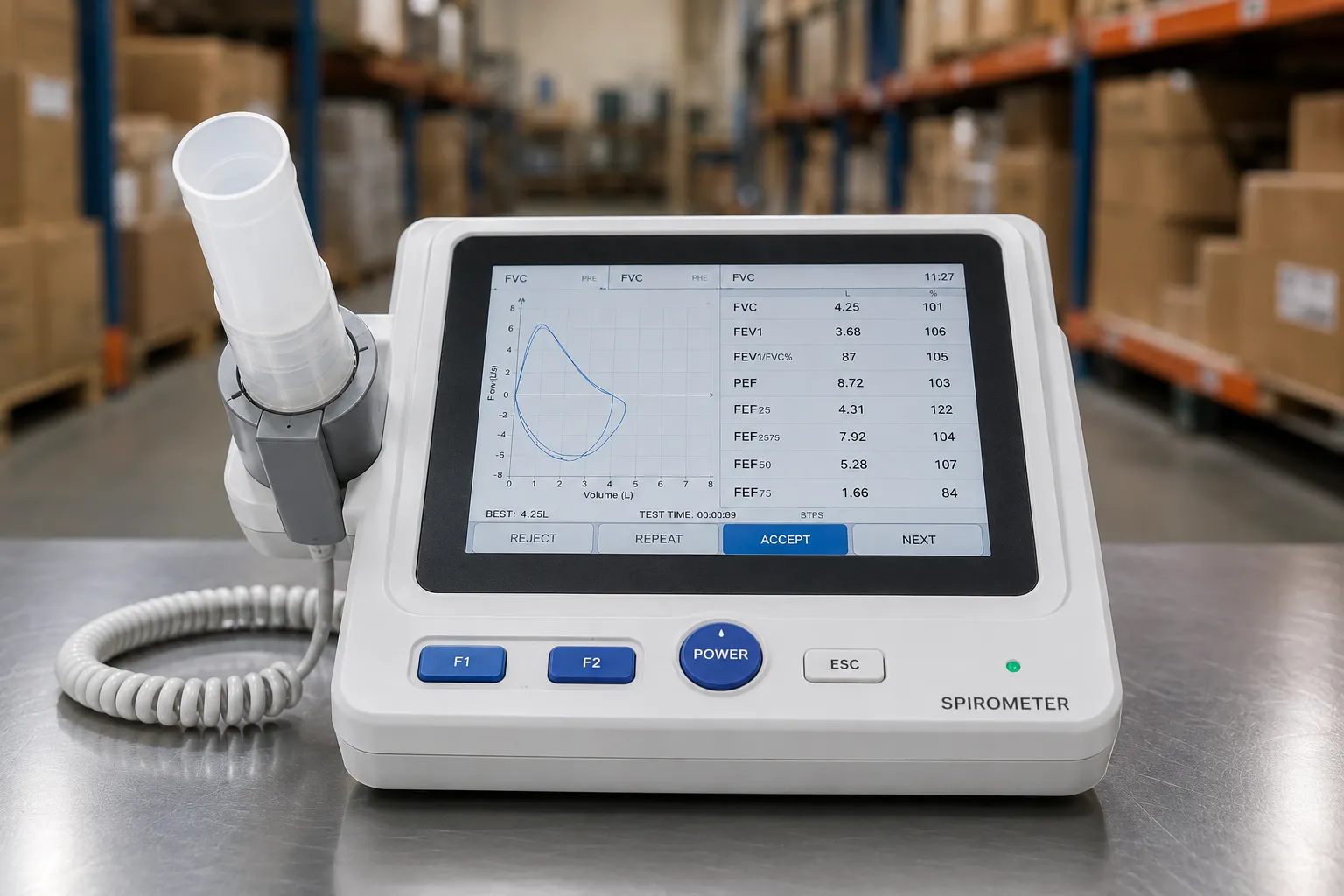
A spirometer measures how much air a person can breathe out and how fast, which is the basic test of lung function. In a test, the patient takes a full breath and blows out as hard and as long as they can into a mouthpiece, and the device records the volume and flow of that breath over time. From those curves it derives the numbers clinicians use to assess airway obstruction and lung volume.
For a GP practice, a respiratory clinic, an occupational health service or a hospital pulmonary function lab, the spirometer is a core diagnostic tool. The buying decision turns on measurement technology, calibration, infection control of the breathing circuit, and how results move into the record.
The Key Measurements
Two headline values do most of the work. FVC (forced vital capacity) is the total volume forced out after a full breath in. FEV1 (forced expiratory volume in one second) is how much of that comes out in the first second. Their ratio, FEV1/FVC, is central to distinguishing obstructive from restrictive patterns. The device also plots the flow-volume loop and volume-time curve, and reports peak expiratory flow and other derived values. Results are compared against predicted values for the person's age, height, sex and ethnicity, so accurate demographic entry is part of a valid test.
Why technique and repeatability matter
A spirometry result is only as good as the breath. Recognised quality criteria require several acceptable, repeatable manoeuvres, so the instrument must show real-time curves and flag efforts that fall short. Devices that guide the operator to acceptable and repeatable results improve data quality, which is why usability is a clinical feature, not a nicety.
How Spirometers Measure Flow
The measurement principle varies by sensor, and it affects calibration and cleaning.
Pneumotachograph and differential pressure
These measure the small pressure drop across a fixed resistance as air flows through, and calculate flow from it. They are accurate but can be sensitive to temperature and condensation, and the flow head needs cleaning or replacing.
Turbine and volumetric sensors
Turbine sensors count the rotation of a light vane in the airflow. Many use a single-use disposable turbine, which sidesteps cleaning between patients. Volumetric spirometers measure displaced volume directly. Ultrasonic sensors time sound pulses across the flow and have no moving parts to wear. Each approach trades accuracy, robustness, calibration behaviour and consumable cost differently, so match the sensor to how the device will be used and cleaned.
Types of Spirometer and Care Settings
Handheld and portable spirometers suit general practice, occupational health screening and domiciliary visits, running on batteries with disposable mouthpieces. Desktop diagnostic spirometers offer larger displays, printers and fuller reporting for respiratory clinics. Full pulmonary function systems in hospital labs add lung-volume and gas-transfer measurement well beyond simple spirometry. Occupational health uses spirometry for respiratory health surveillance where workers are exposed to hazards, which brings HSE expectations into the specification. Matching the device class to the setting and caseload is the first procurement decision.
Bronchodilator and Reversibility Testing
Some assessments compare spirometry before and after an inhaled medicine to see whether airflow improves, which helps characterise the airways. From an equipment point of view, this means the device must store and clearly display paired pre- and post-results and calculate the change for the operator. If your service performs this kind of testing, confirm the software supports paired sessions and reports the comparison cleanly, because reconstructing it by hand wastes clinician time and invites error. The clinical decision remains with the clinician; the device is to present the data well.
Standards, Regulation and Calibration
A spirometer sold in the UK is a medical device requiring a UKCA or CE mark, with the supplier registered with the regulator. Performance and accuracy expectations follow the widely used ATS/ERS technical standards for spirometry, and electrical safety for mains-powered devices follows the IEC 60601-1 family. Calibration verification is central: many services verify volume accuracy daily using a 3-litre calibration syringe, and disposable-turbine devices may be described as calibration-free but still need periodic verification against a syringe. Ambient temperature, pressure, and humidity affect gas volumes, so devices apply BTPS correction, and some need to have specific conditions entered. Build the calibration syringe, its own verification, and the daily-check routine into the running plan. The MHRA and NICE are useful references for device guidance and the clinical context spirometry supports.
Decontamination, Single-Use and Infection Control
The breathing circuit is a direct infection-control concern because patients exhale forcefully through it. Approaches differ: single-use disposable mouthpieces are universal, and many devices add a single-use turbine or an in-line bacterial and viral filter to protect the sensor and the next patient. Reusable flow heads must be decontaminated to a validated procedure between patients, which takes time and needs enough heads in rotation. Single-use sensor paths cost more per test but remove reprocessing and its risks. Cost this honestly across your annual test volume, because at scale the consumable route can dominate the total.
Warranty, Servicing and Spares
A spirometer is used daily and handled by many staff, so servicing terms matter. Ask about the warranty length, the cost of a replacement flow sensor or turbine, and how software updates and support are provided for PC-connected devices. Confirm the price and availability of the calibration syringe and its periodic verification, since a syifted unsyringe determines every daily check. For devices central to a busy clinic, ask whether a loan or rapid repair is offered, because a service that cannot test loses appointments and delays assessments.
Consumables, Connectivity and Total Cost of Ownership
The purchase price is only the start. Mouthpieces, filters, disposable turbines, nose clips, printer paper and the calibration syringe are recurring costs that scale with activity. PC-based spirometers may carry a software licence but simplify reporting and storage. Connectivity to the patient record, whether through a documented export or direct integration, removes manual transcription and its errors on every test and is a genuine time saving. A cheap unit with expensive proprietary consumables can cost more over five years than a dearer one with open, affordable parts. When you plan a service or refresh a fleet, our team can help you weigh sensor type against consumable cost through MediGear for buyers.
What to Check Before You Buy
-
Sensor type and how it trades accuracy, robustness and consumable cost.
-
Real-time curves and quality prompts that help staff meet acceptability criteria.
-
Conformance with ATS/ERS spirometry standards and BTPS correction handling.
-
Calibration verification method, including the 3-litre syringe and daily-check routine.
-
Infection control: disposable mouthpieces, in-line filters or single-use turbines.
-
UKCA or CE marking and IEC 60601-1 electrical safety for powered devices.
-
Recurring consumable cost and connectivity into your patient record system.
Conclusion
A spirometer converts a forced breath into the FEV1, FVC and flow curves that respiratory assessment relies on, and the quality of that data depends on a sound sensor, disciplined calibration and good technique support. Choose the device class for your setting, cost the consumables and calibration honestly, and insist on ATS/ERS performance and IEC 60601-1 conformity. To compare spirometry options for your service, talk to MediGear and buy on total cost and data quality, not the sticker price.
Disclaimer
This article is for informational purposes only. MediGear (medigear.uk) publishes it for general information and procurement guidance. It is not clinical diagnostic, treatment, technical, engineering, legal, or regulatory advice, nor a product endorsement, guarantee, or substitute for professional assessment. MediGear does not provide medical consultations. Buyers should consult their clinical, biomedical, estates and regulatory contacts, and the manufacturer's documentation, and independently verify all specifications, certifications, compatibility and suitability before purchase. Specifications, certifications and availability are correct at the time of publication and may change without notice. MediGear is a medical-equipment distributor and does not sell medicines or pharmaceutical products.