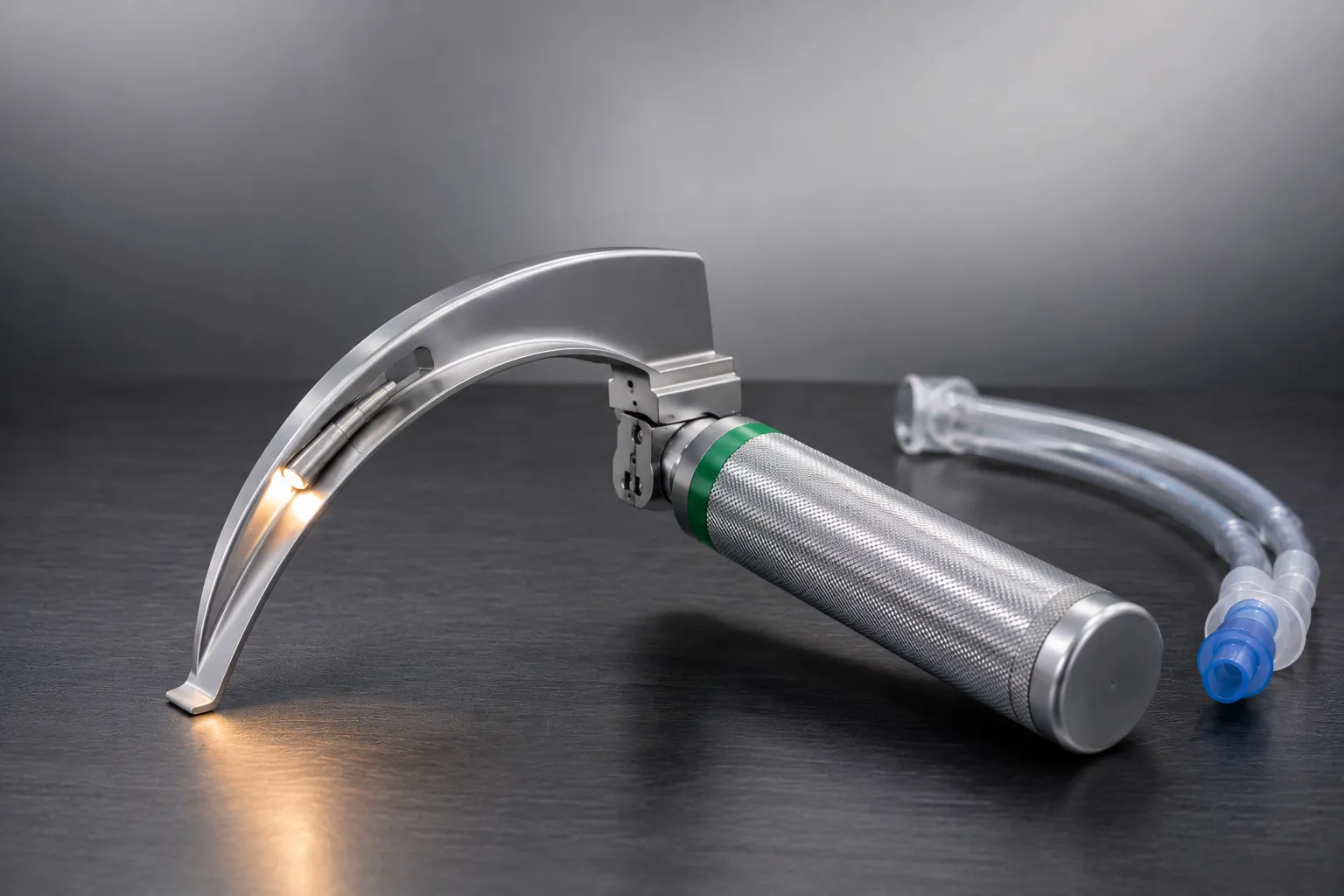
A laryngoscope is a handheld instrument that lets a clinician see the larynx and vocal cords in order to pass a breathing tube into the trachea. It does two jobs at the same time: it lifts the tongue and soft tissue out of the sight line, and it lights the airway so the glottic opening is visible. A clean view makes intubation fast and controlled; a poor one makes it slow and dangerous.
For a procurement team, the device matters less as a single object and more as a fleet decision. The market splits into reusable rigid laryngoscopes, where a handle carries detachable blades, and video laryngoscopes, where a small camera at the blade tip sends the image to a screen. Both are judged on the same four things: light quality, blade range, infection control and cost across the whole service life.
How Airway Intubation Works
Intubation follows a set sequence, and knowing the sequence explains why blade shape, illumination and grip all matter to the staff who use the kit under pressure.
Positioning and pre-oxygenation
The head is positioned to bring the oral, pharyngeal and laryngeal axes into better alignment, and the patient is pre-oxygenated to buy a safety margin before the tube is placed.
Blade insertion and tongue control
The blade enters along the right side of the mouth and sweeps the tongue to the left. A curved Macintosh blade sits in the vallecula and lifts the epiglottis indirectly; a straight Miller blade lifts the epiglottis directly. The choice is clinical, so a department needs both patterns available.
Visualising the glottis
The handle is lifted forward and upward, never levered against the teeth, to expose the cords. Cool, steady light is what makes this step repeatable across a long list.
Tube placement and confirmation
The tube is passed between the cords; placement is confirmed with capnography and auscultation before the blade is withdrawn. Confirmation is a clinical step, but the equipment has to hold a clear image throughout.
The Illumination Principle a Buyer Should Understand
Older laryngoscopes used a bulb seated in the blade tip. Modern fibre-optic blades instead carry light from a source in the handle along a bundle to the tip, which keeps heat away from tissue and makes the blade easier to clean. LED sources have largely replaced xenon and halogen bulbs because they run cooler, last far longer and hold a whiter colour temperature as the battery drains. Colour temperature matters more than raw brightness: a warm, yellowing light flattens the contrast between mucosa and the glottic opening, while a consistent white light preserves it. When you evaluate units, judge light at the end of a battery cycle, not straight off the charger.
Direct Versus Video Laryngoscopy
Direct laryngoscopy depends on a straight line of sight from the operator's eye to the glottis. Video laryngoscopy places the camera at the blade tip, so the operator sees around the curve of the airway on a monitor. Video units are widely chosen for anticipated difficult airways and for training, because a supervisor sees exactly what the trainee sees and can guide in real time. They cost more, add a screen and battery to maintain, and often use single-use blades, all of which reshape the procurement maths. Many high-turnover theatres and emergency departments keep both: a dependable direct set for routine work and a video unit held in reserve for difficult or teaching cases. Standardising one video platform across sites also lets clinicians move between departments without relearning the controls, which is a genuine safety and training saving.
Blades, Handles and Sizing
Blade sizes typically run from 00 for neonates to 4 for large adults, so a department needs a spread rather than one size. The fitting between blade and handle is a procurement lever in its own right: the green system defined in ISO 7376 keeps blades and handles interchangeable across compliant brands, which protects you from being locked to a single supplier. Battery handles must hold a consistent output across a shift; rechargeable handles cut disposable battery spend but need a charging routine and spare handles in circulation so nothing is ever off the trolley. Grip diameter and balance affect control during an awkward view, so have clinicians handle samples before you commit a fleet to one design.
Standards, Regulation and Electrical Safety
Any laryngoscope placed on the UK market is a medical device and must carry a UKCA or CE mark under the applicable regulations, with the manufacturer or importer registered with the regulator. Powered and video devices should meet the IEC 60601-1 family for electrical safety and, where a monitor is involved, the relevant electromagnetic compatibility parts. ISO 7376 governs the blade-and-handle fitting. Ask suppliers to state current conformity in writing rather than accepting a logo on a box, and check the MHRA for device guidance and field safety notices during evaluation. The NHS sets the clinical context these tools serve and is a sensible reference point for service-level expectations.
Decontamination and Single-Use Choices
Reusable blades and handles have to survive repeated decontamination without losing light output or corroding, so confirm the validated cycle, whether thermal washer-disinfector or autoclave, before you buy. Single-use blades remove reprocessing and cross-contamination risk entirely, which suits emergency and infection-control situations, but they raise consumable spend and waste volume that estates and sustainability leads will want costed. Fibre-optic reusable blades are usually easier to clean than tip-bulb designs because there is no electrical contact in the blade itself. The right mix is rarely all one or the other.
Care Settings, Consumables and Total Cost
The same headline device serves very different settings. A theatre suite wants a matched reusable fleet with reprocessing capacity; an ambulance or resus trolley leans towards single-use to guarantee a clean blade every time; a paediatric unit needs the smaller blade sizes and gentler handling. Total cost of ownership therefore has to include batteries or charging, replacement blades, reprocessing consumables, and the spares and servicing you will need over a multi-year contract. A cheap handle that eats batteries and has no spare supply is not cheap. When you standardise across several sites,o ur team can help you compare configurations and lifetime cost through MediGear for buyers.
What to Check Before You Buy
-
Full blade size range in both Macintosh and Miller patterns for your patient mix.
-
ISO 7376 green-system compatibility so handles and blades interchange between brands.
-
LED light output that stays bright and white as the battery drains, with a clear replacement path.
-
Whether blades are reusable, single-use or both, and the true cost per use of each.
-
UKCA or CE marking and electrical safety to IEC 60601-1 for any powered or video component.
-
The validated decontamination method each reusable blade tolerates.
-
Guaranteed availability of spares, batteries and the same models across the contract term.
Conclusion
A laryngoscope is only as good as the view it holds when a case turns difficult, so the smart purchase balances reliable light, a sensible blade range and a decontamination route your team can actually sustain. Weigh reusable against single-use on real cost per use, insist on ISO 7376 and IEC 60601-1 conformity, and lock in long-term parts supply. To scope options for your department, talk to MediGear and buy on evidence rather than list price.
Disclaimer
This article is for informational purposes only. It is published by MediGear (medigear.uk) for general information and procurement guidance, and is not clinical, diagnostic, treatment, technical, engineering, legal or regulatory advice, nor a product endorsement, guarantee or substitute for professional assessment. MediGear does not provide medical consultations. Buyers should consult their clinical, biomedical, estates and regulatory contacts, and the manufacturer's documentation, and independently verify all specifications, certifications, compatibility and suitability before purchase. Specifications, certifications and availability are correct at the time of publication and may change without notice. MediGear is a medical-equipment distributor and does not sell medicines or pharmaceutical products.