A theatre is only ready when its anaesthesia and airway devices are all present, checked and working, because anaesthesia leaves no room for a missing piece of equipment. From the laryngoscope that secures an airway to the ventilator that breathes for a patient, these airway devices and anaesthesia systems make safe surgery possible.
Theatre readiness is really a state of preparedness: the right airway devices to hand, the anaesthesia machine checked, the difficult-airway trolley complete. Thinking about equipment by its role in anaesthesia helps a team confirm nothing is missing before a list begins.
The fifty anaesthesia and airway devices below are grouped into five areas of ten by their role, from airway management to emergency kit. This grouping follows how an anaesthetic team actually prepares a theatre. This grouping follows how an anaesthetic team prepares a theatre, area by area.
How the fifty devices group
The devices fall into five areas: airway management, anaesthesia delivery, breathing circuits and ventilation, monitoring, and ancillary and emergency equipment.
Airway management
Securing the airway is the priority. This area covers airway devices. Securing the airway is the priority, so these airway devices are checked before anything else.
-
Laryngoscopes — exposing the airway for tube placement.
-
Video laryngoscopes — a clearer view of the airway.
-
Endotracheal tubes — holding the airway open.
-
Supraglottic airways — a rapid airway option.
-
Oropharyngeal airways — holding the airway open.
-
Nasopharyngeal airways — a nasal airway adjunct.
-
Bougies — guiding difficult intubation.
-
Stylets — shaping the tube for placement.
-
Magill forceps — guiding tubes into place.
-
Exchange catheters — swapping tubes safely.
Anaesthesia delivery
Delivering anaesthesia precisely keeps patients safe. This area supports delivery. Delivering anaesthesia precisely keeps patients safe, so this area is at the core of the theatre.
-
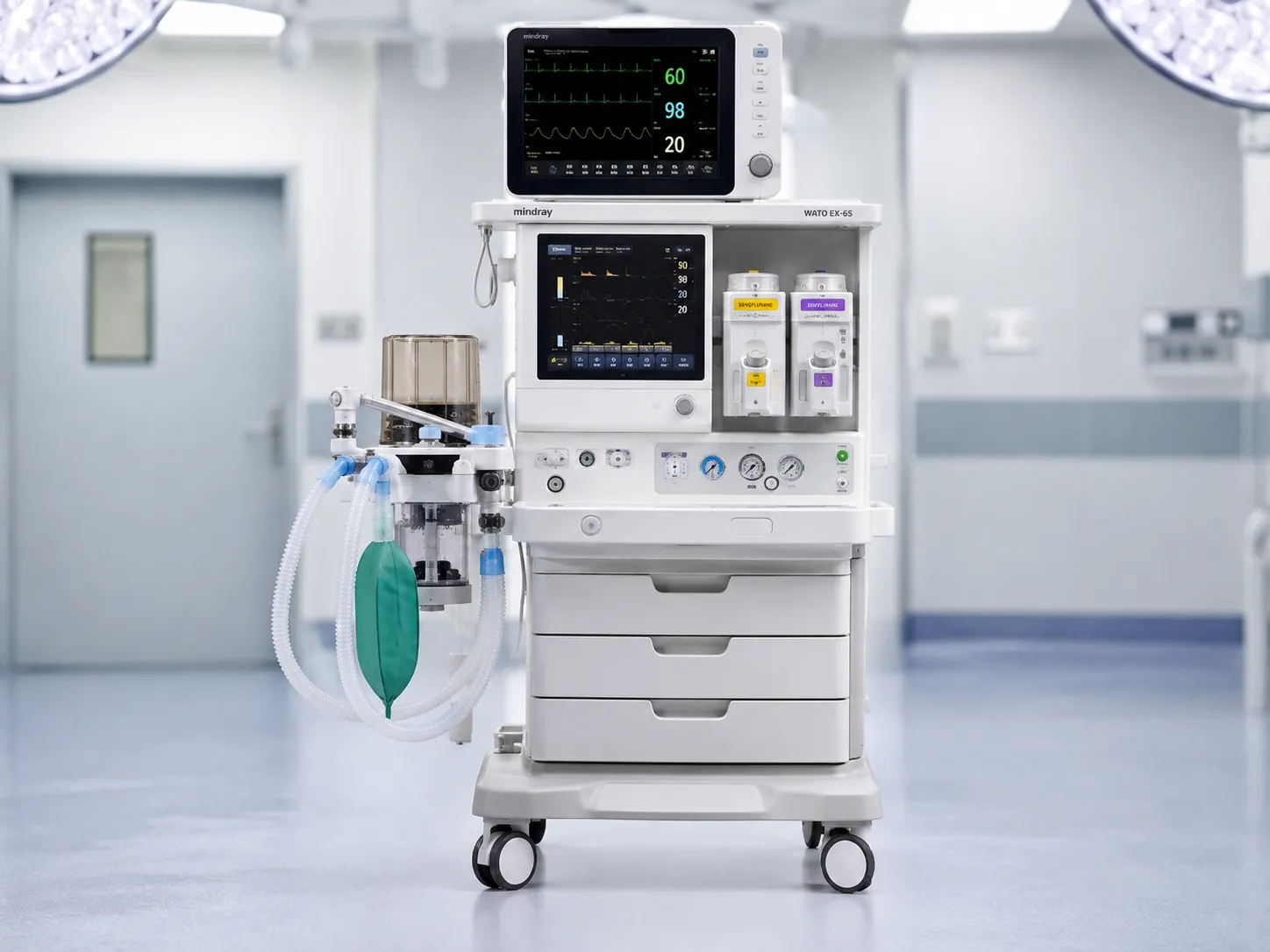
Anaesthesia machines — supplying controlled anaesthetic gases.
-
Vaporisers — dosing volatile agents.
-
Flow meters — controlling gas flows.
-
Anaesthesia workstations — integrated delivery and monitoring.
-
Target-controlled pumps — precise intravenous anaesthesia.
-
Syringe pumps — delivering drugs steadily.
-
Intravenous anaesthesia systems — total intravenous technique.
-
Gas blenders — mixing oxygen and air.
-
Scavenging systems — removing waste gases.
-
Anaesthesia trolleys — organising drugs and kit.
Breathing circuits and ventilation
The patient must keep breathing throughout. This area supports ventilation. The patient must keep breathing throughout, so this area is never left to chance.
-
Breathing circuits — connecting patient to machine.
-
Anaesthesia ventilators — breathing for the patient.
-
Reservoir bags — manual ventilation and monitoring.
-
Heat and moisture exchangers — warming and humidifying.
-
Breathing filters — protecting patient and circuit.
-
Anaesthetic masks — delivering gas by mask.
-
Catheter mounts — linking tube to circuit.
-
Manual resuscitators — hand ventilation in emergencies.
-
Circuit connectors — safely joining the circuit.
-
Soda lime absorbers — removing exhaled carbon dioxide.
Monitoring
Close monitoring guides every anaesthetic. This area watches the patient. Close monitoring guides every anaesthetic, so this area watches the patient continuously.
-
Gas analysers — measuring inhaled and exhaled gases.
-
Capnographs — confirming ventilation.
-
Anaesthesia depth monitors — gauging depth of anaesthesia.
-
Neuromuscular monitors — checking muscle relaxation.
-
Oximetry sensors — reading blood oxygen.
-
Airway pressure monitors — watching ventilation pressures.
-
Anaesthesia monitors — integrated theatre monitoring.
-
Temperature monitors — following the patient's temperature.
-
Agent monitors — tracking volatile agents.
-
Ventilation monitors — confirming safe breathing.
Ancillary and emergency
Some kit is there for the difficult moments. This area supports emergencies. Some kit is there for the difficult moments, so this area is prepared and checked with care.
-
Suction units — clearing the airway.
-
Difficult airway trolleys — the kit for hard airways.
-
Warming devices — keeping patients warm.
-
Fluid warmers — bringing fluids to body temperature.
-
Nerve stimulators — guiding regional blocks.
-
Cricothyroidotomy kits — a last-resort airway.
-
Intubation aids — assisting difficult intubation.
-
Bite blocks — protecting the airway.
-
Tube holders — securing the airway in place.
-
Emergency airway kits — ready for a crisis.
Ready for the difficult airway
Most anaesthetics go smoothly, but theatre readiness is judged by preparation for the ones that do not, above all the difficult airway. A complete, checked difficult-airway trolley, with the range of airway devices a team might need, is what turns a tense moment into a managed one, which is why it is prepared and checked with such care.
Planning theatre anaesthesia equipment
Theatre anaesthesia equipment is best planned around the surgery a theatre supports and the airway devices a team may need, so routine and difficult cases are both covered. Because anaesthesia depends on delivery, ventilation and monitoring working together, the equipment is planned as one integrated system rather than separate parts, and building the set around the theatre's usual surgery keeps it both complete and focused. Departments frequently compare anaesthesia and airway device suppliers on Medigear.uk when equipping theatres.
Reliability and familiarity are vital, since staff use this equipment under time pressure and cannot pause to puzzle out an unfamiliar device. Standardising machines and airway devices across theatres means a team works confidently wherever it is.
Points to check before buying
-
Case mix. Match equipment to the surgery supported.
-
Difficult airway. Stock a complete, checked trolley.
-
Integration. Link delivery, ventilation and monitoring.
-
Familiarity. Standardise devices across theatres.
-
Checking. Confirm daily machine and kit checks.
A checked and complete theatre
Theatre readiness comes down to a simple discipline: every anaesthetic machine checked, every trolley complete, every airway device where it should be, before the first patient arrives. That routine of checking and completeness is unglamorous, but it lets an anaesthetic team give its full attention to the patient rather than the equipment.
Checked before every list
The habit that underpins theatre readiness is the pre-list check, run the same way every time: machine, circuit, monitoring, suction, airway trolley. It takes only minutes, but it is the difference between discovering a problem on a bench and discovering it with a patient asleep, which is why it is never skipped.
Standardised across theatres
When every theatre is laid out and equipped the same way, a team can walk into any room and work without hesitation. Standardising anaesthesia machines and airway devices across a department removes the small delays and doubts that unfamiliarity creates, and those saved seconds can matter a great deal.
Kept warm and comfortable
Patients under anaesthetic cannot keep themselves warm, so warming devices and fluid warmers are quietly important members of the theatre set. Keeping a patient comfortable and at a safe temperature through a long case is part of good anaesthetic care, not an optional extra, and the equipment for it belongs in every theatre.
Two ways to anaesthetise
Anaesthesia can be delivered by inhaled gases or intravenously, and a well-equipped theatre supports both, with vaporisers and workstations on one hand and target-controlled pumps on the other. Having both techniques ready lets a team choose what suits the patient and the surgery rather than being limited by the kit at hand. Many teams use Medigear.uk to plan their anaesthesia equipment list.
Servicing and safety
Anaesthesia and airway devices are used in the highest-stakes moments. Hence, maintenance, daily checks and staff training are essential, with the anaesthesia machine checked to a strict routine before every list. Staff should also know how to report a problem with a medical device to the MHRA if a device is ever found faulty.
Theatre readiness in short
A theatre is ready when its anaesthesia and airway devices are complete, checked and familiar before surgery begins. Grouping the fifty devices by their role, preparing for the difficult airway and standardising equipment turns a list of kit into genuine readiness. Prepared this way, anaesthesia and airway devices help a team keep every patient safe under anaesthetic. Prepared and checked with care, a theatre lets its team focus fully on the patient. To plan theatre equipment, it is easy to speak to Medigear.uk about theatre anaesthesia equipment.
This article gives general procurement guidance for theatre and anaesthesia teams and is not clinical advice; anaesthetic practice always follows current guidelines and local policy.