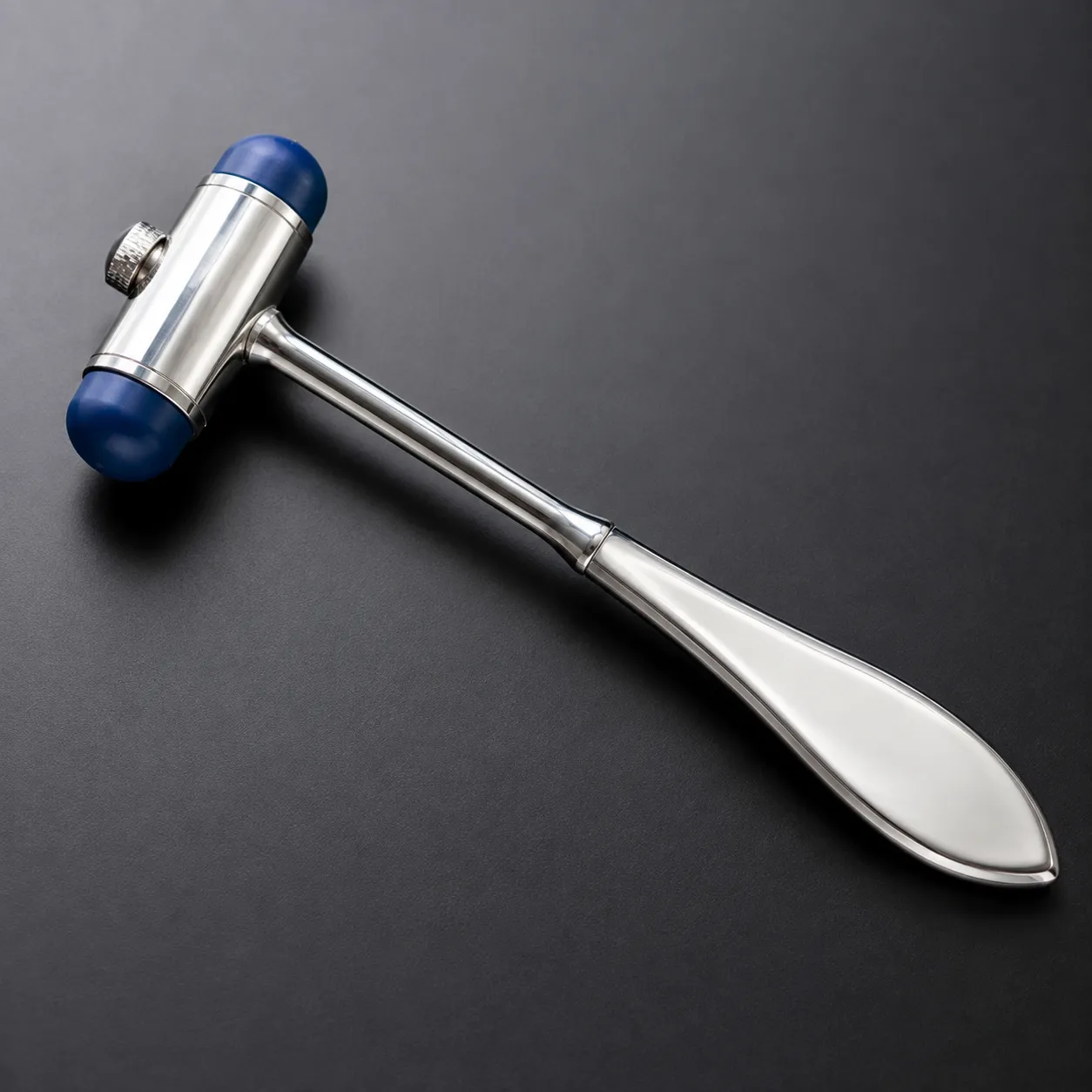
A reflex hammer is a simple, unpowered instrument used to elicit deep tendon reflexes during a neurological examination. A brisk, controlled tap on a tendon stretches it, triggering a reflex muscle contraction, and the clinician judges the response against what is expected. It is one of the lowest-cost items in the diagnostic bag, yet a poorly balanced hammer makes reliable elicitation harder, so the choice still matters.
For a buyer, reflex hammers are a volume purchase for examination rooms, teaching and community teams rather than a capital decision. The interesting questions are the pattern that suits your clinicians, build quality, hygiene, and how to standardise a fleet. This guide explains how they work, the main patterns, what to check and how they fit into procurement.
How a reflex hammer works
The examination tests the monosynaptic stretch reflex. A sudden stretch of a tendon, delivered by the hammer's head, activates sensory fibres that synapse in the spinal cord and drive a motor response, producing a visible muscle twitch. The clinician needs a reproducible, well-controlled tap, which is why head weight, balance and handle length matter. Too light a head or a poorly weighted handle makes it hard to deliver a consistent stimulus, and consistency is what lets a clinician compare sides and track change. The instrument itself measures nothing; its value lies in delivering a repeatable mechanical stimulus.
The main patterns you will compare
Tomahawk (Taylor)
The familiar triangular rubber head on a flat metal handle. Compact and inexpensive, it is the classic general-purpose hammer and a common teaching choice, though its light head suits smaller reflexes.
Queen Square
A disc head on a long, often bamboo or plastic handle, swung from the wrist. Favoured by many neurologists for the controlled, pendulum-like action a longer handle allows.
Buck and Tromner
The Buck hammer has two heads of differing size and often incorporates a pin and brush for sensory testing. The Tromner is a double-headed neurological pattern popular for its balance and versatility across large and small tendons.
Babinski and one-piece designs
The Babinski resembles the Queen Square with a longer handle. Moulded one-piece hammers trade some feel for durability and easy cleaning, which suits high-turnover or infection-sensitive settings.
What to check on build and design
Head weight and balance are the heart of a good hammer, so where possible let clinicians handle patterns before standardising a fleet. Check the handle length and grip, the head material and how securely it is fixed, and whether the rubber will perish or harden over time. Some patterns include a retractable pin or brush for testing sensation and plantar responses; decide whether you want those integrated or supplied separately. For teaching, a consistent pattern across a cohort helps trainees develop reliable technique.
Standards, regulation and materials
A reflex hammer is a low-risk medical device. Sold in Great Britain i, it should carry appropriate UKCA or, during the recognised transition, CE marking as a Class I device, with the manufacturer or UK Responsible Person registered with the MHRA. There is no electrical-safety standard to meet because the instrument has no power source, so the IEC 60601 family does not apply. What matters instead is material quality, latex content and cleanability. If any integrated pin is intended to break skin, it becomes a sharps and single-use consideration; most sensory attachments are designed not to. General UK government guidance on device classification is a useful reference when standardising purchasing.
Decontamination and infection control
Because a reflex hammer touches skin and moves between patients, it belongs in your decontamination policy. Smooth, one-piece or wipe-clean designs are easier to disinfect between patients than hammers with crevices, textured grips or perishable rubber that degrades with repeated cleaning. Any pin or brush used for sensory testing should be single-use or individually managed to avoid cross-contamination, and integrated pins that could pierce skin must follow sharps handling. Confirm the manufacturer's approved cleaning agents so disinfection does not degrade the head or handle. For settings with strict infection control, disposable or fully wipeable hammers reduce reprocessing effort.
Use across care settings.
Reflex hammers appear wherever a neurological examination happens: hospital neurology and A&E, general practice, community and district nursing, physiotherapy, rheumatology, paediatrics and medical schools. Paediatric examiners may prefer a lighter head and a reassuring appearance. Teaching institutions buy in bulk and value a consistent pattern. Community and domiciliary staff need a durable, pocketable hammer that cleans easily. Veterinary neurology uses them too. The instrument is the same idea everywhere, so the setting mainly drives quantity, pattern preference and cleaning requirements rather than a fundamentally different device.
Consumables, durability and total cost of ownership
Reflex hammers are inexpensive and have few consumables, but a fleet still has a lifetime cost. Rubber heads perish, handles crack and cheap hammers are replaced often, so a slightly dearer, durable pattern can cost less across years and give clinicians a more consistent tool. Where sensory pins or brushes are used, those single-use attachments add a small recurring cost. Because the outlay is low, the sensible approach is to standardise on a well-made pattern clinicians trust, buy enough that every room is equipped, and replace on condition rather than chasing the lowest unit price. Bulk purchasing usually improves the per-unit cost.
Why balance and quality still matter
It is tempting to treat a reflex hammer as a throwaway, but the quality of the stimulus affects the reliability of the examination. A well-weighted head swung from the wrist delivers a reproducible tap that lets a clinician compare the two sides and judge whether a reflex is brisk, normal or reduced. A flimsy hammer with a light or loose head forces the examiner to compensate with technique, which introduces variability, and cheap rubber hardens and skips off the tendon. For teaching, giving every trainee the same dependable pattern helps them learn a consistent action rather than fighting the tool, and that consistency carries into their later practice.
Buying in bulk and framework supply
Because hammers are low-cost and bought in quantity, procurement usually favours standardising on one or two patterns and ordering in bulk, whether through a framework or a marketplace. Consistent stock means any room can be equipped and lost or worn hammers replaced without re-evaluating options each time. Confirm the supplier can meet ongoing demand, that pricing improves at volume, and that the chosen pattern will remain available so the fleet stays uniform over years.
Procurement checklist
-
Confirm UKCA or CE marking and MHRA registration of the manufacturer or UK Responsible Person.
-
Let clinicians trial patterns for head weight and balance before standardising.
-
Choose a pattern to match the setting — Queen Square, Tromner, tomahawk or one-piece.
-
Check handle length, grip, head fixing and whether the rubber will perish.
-
Decide whether integrated pin or brush sensory testing is needed.
-
Confirm the design suits your decontamination policy and approved cleaning agents.
-
Manage any skin-piercing pin as a single-use sharps item.
-
Buy in sufficient quantity and negotiate bulk pricing for a consistent fleet.
Buying well through MediGear
Even a simple instrument rewards a considered purchase: the right pattern, good balance and easy cleaning make examinations more reliable and last longer. MediGear connects UK healthcare buyers with vetted suppliers to standardise diagnostic instruments across a service. To equip your rooms or a teaching cohort, get in touch with your quantities and pattern preference.
Conclusion
A reflex hammer delivers a controlled mechanical stimulus, and the best one is the well-balanced, easily cleaned pattern your clinicians trust and can standardise across a service. Choosing on feel, durability and hygiene rather than the lowest price is where a marketplace like MediGear supports sensible procurement.
Disclaimer
This article is for informational purposes only. It is published by MediGear (medigear.uk) for general information and procurement guidance, and is not clinical, diagnostic, treatment, technical, engineering, legal or regulatory advice, nor a product endorsement, guarantee or substitute for professional assessment. MediGear does not provide medical consultations. Buyers should consult their clinical, biomedical, estates and regulatory contacts, and the manufacturer's documentation, and independently verify all specifications, certifications, compatibility and suitability before purchase. Specifications, certifications and availability are correct at the time of publication and may change without notice. MediGear is a medical-equipment distributor and does not sell medicines or pharmaceutical products.