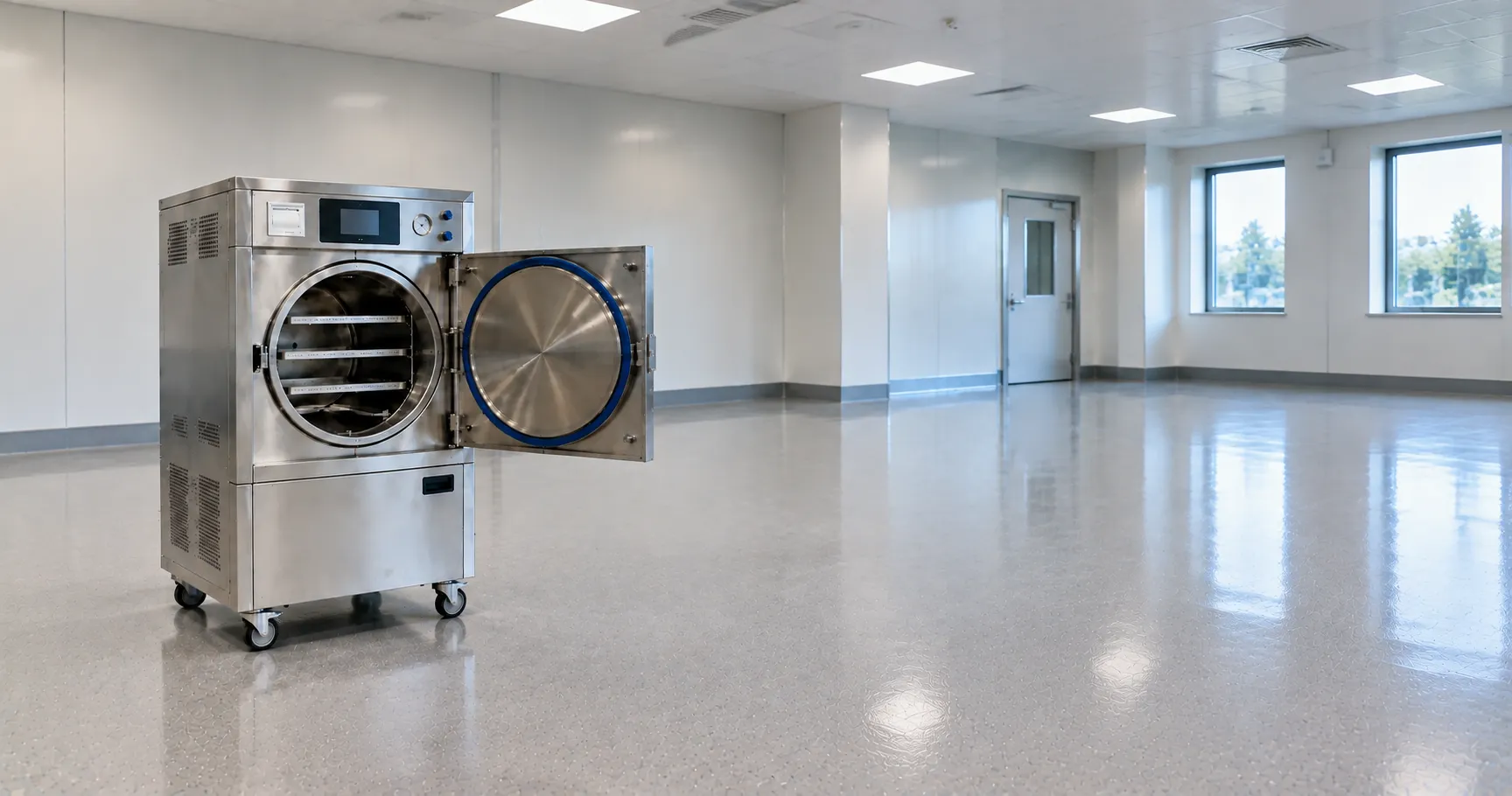

A plasma steriliser uses vaporised hydrogen peroxide, energised into a low-temperature gas plasma, to sterilise delicate, heat- and moisture-sensitive instruments that a steam autoclave would ruin. The process runs under vacuum at around 45–55 °C: hydrogen peroxide vapour diffuses over the load and its free radicals attack microbial cell membranes, DNA and enzymes, killing all organisms including spores. A brief plasma phase and the breakdown of peroxide into water vapour and oxygen leave no toxic residue, so instruments are ready to use almost immediately.
This makes it a popular alternative to the ethylene oxide steriliser for routine low-temperature work. But plasma sterilisation has real limits — particularly on lumens and cellulose materials — that a buyer must understand before assuming it can replace every other method.
How vaporised hydrogen peroxide and plasma work
The active agent is hydrogen peroxide vapour. In a vacuum chamber, liquid peroxide is vaporised and diffuses around the instruments, where its oxidising free radicals disrupt the essential molecules of any microorganism present. The plasma stage — created by applying radio-frequency energy to the low-pressure vapour — generates additional reactive species and, importantly, helps break the peroxide down into water and oxygen at the end of the cycle. The result is potent oxidative sterilisation followed by a clean, residue-free finish, which is why the technology is often described simply as low-temperature hydrogen peroxide sterilisation.
The low-temperature cycle in detail
A typical cycle begins by drawing a deep vacuum to remove air and moisture, because water interferes with peroxide diffusion — loads must be thoroughly dry before they go in. Peroxide is then injected and vaporised, diffusing through the chamber and into the packaging during a diffusion phase. An energised plasma phase follows, and the cycle may repeat the injection-diffusion-plasma sequence in two or more half-cycles for added assurance. Total cycle times commonly run from around 28 to 75 minutes depending on the model and load — far quicker than ethylene oxide, and with no aeration tail.
Lumen limits and load restrictions
The critical constraint is lumen penetration. Hydrogen peroxide vapour struggles to reach the far end of long, narrow channels, so every system specifies maximum lumen restrictions — a minimum internal diameter and maximum length, sometimes only achievable with a booster or diffusion adapter. Exceed those limits, and the far end may not be sterilised. Loads must also be dry, because residual moisture aborts cycles. Getting the lumen claims of a prospective machine matched against your actual instrument inventory is the single most important compatibility check.
Materials that suit and materials that don't
Plasma sterilisation is kind to most metals, many plastics, electronics and delicate optics, making it well suited to rigid endoscopes, cameras, cables, batteries and precision instruments. It cannot process items that absorb peroxide, however. Cellulose materials — paper, linen, cotton wraps, gauze and cardboard — soak up the vapour and cause cycle failure, so these loads need Tyvek or synthetic wraps and non-cellulosic pouches. Liquids and powders cannot be processed, and some adhesives or nylon may not tolerate repeated cycles. Confirming your packaging and instrument materials are compatible avoids a stream of aborted cycles.
Comparing plasma sterilisation with EO
Against ethylene oxide, hydrogen peroxide plasma wins on speed and safety: cycles are minutes rather than half a day, there is no toxic residual gas and no lengthy aeration, and staff exposure risk is far lower. EO still wins on penetration — it reaches longer and narrower lumens and diffuses through more packaging materials — and tolerates cellulose. For most hospitals,s the practical answer is that hydrogen peroxide handles the bulk of low-temperature reprocessing quickly and cleanly, while EO or another method is reserved for the awkward long-lumen loads plasma cannot reliably reach.
Specifying a hydrogen peroxide steriliser
Compatibility with your instrument set drives the decision more than headline cycle time. Work through the key points:
-
Compare each cycle's lumen claims — minimum diameter and maximum length — against your actual lumened instruments.
-
Confirm chamber volume and usable tray space suit your typical trays and peak throughput.
-
Check material and packaging compatibility, and budget for Tyvek or synthetic non-cellulosic wraps and pouches.
-
Review cycle options and times, including any express and extended-lumen cycles.
-
Confirm the consumable model — peroxide cassettes or cartridges — and the per-cycle running cost.
-
Verify biological and chemical indicator strip provision suited to hydrogen peroxide sterilisation.
-
Check validation to ISO 14937 or ISO 22441, plus IQ/OQ/PQ documentation and a service contract.
-
Confirm siting, power and any local extraction requirements for the installation.
Consumables, cassettes and lifetime cost
Hydrogen peroxide sterilisers are consumable-led. Each cycle draws on a sealed peroxide cassette or cartridge, and cassette cost multiplied by cycle count is the dominant running expense — so realistic throughput modelling matters more than list price. Add compatible packaging such as Tyvek sterilisation pouches and synthetic wraps, chemical and biological indicators, and periodic replacement of vaporiser components and seals. Because loads must be dry, a reliable drying step upstream is part of the true cost. As with any steriliser, planned maintenance, validation and a spares-backed service contract keep the machine compliant and available across its life.
Throughput planning is where the sums are won or lost. Because each cassette serves a fixed number of cycles and each cycle a fixed tray space, the cost per sterilised tray depends heavily on how fully and efficiently you load. Under-filling wastes peroxide; forcing incompatible items in causes aborted cycles that consume a cassette for nothing. Modelling your real daily instrument volumes against cassette yield and cycle time gives a truer picture of lifetime cost than any headline figure, and often decides whether one machine suffices or a second is needed for peak periods.
Where plasma sterilisation is used
Hydrogen peroxide sterilisers sit mainly in hospital sterile-services departments, theatre suites, endoscopy units, ophthalmology and ENT, wherever delicate powered or optical instruments turn around quickly between cases. Their short, residue-free cycles suit a same-day workflow: a camera head, light lead or rigid scope can be reprocessed and returned to a list far faster than an ethylene oxide loop would allow. Many departments run a peroxide steriliser alongside their steam autoclaves, using each for the loads it handles best. The same oxidising chemistry appears at room scale, where hydrogen peroxide vapour is fogged through whole bays to decontaminate surfaces between patients.
The technology has reshaped low-temperature reprocessing in the UK by cutting reliance on toxic gas. Because there is no carcinogenic residual and no lengthy aeration, the safety and facilities burden is far lighter than EO, which matters to estates and infection-control teams working within NHS decontamination policy and the wider infection-prevention guidance published by the NHS. The limits remain real — lumen restrictions and the cellulose problem — so plasma complements rather than wholly replaces other methods, but for the bulk of delicate instrument work it has become the default low-temperature choice.
The verdict on plasma sterilisation
Hydrogen peroxide plasma sterilisation gives fast, residue-free, low-temperature processing for the delicate instruments that heat would destroy — ideal for endoscopes, electronics and precision optics, provided their lumens fall within the machine's limits and cellulose packaging is avoided. Specify around your instrument inventory and packaging first, then cycle time and cost. MediGear supplies UK healthcare facilities with sterilisation and infection-control equipment; register your requirements as a buyer or contact our team to match a system to your instrument set.
Disclaimer
This article is for informational purposes only. It is published by MediGear (medigear.uk) for general information and procurement guidance, and is not clinical, diagnostic, treatment, technical, engineering, legal or regulatory advice, nor a product endorsement, guarantee or substitute for professional assessment. MediGear does not provide medical consultations. Buyers should consult their clinical, biomedical, estates and regulatory contacts, and the manufacturer's documentation, and independently verify all specifications, certifications, compatibility and suitability before purchase. Specifications, certifications and availability are correct at the time of publication and may change without notice. MediGear is a medical-equipment distributor and does not sell medicines or pharmaceutical products.