
Choosing medical equipment involves more than comparing product prices or selecting a recognised manufacturer. Equipment that performs well in one clinical setting may be unsuitable for another because of differences in workload, infrastructure, staff skills, maintenance capacity or patient needs.
For healthcare facility buyers and equipment managers, the selection process should begin with a clear clinical requirement and continue through technical evaluation, supplier verification and lifecycle planning. Every proposed device should be assessed as a complete operating package rather than as a base unit.
Clinical users, biomedical engineers, infection-control representatives, and other relevant teams should contribute before the final decision is made. Their input helps identify requirements that may not be visible in catalogues or commercial quotations.
This guide explains how healthcare facilities can compare medical equipment, verify supplier proposals and choose products that remain suitable, compliant and supportable throughout their service life.
Match Equipment to Clinical and Operational Needs
The first stage of equipment selection is defining the problem the healthcare facility needs to solve. Buyers should understand the intended clinical use before reviewing manufacturers or models.
Clinical purpose — Define the procedure, examination, monitoring activity or treatment function the equipment must support. The intended use should align with the services the facility provides.
In practice, healthcare teams often find that initial requests focus on a product name rather than the required clinical outcome.
Expected workload — Estimate the number of patients, tests or procedures the equipment must support. A device designed for occasional use may not remain reliable under continuous operation.
Intended users — Consider who will operate the equipment and what training they possess. Complicated controls may create avoidable errors or training difficulties.
Patient requirements — Equipment capacity, size, measurement range and accessibility should suit the relevant patient groups.
Clinical workflow — Buyers should examine how the device will fit into existing processes. Setup time, cleaning, movement and result reporting can affect department efficiency.
Consequences of failure — Critical equipment may require stronger reliability, service and backup arrangements than devices with limited clinical impact.
A clear needs assessment prevents buyers from selecting equipment with attractive features that do not address the facility’s real requirements.
Adapt Selection Criteria to the Healthcare Setting
Different healthcare environments require different equipment characteristics. Buyers should avoid using a single generic specification across all types of facilities.
Large hospitals and teaching facilities — Major hospitals may require high-capacity equipment, advanced connectivity and compatibility with central clinical systems. Standardisation across departments can simplify training and maintenance.
District and regional hospitals — These facilities may have limited access to specialist engineers or replacement parts. When comparing regulated and certified equipment suppliers worldwide, buyers should confirm that support coverage applies to the exact facility location.
Experienced equipment managers typically favour dependable systems with accessible parts and remote technical support.
Community clinics and outpatient centres — Smaller facilities may prioritise compact dimensions, straightforward controls and manageable infrastructure requirements. Unused advanced functions can increase cost without improving service delivery.
Diagnostic and laboratory facilities — Buyers should assess accuracy, throughput, quality controls, reagents, software and information-system compatibility. The cost per test may be more important than the analyser price alone.
Surgical and critical care departments — Equipment should support alarm management, emergency operation, backup power and rapid technical response.
Mobile and remote healthcare services — Portability, battery duration, protective packaging and environmental tolerance may be essential.
Multi-facility healthcare groups — Common equipment platforms can reduce product variation, and support shared training, accessories and maintenance processes.
Selection criteria should reflect the actual setting rather than being copied from another facility or supplier catalogue.
Compare Technical and Compliance Requirements
A structured technical specification gives suppliers a consistent basis for proposing equipment and allows buyers to compare equivalent configurations.
Intended-use evidence — The manufacturer’s stated intended use should match the facility’s planned clinical application.
Performance requirements — Buyers should define capacity, measurement range, accuracy, throughput and operating limits using measurable criteria.
Complete configuration — Quotations should list probes, cables, sensors, batteries, trolleys, mounts, software and starter consumables. The term “standard accessories” is rarely detailed enough.
Installation conditions — Electrical supply, ventilation, water, drainage, medical gases, network access and space requirements should be reviewed before purchase.
Regulatory evidence — Equipment should meet applicable local regulatory standards, including CE, FDA, or their regional equivalents where relevant. Documents should apply to the exact manufacturer and model.
Cleaning compatibility — Equipment surfaces and reusable accessories should support the facility’s approved cleaning processes.
Software and connectivity — Connected equipment may require specific interfaces, licences, security controls and update arrangements.
Document availability — User manuals, installation guides and technical documents should be available in a format that relevant staff can understand and retain.
One aspect that surprises first-time buyers is how often supplier quotations appear similar while containing different accessories or service commitments.
Evaluate Suppliers and Commercial Proposals
A technically suitable product can still create problems when the supplier cannot provide reliable delivery, documentation or support.
Verify supplier identity — Buyers should confirm the legal business name, address, contact information and authority to supply the proposed equipment.
Assess product experience — The supplier should demonstrate experience with the relevant manufacturer, model or equipment category.
Check advertising claims — Equipment advertising listings for global hospital buyers should present accurate information about features, compliance, and support. Buyers should compare public claims with formal technical documents.
Request itemised quotations — Equipment, accessories, software, freight, installation, training and service should be priced separately.
Review commercial exclusions — Buyers should identify items that are not included, such as customs, unloading, engineer travel, calibration or recurring licences.
Compare total ownership cost — consider purchase price alongside consumables, maintenance, software, energy use, and spare parts.
Check references — References from comparable healthcare settings can provide evidence of delivery, installation and service performance.
Healthcare organisations seeking repeated sourcing arrangements may benefit from international healthcare distribution partnership programmes. Each purchase should still use controlled specifications, supplier verification and formal approval.
Plan Installation, Training and Lifecycle Support
Equipment selection should include the work required after the purchase order is issued.
Site-readiness assessment — Confirm room dimensions, access routes, power, ventilation, network connections and other utilities before dispatch.
Delivery and installation responsibilities — The agreement should state who manages transport, unloading, positioning, installation and safety testing.
Commissioning criteria — Equipment should be inspected and tested against the approved specification before clinical acceptance.
User training — Clinical staff should receive operating, alarm, cleaning and basic troubleshooting instruction appropriate to their responsibilities.
Technical training — Biomedical engineers may require maintenance guidance, diagnostic tools and service documentation.
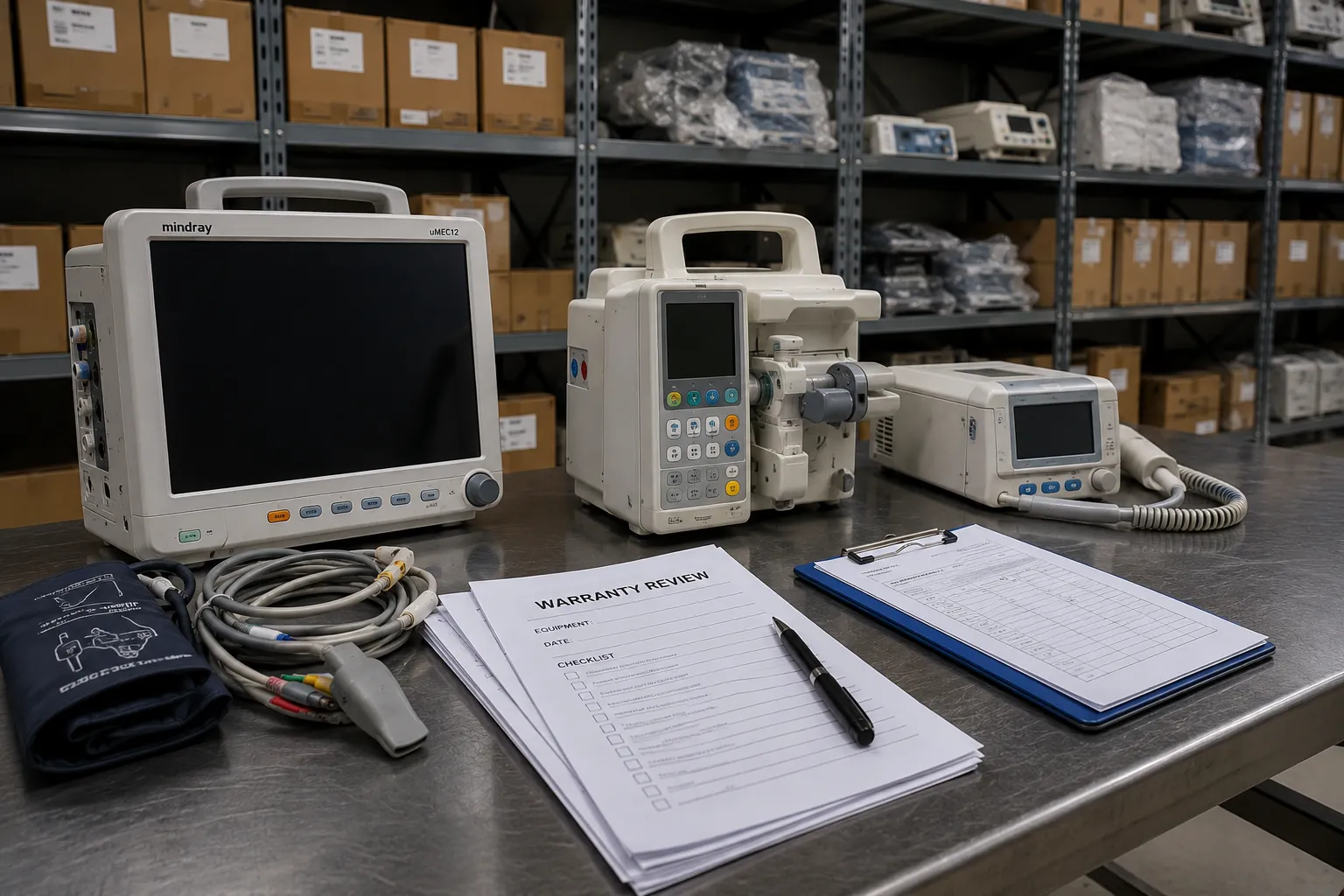
Warranty coverage — Buyers should confirm the warranty start date and coverage for parts, labour, software, freight and engineer travel.
Preventive maintenance — Recommended service and calibration intervals should be understood before purchase.
Spare-parts support — Suppliers should confirm expected availability and lead times for essential components.
End-of-support planning — Buyers should understand how long software, parts and technical service are expected to remain available.
A product is only a suitable choice when the healthcare facility can successfully install, operate, and maintain it.
Manage International Sourcing Risks
International sourcing can increase product choice, but buyers must control logistics, documentation and after-sales responsibilities.
Destination-market compliance — Confirm registration, conformity and import requirements before ordering.
Shipping terms — The quotation should state who arranges freight, insurance, customs clearance, unloading and final delivery.
Document consistency — Manufacturer names, model numbers and product descriptions should match across quotations, invoices, manuals and compliance records.
Language requirements — Operating and technical documents should be understandable to the receiving facility’s users and engineers.
New and refurbished equipment — Refurbished products should include condition reports, testing evidence, configuration details, service history and warranty information.
Payment controls — Payments may be linked to document approval, shipment, delivery, installation and commissioning.
International service coverage — Buyers should verify whether warranty, engineer support and parts delivery apply at the final location.
Specialist sourcing assistance — Healthcare facilities seeking product comparisons, equipment quotations or global sourcing support can submit a medical equipment enquiry to the Medigear.uk contact. The enquiry should include the equipment category, intended use, required quantity and destination.
International equipment should not be dispatched until compliance, documentation, site readiness and support arrangements are confirmed.
Final thoughts
Choosing medical equipment requires a structured assessment of clinical suitability, performance, compliance, supplier capability and lifecycle support.
Healthcare facilities should begin with a clear needs assessment rather than a preferred brand or model. Technical criteria should be measurable and connected to actual clinical and operational requirements.
Purchase price should not be considered alone. Accessories, installation, training, consumables, maintenance, software and spare parts can significantly affect long-term value.
A multidisciplinary, documented selection process helps healthcare facilities choose equipment that remains practical, reliable, and supportable throughout its intended service life.
Disclaimer
Medigear.uk is a global medical equipment supplier, exporter, and distributor. The content published on this site is intended for educational and product awareness purposes only. Nothing on this page constitutes medical advice, clinical guidance, or treatment recommendations. All healthcare procurement and clinical decisions should be made by qualified medical professionals and compliant procurement teams operating within the regulatory frameworks of their respective countries.