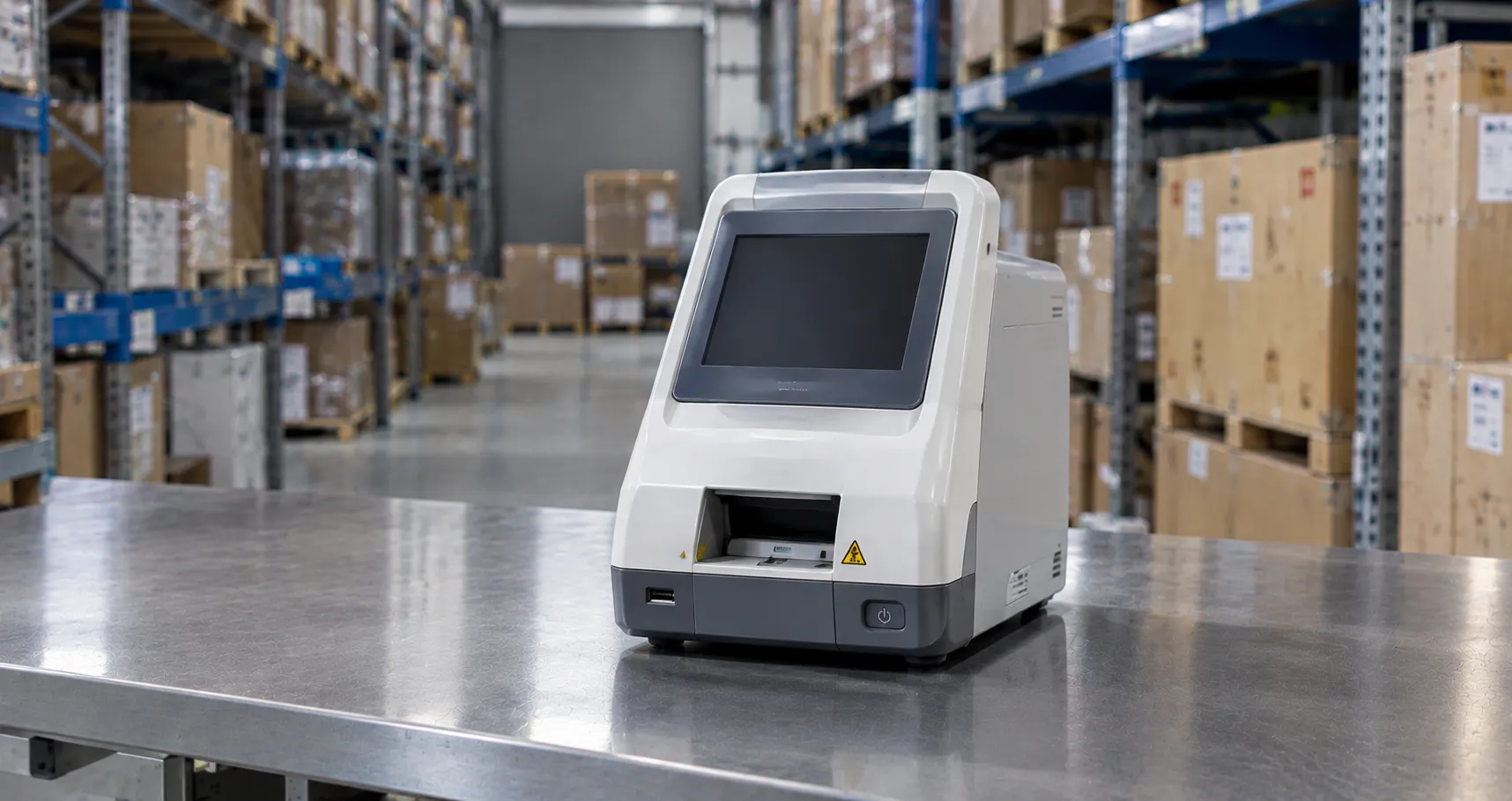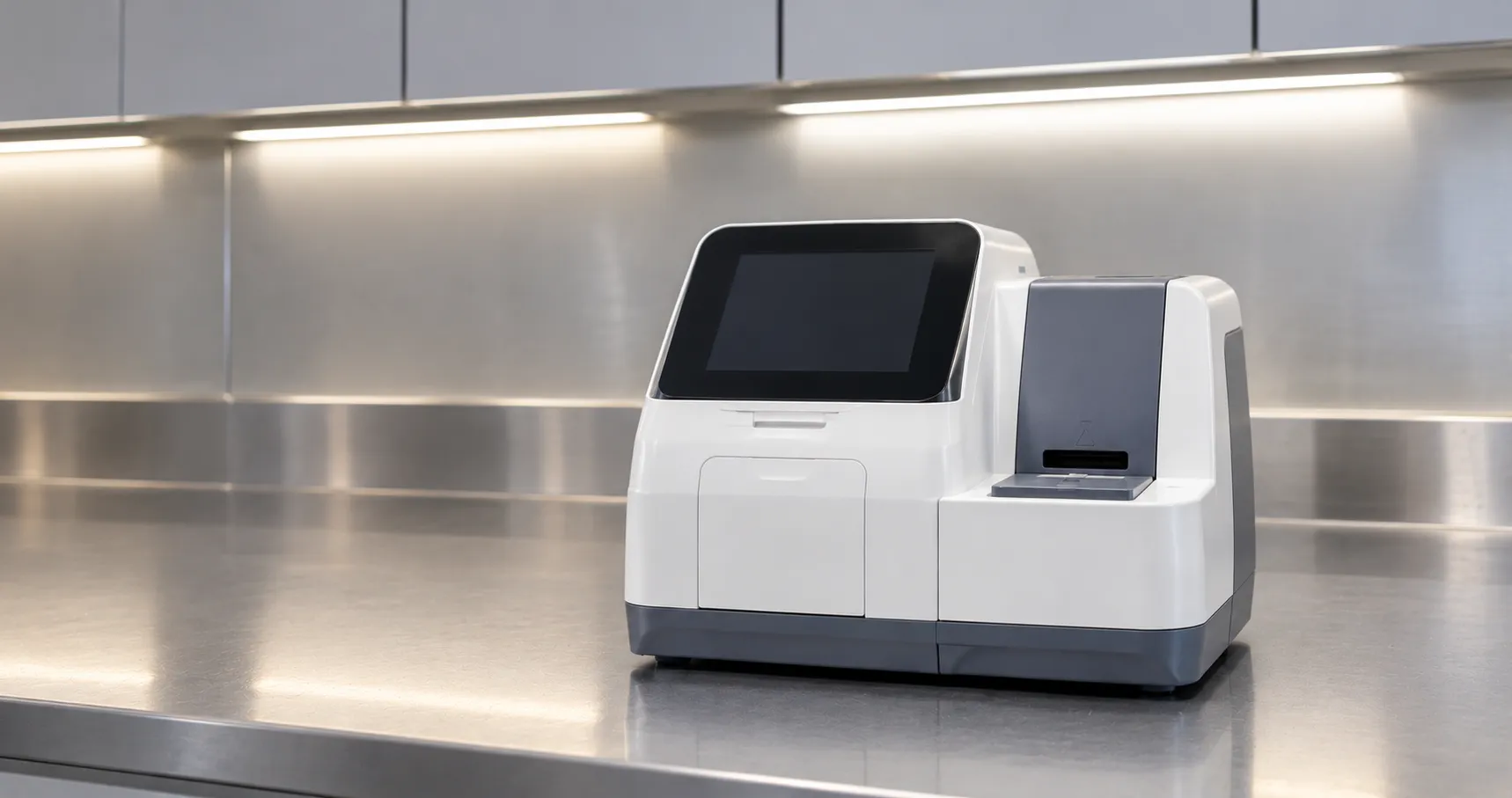
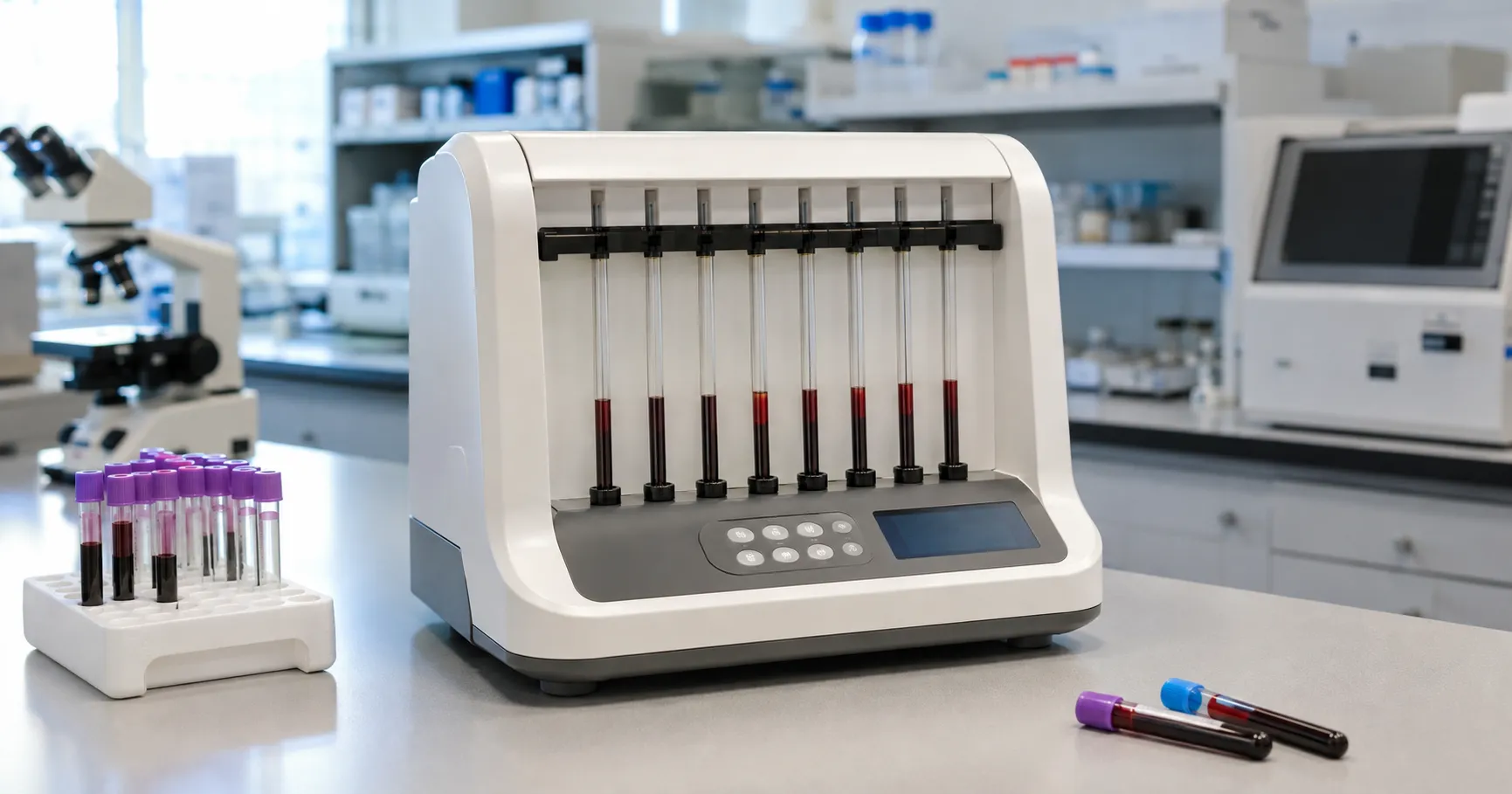
An erythrocyte sedimentation rate (ESR) analyser measures how quickly red blood cells settle in a column of anticoagulated whole blood, with the result reported in millimetres per hour. A faster fall indicates elevated plasma proteins, chiefly fibrinogen and immunoglobulins, which cause red cells to clump and sink more readily. For a laboratory or primary-care buyer, the decision turns on the measurement method, the tube type and sample volume, throughput and time to result, and how closely the device tracks the recognised Westergren reference.
ESR is a non-specific marker of inflammation, used alongside other tests to support monitoring in conditions such as rheumatological disease and certain infections. The analyser supplies the number; the clinical protocol decides what it means.
The measurement principle in detail
The classical method places well-mixed anticoagulated blood in a vertical graduated tube and records the distance the red-cell column falls in one hour at a controlled temperature. Sedimentation depends on the balance between the downward pull on aggregated cells and the plasma's resistance. When acute-phase proteins rise, red cells form stacked aggregates called rouleaux, which have a smaller surface area-to-mass ratio and therefore fall faster. Anaemia, red-cell shape and haematocrit all influence the result, which is why ESR is read as a trend and in context rather than as a stand-alone figure.
Manual, modified and automated methods
Three broad approaches exist. The manual Westergren method uses a 200 mm open tube with citrate-diluted blood and a full sixty-minute read; it is inexpensive but slow, labour-intensive and exposes staff to open samples. Modified Westergren systems keep the same physics but use closed, pre-filled tubes and racks that improve safety and standardisation. Automated analysers speed the process using optical or photometric detection of the falling interface, or centrifugation-enhanced techniques that shorten a read to a few minutes and scale the result back to a Westergren-equivalent value. Faster methods raise throughput and cut hands-on time, but a buyer should confirm the correlation study against the reference method across the reporting range.
Key specifications a buyer must check
Confirm whether the device accepts dedicated citrate tubes or samples directly from EDTA primary tubes, since EDTA sampling removes a separate draw and reduces pre-analytical error. Check the sample volume, time to result, and hourly throughput against your workload. Review the measuring range in millimetres per hour, the closed-tube sampling that protects staff from open blood, and onboard mixing to keep samples homogeneous. Look at the correlation coefficient against the Westergren reference quoted in the validation data, temperature compensation, and how the analyser flags short samples, clots or results beyond range. For smaller sites, footprint, walk-away capacity and cap-piercing sampling matter.
Why standardisation and temperature control matter
ESR is sensitive to conditions of measurement, so consistency is everything for a result that will be trended over months. Temperature affects plasma viscosity and therefore the fall rate, which is why automated analysers hold samples at a controlled temperature and apply compensation. Tube verticality, vibration and delays between draw and analysis all shift the figure, so a bench free from knocks and a defined maximum time from venepuncture to loading both protect quality. When a service moves from a manual method to an automated one, run parallel samples so clinicians understand any offset before the changeover, and document the method on the report so results are compared like with like. It is worth noting that ESR complements rather than replaces C-reactive protein, which responds faster to acute change; some laboratories report both so clinicians can weigh a slower and a faster marker together, and a buyer serving such a service should check the analyser fits alongside existing chemistry workflows rather than adding an isolated bench.
Regulation, standards and reference method
An ESR analyser is an in-vitro diagnostic device, so it must carry UKCA or CE marking with a declaration of conformity, and its manufacturer must hold Great Britain registration with the MHRA. The International Council for Standardisation in Haematology defines the selected Westergren procedure as the reference against which methods are compared, and a credible supplier will show how their instrument correlates with it. Electrical safety follows IEC 61010 and electromagnetic compatibility IEC 61326, while a laboratory operating the analyser works to ISO 15189. Wider device guidance for buyers is published on GOV.UK. Standards may be cited by number, but never rely on a marketing claim in place of the conformity paperwork.
Calibration, quality control and maintenance
Because ESR underpins monitoring decisions, a controlled process protects the result. Run manufacturer control materials at defined intervals and after any service, log the values, and act on drift before it reaches reporting. Verify the optical or interface-detection system to the maker's schedule, keep the sampling path clean to prevent carry-over, and replace tubing and seals as specified. Participation in an external quality assessment scheme lets a laboratory benchmark its ESR performance against peers. Keep maintenance and quality-control records for accreditation, and include routine parts, cleaning agents, and an annual service in the operating budget rather than treating them as surprises.
Use across different care settings.
The right machine depends on where it sits. A busy hospital haematology laboratory needs a high-throughput automated analyser, ideally sampling from EDTA tubes already drawn for the full blood count so no extra specimen is required. A rheumatology or general-practice setting handling fewer samples may prefer a compact bench analyser or a well-run modified Westergren system, where closed tubes protect staff and standardise handling. Whatever the setting, define who is trained to operate the device, how results are recorded, and how out-of-range values are reviewed, because a fast result is only useful if it is reported reliably.
Consumables, connectivity and total cost of ownership
Headline price rarely tells the whole story. Automated analysers consume dedicated tubes or cartridges, controls, and cleaning solutions, and their cost per test falls as volume increases; sampling directly from EDTA tubes can eliminate the need for a consumable line entirely. Confirm interfacing to the laboratory information system so results post without transcription, and check middleware compatibility if you run a connected haematology bench. Model the genuine cost per reported result at your expected volume with controls and external quality assessment included, and ask each supplier about warranty length, first-service cover, loan-unit availability and the likely price of wear parts. The MediGear buyers team can compare configurations, or contact us for availability and support.
Procurement checklist
-
Decide manual, modified Westergren or automated to match workload and safety needs.
-
Confirm whether the analyser samples from EDTA tubes or needs dedicated citrate tubes.
-
Check time to result, throughput, measuring range and closed-tube sampling.
-
Review the correlation study against the ICSH Westergren reference method.
-
Confirm UKCA or CE marking, IEC 61010 and MHRA registration on paper.
-
Set control materials, a maintenance schedule and external quality assessment.
-
Verify interfacing to the laboratory information system and any middleware.
-
Model cost per reported result including tubes, controls and servicing.
Conclusion
An ESR analyser turns a simple physical principle into a monitoring number that only holds value when it is standardised, temperature-controlled and traceable to the Westergren reference. Match the method to your throughput and safety requirements, favour EDTA sampling where it removes a separate draw, and budget honestly for consumables and quality assessment. Comparing verified specifications through MediGear helps your service buy an ESR platform that delivers consistent, defensible results for the clinicians who rely on them.
Disclaimer
This article is for informational purposes only. It is published by MediGear (medigear.uk) for general information and procurement guidance, and is not clinical, diagnostic, treatment, technical, engineering, legal or regulatory advice, nor a product endorsement, guarantee or substitute for professional assessment. MediGear does not provide medical consultations. Buyers should consult their clinical, biomedical, estates and regulatory contacts, and the manufacturer's documentation, and independently verify all specifications, certifications, compatibility and suitability before purchase. Specifications, certifications and availability are correct at the time of publication and may change without notice. MediGear is a medical-equipment distributor and does not sell medicines or pharmaceutical products.