
Introduction
For most of the last two decades, robotic surgery meant one dominant system, and the story changed slowly. The past two years have been different. A run of regulatory clearances and new platforms has turned a one-name field into a genuinely competitive one, and the shape of the technology is shifting with it.
This article looks at the main surgical robot technology advancements of 2025 and 2026 — the new systems, the design ideas behind them, and the digital features arriving alongside. It is written for surgical and procurement teams across the UK, Europe, the US, the Gulf and South Africa trying to make sense of a fast-moving market.
A field that finally has competition
The headline change is simply that there is now more than one serious soft-tissue system. Medtronic's Hugo gained its first US clearance for urologic procedures in late 2025. In July 2026, Johnson & Johnson's Ottava received a de novo authorisation covering a range of general surgery procedures — the first real challenge in that space to the long-dominant da Vinci, which itself has moved on to a newer generation.
Alongside them, CMR Surgical's Versius has expanded its cleared procedures, and newer entrants such as SS Innovations' system are pushing in with an emphasis on wider access. The FDA continues to authorise these platforms procedure by procedure rather than in general, which is worth remembering: a new system's arrival does not mean it is approved for everything.
Modular and portable by design
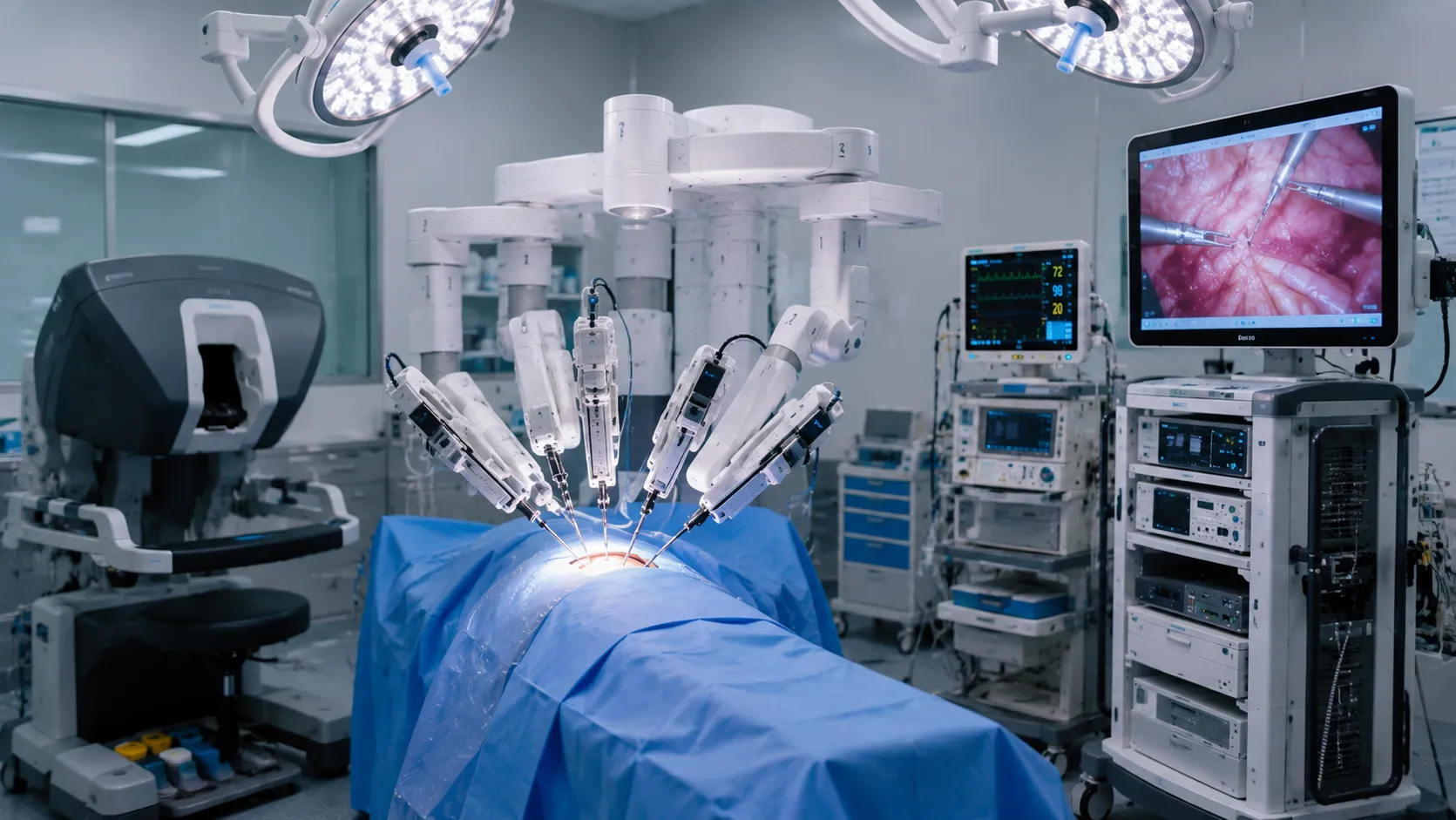
A clear theme in the newer systems is a move away from a single large structure towards something more flexible. Where the established design puts the arms on one big cart, several newer platforms use separate, individually movable arms that can be arranged around the patient and stored more easily. Others are built to be smaller and portable, so a system can be wheeled between theatres rather than tying up one room.
The reason is practical. Modular, portable designs are easier to fit into theatres that were never built for a robot, and they suit hospitals that want to share a system across departments. This is part of a wider shift of robotic procedures towards smaller sites and day-case settings, where a compact, movable system makes far more sense than a fixed installation.
Single-port and specialised platforms
Advancements are not only about competition; they are about doing particular jobs better. Single-port systems, which work through one small opening rather than several, have matured and suit operations where a single entry point is an advantage. Specialised robotic platforms for the lung and airways extend the same precision to diagnosis and biopsy rather than open surgery.
-
Single-port systems — operating through one small opening.
-
Airway and lung platforms — robotic reach for diagnosis and biopsy.
-
Orthopaedic systems — guiding bone work rather than teleoperating.
-
General-surgery platforms — the newly competitive soft-tissue space.
The upshot is that “a surgical robot” is no longer one thing. It is a growing family of systems, each shaped for particular work, which makes matching the platform to the procedure a more meaningful decision than it used to be.
The digital and AI layer
Some of the most talked-about advancements are not in the hardware at all but in the software and data around it. Newer systems capture detailed information from each case, offer image integration and on-screen guidance, and are building analytics to help teams review and refine how they work. This is where much of the near-term progress is expected.
A word of caution is due here. These digital features are assistive: they inform and support the surgeon, who remains in control of every action. The Royal College of Surgeons of England frames robotic-assisted surgery as a way to enhance a surgeon's work when adopted safely, and that framing applies squarely to the new data and guidance tools. They are aids to judgement, not replacements for it, and should be assessed on evidence rather than enthusiasm.
Surgery across distance
One striking demonstration of how far the technology has come is remote, or tele-, surgery. Over the past two years, surgeons have operated systems on patients many miles away, with the procedure carried out across a network connection in real time. These are still carefully controlled demonstrations rather than everyday practice, but they hint at a future where expertise need not be in the same room as the patient.
It is a development to watch rather than plan around. The regulatory, safety and connectivity questions are considerable, and routine remote surgery remains some way off. But the fact that it can be done at all is a measure of how capable and reliable the underlying systems have become.
A shift towards smaller sites
A quieter but important advancement is where robotic surgery is heading geographically. As systems become smaller, more portable and easier to set up, robotic procedures are moving beyond large academic centres towards smaller hospitals and day-case units. Changes to how some procedures are funded have encouraged this shift, and the newer platforms are designed with exactly these settings in mind.
For patients, that could mean access to robotic surgery closer to home rather than only at a handful of major centres. For hospitals, it opens the technology to sites that could never have housed the earlier, bulkier systems. It is a trend to watch, because it changes not just what robotic surgery can do but where it can realistically be offered.
What the advancements mean for hospitals
For a hospital, the practical effect of all this is more choice and more to weigh up. There are now several credible systems rather than one, with different strengths in footprint, flexibility and cost of ownership. That is good news, but it makes the decision harder, not easier, and puts a premium on matching the platform honestly to the procedures a hospital actually does.
What has not changed is the fundamentals. However advanced the system, it is still a tool the surgeon controls, its approvals are still procedure-specific, and its success still rests on trained teams and sound governance. The advancements of 2025 and 2026 widen the options and sharpen the technology; they do not change the basic rules for using it well.
If there is one thing to hold on to amid the announcements, it is that a newer system is not automatically a better fit. The right choice depends on the procedures a hospital does, the theatres it has and the team it can train. The advancements are genuine and welcome; using them well still means the same patient, unhurried judgement it always did.
In a field moving this quickly, that steadiness is itself a useful discipline. The systems will keep improving; the questions a hospital should ask of them will not.
More from Business
-
Buyers — source approved, well-documented equipment.
-
Suppliers — list your equipment and reach buyers worldwide.
-
Advertise — promote your products and services to a clinical audience.
-
Business overview — explore everything MediGear offers healthcare organisations.
Disclaimer
This article is for general information only and is not clinical, procurement or regulatory advice. The surgical robotics market is developing quickly; system availability and approvals are procedure-specific and change over time. Confirm the current status of any system with the manufacturer and the relevant authorities before making decisions. medigear.uk accepts no liability for actions taken on the basis of this content.
New systems, dependable foundations
Genuine, approved, fully documented theatre and surgical equipment — the dependable kit that surrounds every generation of robotic system.Frequently Asked Questions
The biggest is real competition. Medtronic's Hugo gained its first US clearance for urologic procedures in late 2025, and in July 2026 Johnson & Johnson's Ottava received authorisation for a range of general surgery procedures — the first serious soft-tissue challenge to the long-dominant da Vinci, which has itself moved to a newer generation. CMR's Versius and newer entrants have expanded too.
No. Regulators authorise these platforms procedure by procedure rather than in general, so a new system's arrival does not mean it is cleared for every operation. Approvals are specific and change over time, which is why the current status of any system should be confirmed with the manufacturer and the relevant authorities before decisions are made.
A move towards modular and portable designs. Where the established approach puts the arms on one large cart, several newer platforms use separate, individually movable arms, and others are built smaller and portable so a system can move between theatres. These designs fit theatres never built for a robot and suit the shift of procedures towards smaller sites and day-case settings.
Software and data features built around the hardware: capturing detailed information from each case, integrating images, offering on-screen guidance, and building analytics to help teams review and refine their work. These features are assistive — they inform and support the surgeon, who remains in control of every action. They should be judged on evidence rather than enthusiasm.
No. Over the past two years surgeons have operated systems on patients many miles away in real time, but these remain carefully controlled demonstrations rather than everyday practice. The regulatory, safety and connectivity questions are considerable, and routine remote surgery is some way off. That it can be done at all shows how capable the systems have become.
More choice and more to weigh up. There are now several credible systems with different strengths in footprint, flexibility and cost of ownership, which makes matching the platform to the procedures a hospital actually does more important than ever. The fundamentals are unchanged: it is still a surgeon-controlled tool, approvals are procedure-specific, and success rests on trained teams and governance.