
Introduction
If robotic surgery has a signature operation, it is the removal of the prostate for cancer. More than any other procedure, prostate surgery drove the early spread of robotic technology, and it remains one of the operations where the case for a robotic approach is strongest. Understanding why says a great deal about what robotic surgery does well.
This article explains how robotic surgery is changing prostate cancer treatment: why the prostate suits a robotic approach, what nerve-sparing surgery aims for, and the honest limits. It is written for urology and procurement teams across the UK, Europe, the US, the Gulf and South Africa who want a clear account.
The operation that led the way
Robotic prostate surgery has a special place in this story. The removal of the prostate gland for cancer was one of the first operations to be widely adopted robotically, and the popularity of that single procedure did much to establish robotic surgery in hospitals. Where robotic surgery went mainstream, prostatectomy was often leading the way.
There is a reason it took to the technology so readily. The prostate sits deep in the pelvis, surrounded by delicate structures, and removing it while protecting those structures is exacting work. That combination of a confined, deep location and a need for great precision is precisely where robotic surgery's strengths tell most clearly.
Why the prostate suits a robotic approach
The prostate's position makes it hard to reach and work on. It lies low in the pelvis, hemmed in by other structures, in a space that gives poor access and little room to manoeuvre. Straight instruments struggle at that depth and angle, and open surgery to reach it is a substantial undertaking for the patient.
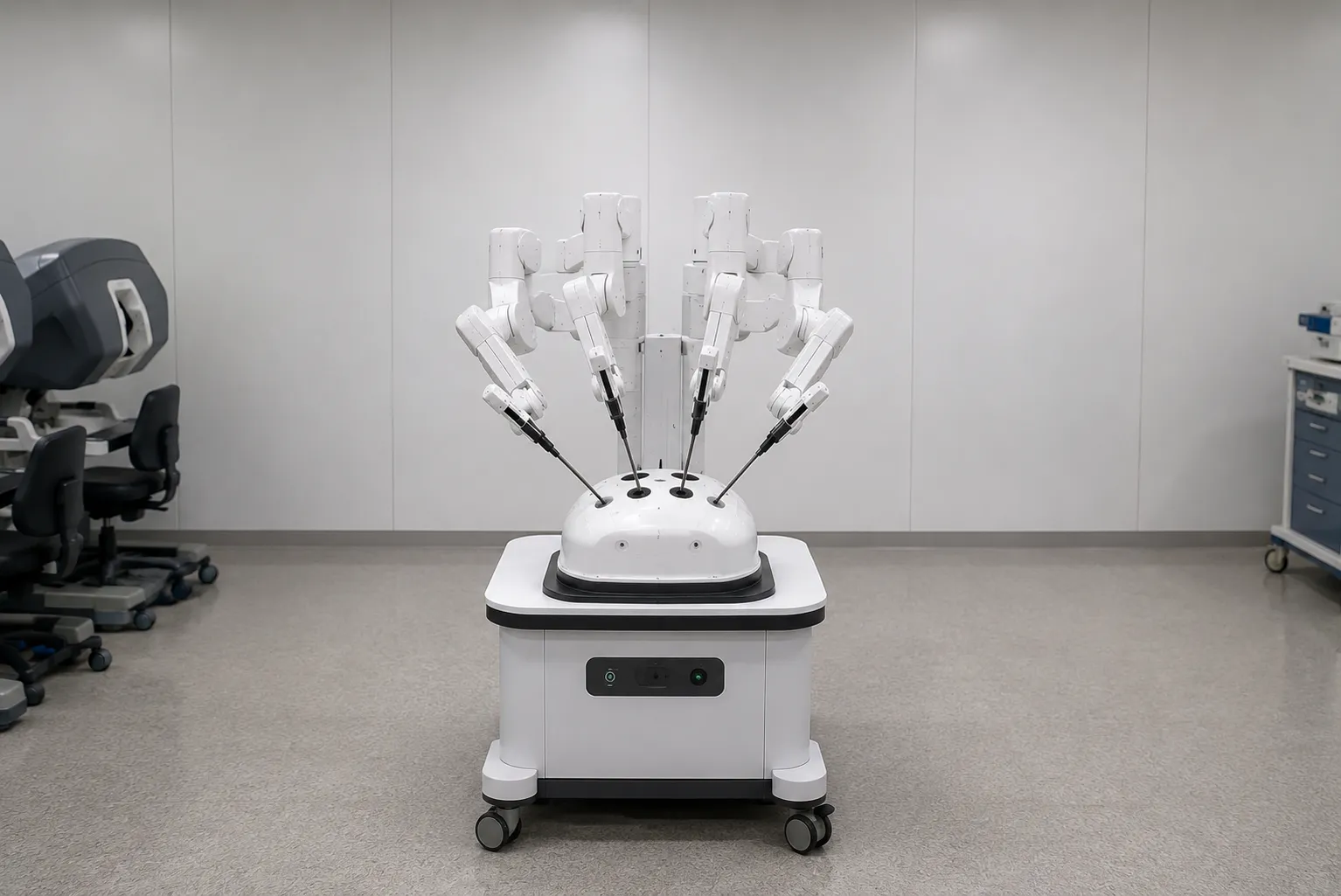
A robotic system answers those difficulties directly. Wristed instruments articulate in the confined pelvic space, a magnified three-dimensional view brings clarity to a cramped field, and steady, tremor-free control supports the fine dissection the operation demands. For reaching and working on the prostate precisely, the technology and the anatomy fit together unusually well.
The result is that a robotic approach can turn an operation that is awkward and cramped into one that is more controlled and clearly seen. For a procedure this exacting, in a space this confined, that improvement in access and vision is a real change in how the operation can be done.
The delicate goal of nerve-sparing
What makes prostate surgery so demanding is not just removing the cancer but doing so while sparing the tiny, delicate nerves that run alongside the gland — nerves that matter to functions patients care about deeply. Preserving these where the cancer allows is one of the central aims of a good prostate operation.
-
Complete removal — taking out the cancer with clear margins.
-
Nerve preservation — protecting the delicate nerves where possible.
-
Precise dissection — separating structures that lie very close together.
-
Careful reconstruction — restoring continuity accurately after removal.
This is exactly where the precision of a robotic approach earns its keep. Seeing clearly and dissecting steadily around those delicate nerves, in a confined space, supports the twin aims of removing the cancer and preserving function — a balance that matters enormously to a patient's life afterwards.
What it means for the patient
For a man facing prostate cancer surgery, a robotic approach can offer the benefits of minimally invasive surgery — smaller incisions than open surgery, less disruption, and often a quicker recovery — for a major operation. Being able to carry out such demanding, deep pelvic work through small openings is a genuine advantage where it applies.
The functional stakes make it more than a matter of recovery time. Because the operation sits so close to functions that shape quality of life, the precision that supports nerve-sparing has consequences a patient feels for years. That is why so much attention goes to doing this operation as precisely as possible, and why robotic surgery's strengths are so valued here.
Precision does not guarantee outcomes
It is important to be honest about what the technology can and cannot promise. A robotic approach supports precise surgery, but it does not by itself guarantee a cure or the preservation of function. Outcomes depend on the cancer itself, the individual patient, and above all the skill and experience of the surgeon and team.
The World Health Organisation emphasis on quality treatment as central to cancer outcomes captures the point: the tool matters, but so does everything around it. Robotic surgery gives a skilled surgeon a better means of doing exacting work; it does not turn a difficult cancer into an easy one, and it is at its best in experienced hands.
Why this operation shaped the field
It is worth reflecting on why prostate surgery, of all operations, did so much to establish robotic surgery. It is a common cancer, so the operation is done in large numbers; it is technically hard in a way the technology genuinely eases; and the functional stakes give both surgeons and patients strong reasons to want the most precise approach available.
Those factors together made prostatectomy the operation on which many surgeons and hospitals first gained robotic experience. In doing so it built much of the expertise and confidence that later spread to other specialities. The prostate, in a real sense, was where a great deal of modern robotic surgery learned its craft.
The surgeon in command
As throughout this field, the system assists rather than acts. The urological surgeon controls every movement from the console and makes every decision; the robot provides the precision and steadiness to carry those intentions out. The FDA treats these platforms as computer-assisted surgical systems under the surgeon's control, not autonomous devices.
And, as always, it is a team operation. A smooth robotic prostatectomy list depends on practised staff around the system as well as the surgeon. The technology extends what a skilled urological team can do; it does not replace the judgement and experience that make the difference between a good outcome and a poor one.
What a hospital should take from this
Robotic surgery changed prostate cancer treatment because the operation — deep in the pelvis, demanding precise dissection around delicate nerves — is so well matched to what the technology does. It was the procedure that led robotic surgery into the mainstream, and it remains one of its most compelling applications.
The measured view is that robotic prostatectomy is a genuinely valuable approach for a demanding operation, whose results still rest on the cancer, the patient and an experienced team rather than on the machine alone. A hospital that keeps that balance — embracing the technology's strengths without overclaiming — gets the real value it offers.
More from Business
-
Buyers — source approved, well-documented equipment.
-
Suppliers — list your equipment and reach buyers worldwide.
-
Advertise — promote your products and services to a clinical audience.
-
Business overview — explore everything MediGear offers healthcare organisations.
Disclaimer
This article is for general information only and is not clinical or procurement advice. The suitability and outcomes of robotic prostate surgery depend on the cancer, the patient and the surgeon's experience, and approvals are procedure-specific. Confirm current guidance with the relevant authorities and professional bodies. If you have concerns about prostate health, speak with a qualified healthcare professional. medigear.uk accepts no liability for actions taken on the basis of this content.
Urology, dependable kit
Genuine, approved, fully documented theatre and surgical equipment — the dependable foundation precise, deep-pelvic urological surgery relies on.Frequently Asked Questions
Because removing the prostate for cancer was one of the first operations widely adopted robotically, and it remains one where the case is strongest. The prostate sits deep in the pelvis, surrounded by delicate structures, and removing it while protecting them is exacting work — a confined, deep location needing great precision, which is exactly where robotic surgery's strengths tell most clearly.
Its position makes it hard to reach: low in the pelvis, hemmed in by other structures, with poor access and little room. Straight instruments struggle at that depth, and open surgery is a substantial undertaking. A robotic system offers wristed instruments that articulate in the confined space, a magnified three-dimensional view, and steady control for fine dissection — a close fit of technology and anatomy.
It is surgery that removes the cancer while sparing the tiny, delicate nerves running alongside the prostate — nerves that matter to functions patients care about deeply. Preserving them where the cancer allows is a central aim of a good operation. The precision of a robotic approach, seeing and dissecting steadily around those nerves, supports the twin aims of removing the cancer and preserving function.
A robotic approach can offer the benefits of minimally invasive surgery — smaller incisions than open surgery, less disruption, often a quicker recovery — for a major operation. And because the operation sits so close to functions that shape quality of life, the precision that supports nerve-sparing has consequences a patient feels for years, which is why doing it precisely matters so much.
No. A robotic approach supports precise surgery but does not by itself guarantee a cure or the preservation of function. Outcomes depend on the cancer itself, the individual patient, and above all the skill and experience of the surgeon and team. The tool matters, but so does everything around it — it is at its best in experienced hands, not a shortcut.
No. The urological surgeon controls every movement from the console and makes every decision; the robot provides the precision and steadiness to carry them out. Regulators treat these as computer-assisted systems under the surgeon's control, not autonomous devices. It is also a team operation, depending on practised staff around the system as well as the surgeon.