


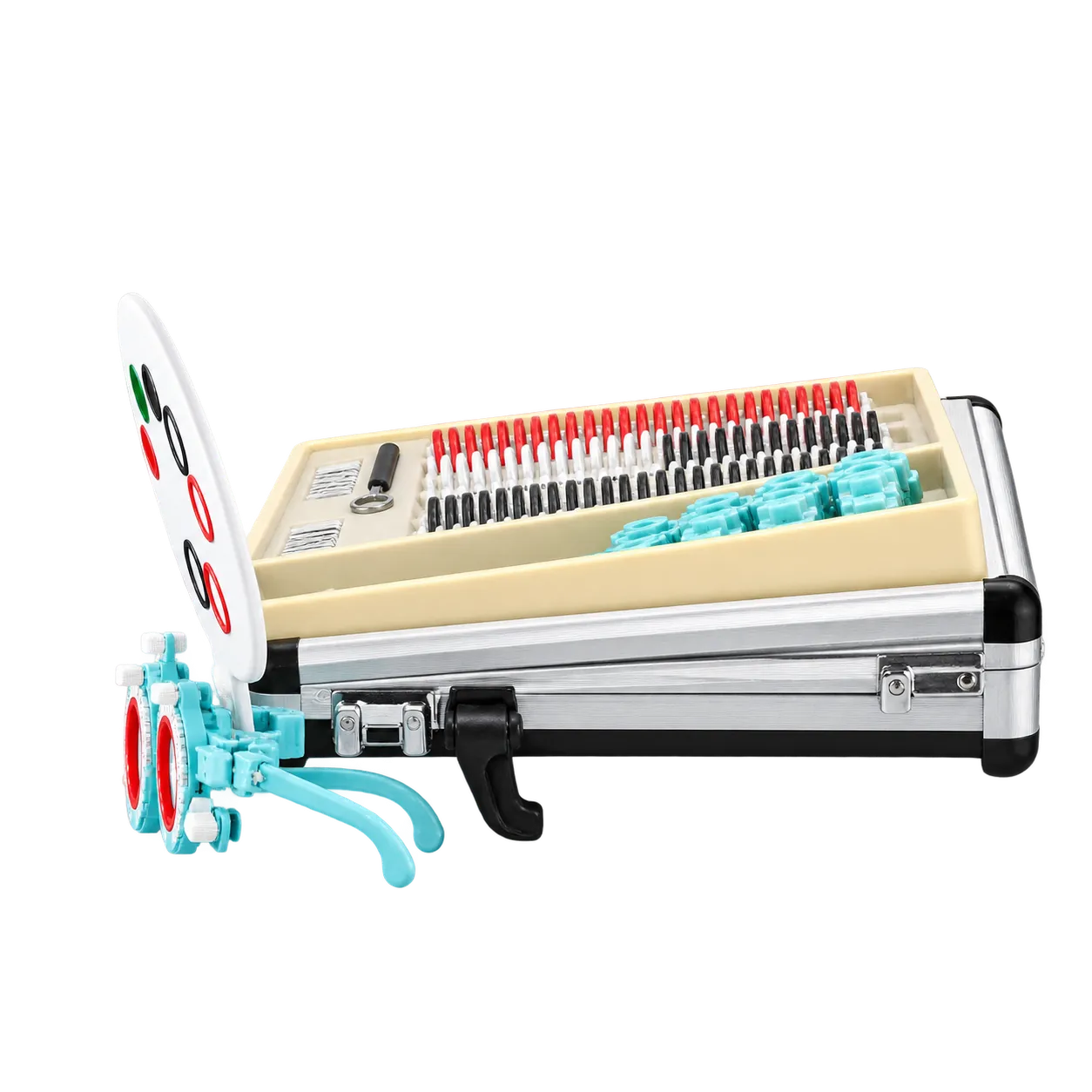
Domiciliary eye care is the clearest fit. A registered optometrist visiting a care home or a housebound patient carries a trial frame, a retinoscope, an ophthalmoscope and a chart as well as the lenses, and a 4.0 kg set keeps that load manageable. Refraction happens in the patient's own chair, where most of the people on a domiciliary list are best examined.
Community optometry practices use a set like this for routine subjective refraction, for checking a phoropter result in a trial frame, and for letting a patient look around the room in a new prescription before it is dispensed. Paired powers let both eyes hold the same lens during binocular balancing.
Outreach, school and screening programmes need a complete set that moves between venues. Where those programmes see children, the set supports retinoscopy with working lenses and a check of the result in a small trial frame, while objective and cycloplegic methods carry the measurement in younger children.
Binocular vision assessment uses the accessory row. The white Maddox rod, the red and green filters and the twelve prisms allow heterophoria measurement and prism trials in free space.
Teaching clinics gain a set whose lenses all read from one printed side, which simplifies the routine a student learns first.
Two settings are weaker fits. Hospital services seeing high astigmatism after keratoplasty or cataract surgery will reach the 4.00 D cylinder ceiling, and low vision clinics working with eccentric viewing will find the 21 mm aperture restrictive. Institutional buyers commonly ask for evidence of conformity before purchase. The conformity documentation those procurement routes require is issued by the manufacturer and provided by the seller.