
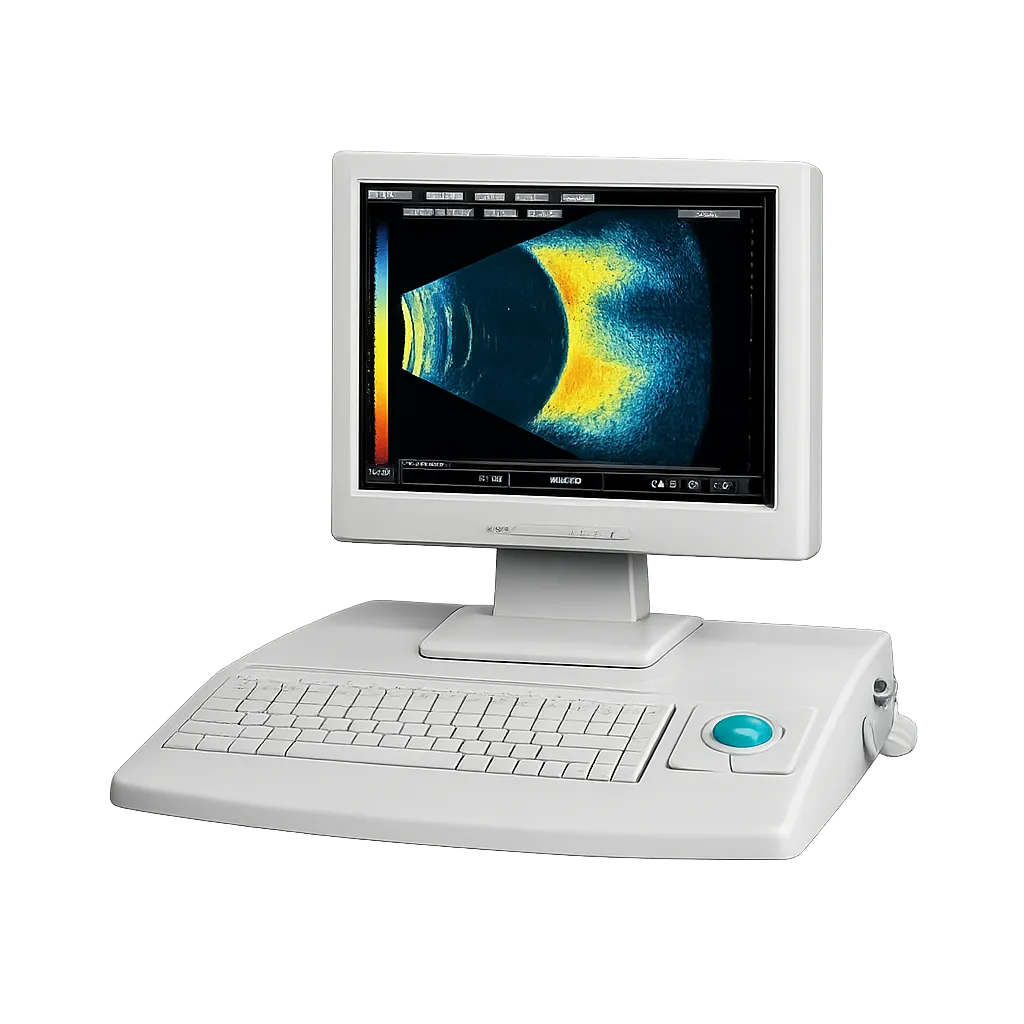
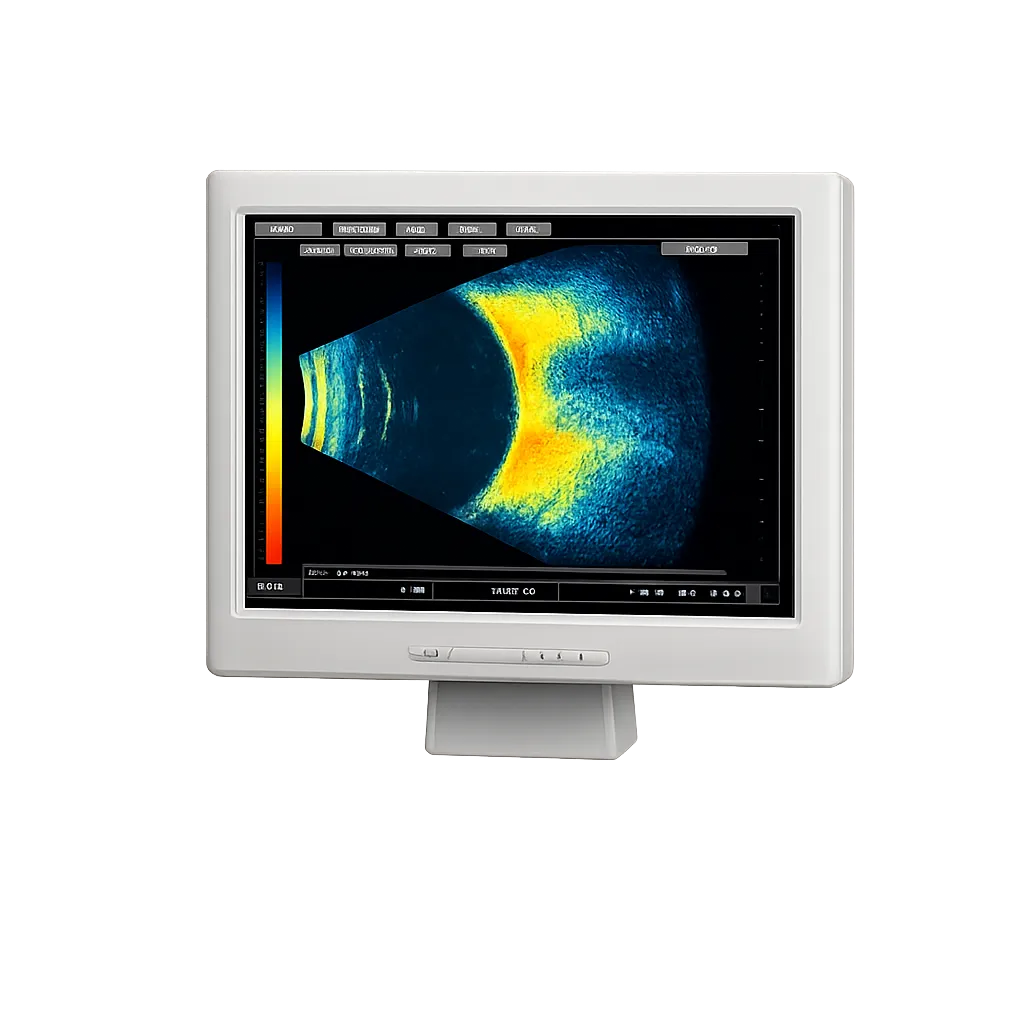
Teaching and training services gain most obviously from pseudo-colour rendering. A colour-mapped structure is far easier to point out to a trainee or a colleague than a grey one, and eight maps mean a presentation can be tuned to whatever is being demonstrated. The same applies when explaining a finding to a patient, where colour separation communicates what tonal separation does not. Greyscale remains available throughout, so nothing is lost by having colour available. All interpretation remains with the practitioner.
Posterior segment assessment benefits where reflectivity differences are subtle. Colour mapping can render as two distinct hues what greyscale renders as two similar tones, which is relevant when distinguishing structures of comparable echogenicity. Five-segment time-gain compensation across a −30 dB to 0 dB range and a gain to 98 dB provide the underlying image control, with memory for eight images allowing several views to be held for comparison during a single examination.
Clinics running full lists benefit from the LCD, which the manufacturer frames explicitly in terms of operator fatigue. B-scan is performed with the room dimmed, and display quality affects how tiring a session becomes. The foot switch addresses the same practical problem from a different direction, freeing the operator from reaching for controls mid-examination.
Services procuring against a documented trail should note that the manufacturer's FDA 510(k) clearance names this model, and that the clearance is traceable to a regulator's own document. Medigear.uk confirms the marking position applicable to supply separately, since a United States clearance does not establish it.