
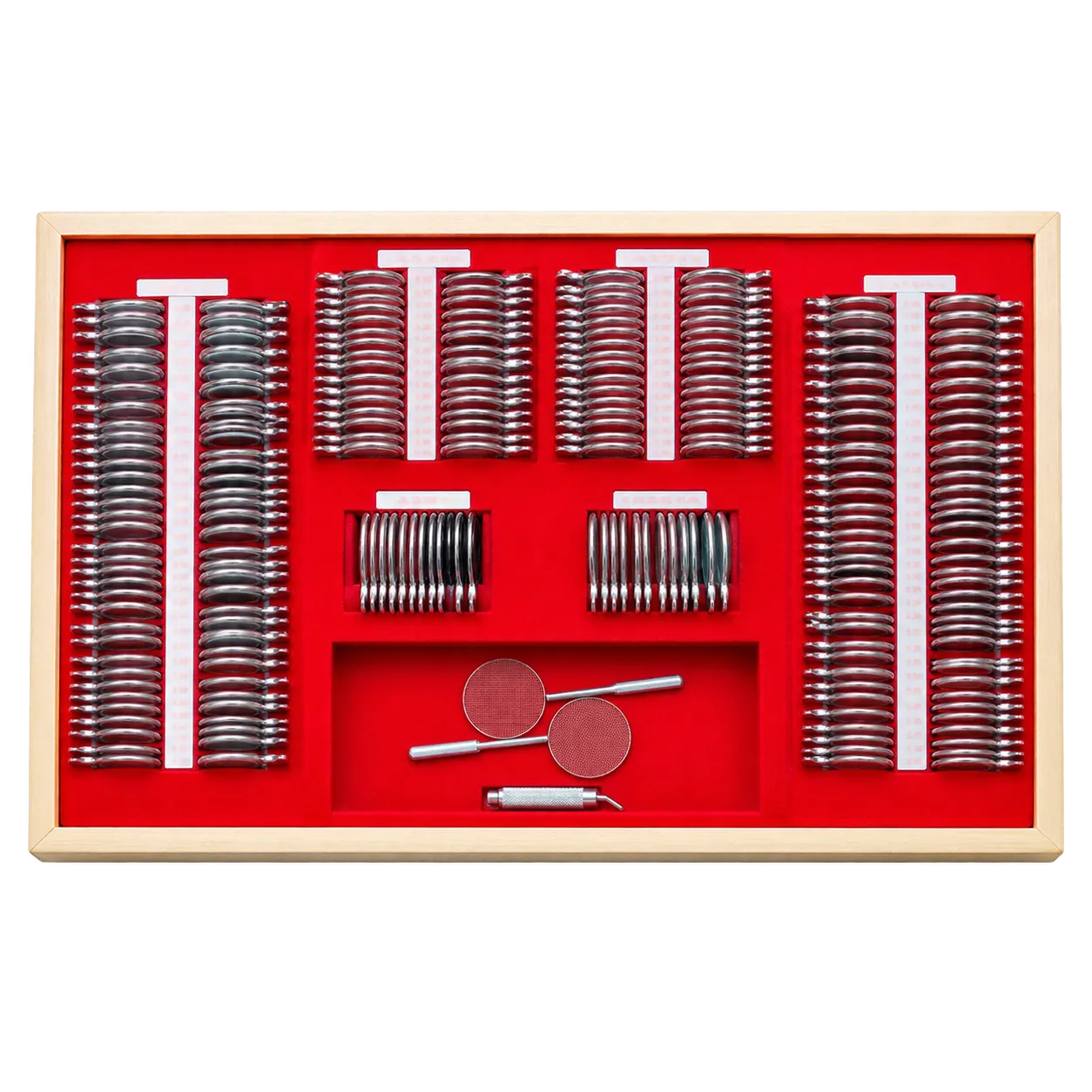

Hospital eye departments are the clearest buyers. A set used across many clinicians and many years justifies metal rings, since fewer lenses go out of service and replacements are needed less often.
Teaching clinics see the heaviest handling of all, with students learning to load and return lenses, and metal rings tolerate that better than plastic.
Main refraction rooms suit a large set that stays in place, with the aluminium case for storage rather than daily carrying.
High prescriptions and low vision work draw on the extremes of a large range, which this format provides.
Procurement teams comparing whole-life cost will find the metal version easier to justify than a cheaper set replaced sooner.
Multi-site groups can move the cased set between clinics occasionally, which 6.0 kg makes practical but not routine.
Practices wanting colour-grouped selection are better served by the plastic SL-232, which sorts its lenses by ring colour.
Domiciliary work suits a compact set, since 6.0 kg is a two-handed lift.