
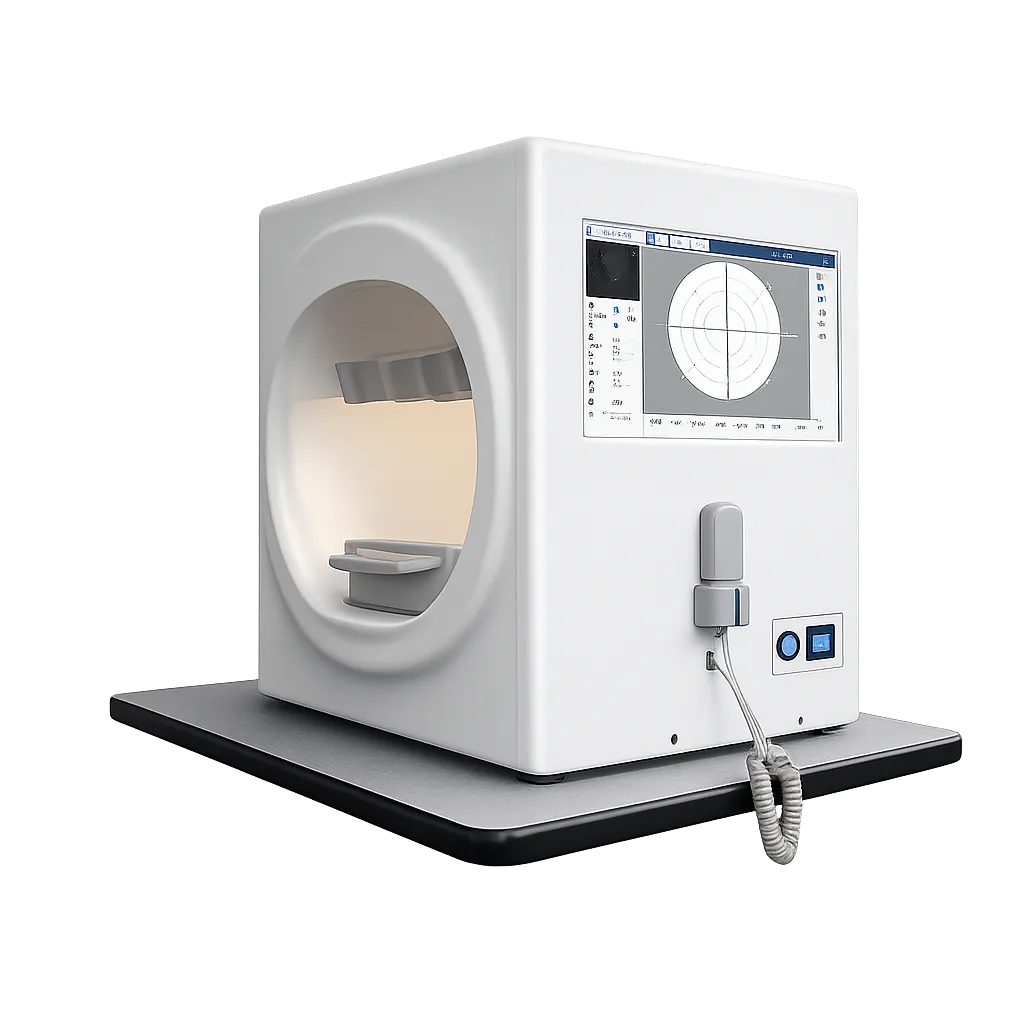
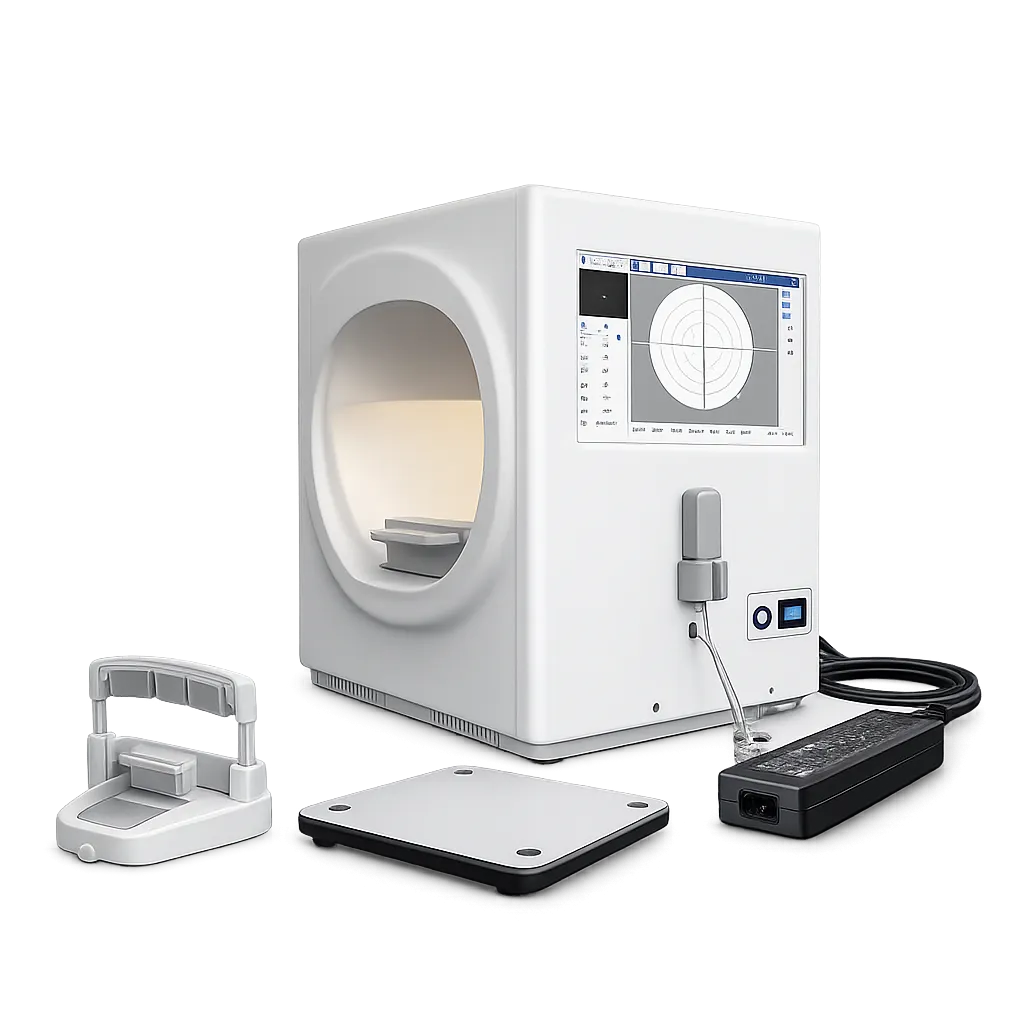
Inspection Range of 90 Degrees
The stated inspection range is 90 degrees, taken at an inspection distance of 30cm. That reach covers central work and extends outward into the periphery where many defects first declare themselves.
Goldmann III Target and Standard
Testing follows the international Goldmann standard using a Goldmann III target size, which keeps results intelligible to any clinician trained on conventional perimetry.
Wide Stimulus Range
Background brightness is listed as white at 31.5 asb, with target brightness running from 1 asb up to 10000 asb and a target interval time of 200ms that can be adjusted to suit patient reflection.
Threshold and Upper Threshold Models
Threshold models listed include central 5 degree and 10 degree patterns, 24-2, 30-2, a 30 to 60 degree pattern and a nasal step, with a separate set of wider upper threshold models.
Special Detection Strategies
Esterman monocular and binocular tests, a user customised test, fast and standard 150 degree driver procedures, an upper 36 degree procedure and a 150 degree horizontal straightness procedure are all listed.
Real Time Fixation Monitoring
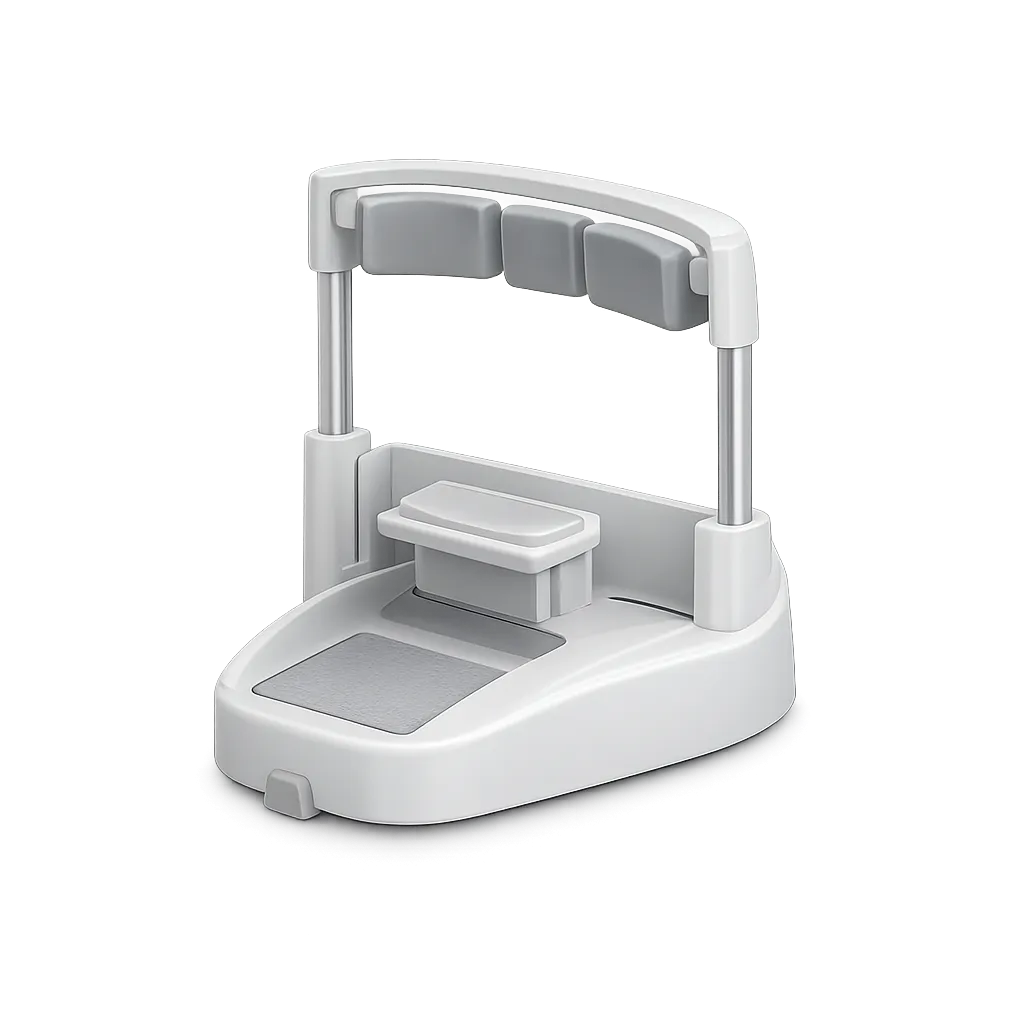
Heijl-Krakau physiological blind spot monitoring runs alongside gaze tracking and head position tracking, with eye position deviation raising an alarm and a deviation curve recorded.
Automatic Pupil and Light Measurement
Pupil diameter is measured automatically, which the manufacturer relates to reducing the effect of pupil size on the result. Ambient light detection is also listed as automatic.
Reporting and Progression Analysis
The software lists reliability analysis, single and triple vision reports, GPA half vision analysis, GPA glaucoma developing analysis and VFI vision index analysis.