
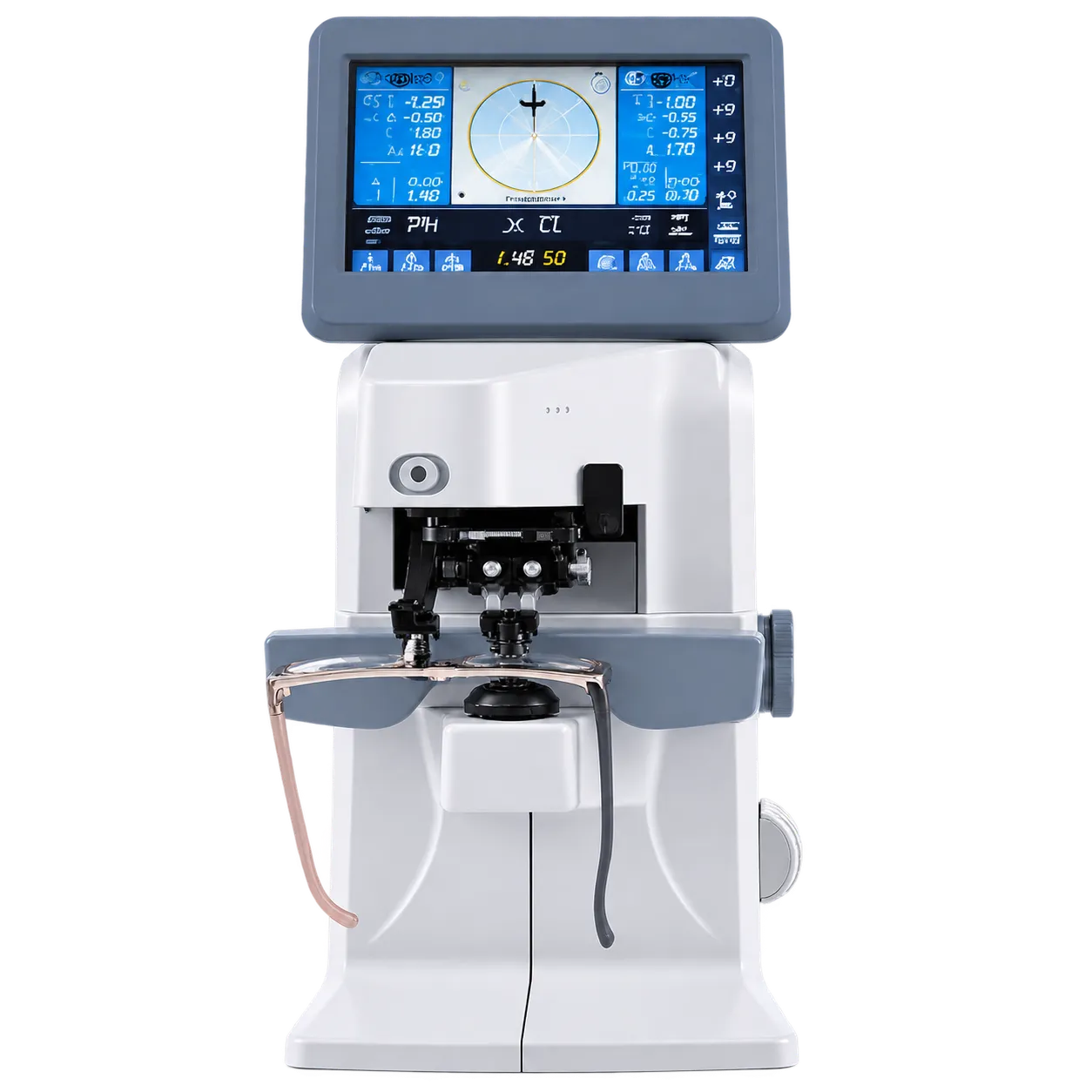


The VX-36 suits optometry practices, ophthalmology clinics, optical dispensaries, and lens-finishing benches. An operator places the lens on the stage, adjusts the swing-arm touchscreen, and reads sphere, cylinder, axis, addition, and prism on a single display. The system automatically detects progressive lenses and removes a selection step for every progressive pair.
At the examination stage, readings from a patient's current spectacles serve as the reference for the next refraction. At dispensing, the same readings check a finished pair against the prescription, and the 57 mm printout travels with the job. The same instrument measures pupillary distance from 42 to 82 mm, which suits fitting frames at the counter.
The defining clinical use is transmission. A dispenser measures blue light and UV transmission through a lens and shows the patient a figure for a coating or a tint. That turns a sales conversation about protection into a result the patient can see on screen and on paper.
Contact between dispenser and patient improves when the figures are visible. Staff can turn the touchscreen toward the patient, and the printed slip leaves the counter with a clear record of what was measured. Staff handling many pairs a day also gain from fewer hand-set steps per lens.
In a busy workshop, the articulating arm lets staff of different heights read the display comfortably. Prism to 20 in steps of 0.01 supports checks on prescriptions with prismatic correction. At 4.5 kg, the instrument can move between a dispensing counter and a back-room bench when a practice reorganises its space.