

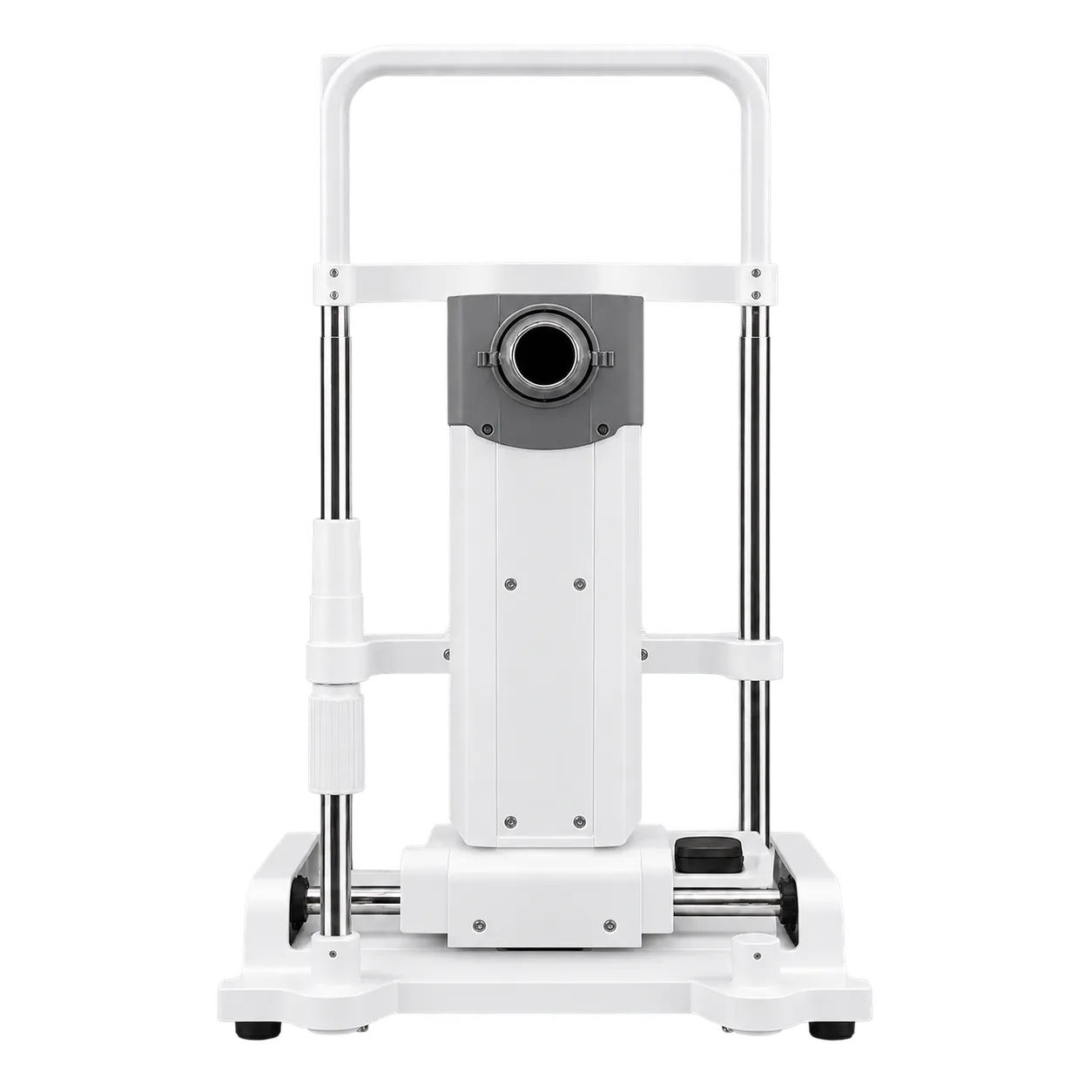


Ophthalmology clinics, optometry practices and contact lens fitting rooms use the SW-6000 to examine the shape of the cornea. Ophthalmologists, optometrists and ophthalmic technicians operate it, and the results inform screening for keratoconus, the fitting of contact lenses and the reading of curvature and elevation before and after treatment.
The SW-6000 suits services whose list is made up of corneal shape questions. A Placido disc of 31 rings gives 7,936 measuring points over a corneal coverage of 10.91 mm, and the radius of curvature is measured from 5.5 to 10.0 mm at a precision of ±0.02 mm. One capture therefore feeds axial curvature, tangential curvature, elevation, simulated keratoscope and 3D cornea maps.
Keratoconus detection and contact lens fitting work from the same data. The clinician can check the detection result against the curvature and elevation maps on one evaluation map view, and a fitting can be reviewed beside the corneal maps. Several examination view modes let the operator arrange the results to suit the question being asked. A contact lens practice can fit from the corneal data in the same visit, and a clinic reviewing a keratoconus finding can read curvature and elevation on the same screen.
The chinrest adjusts from 0 to 50 mm. The head of the instrument travels 0 to 86 mm left and right, 0 to 40 mm forward and back and 0 to 30 mm up and down, so patients of different sizes are aligned to the disc. A colour inkjet printer provides image output for the patient record, and the instrument sits on a stable table in a pre-test or consulting room.